

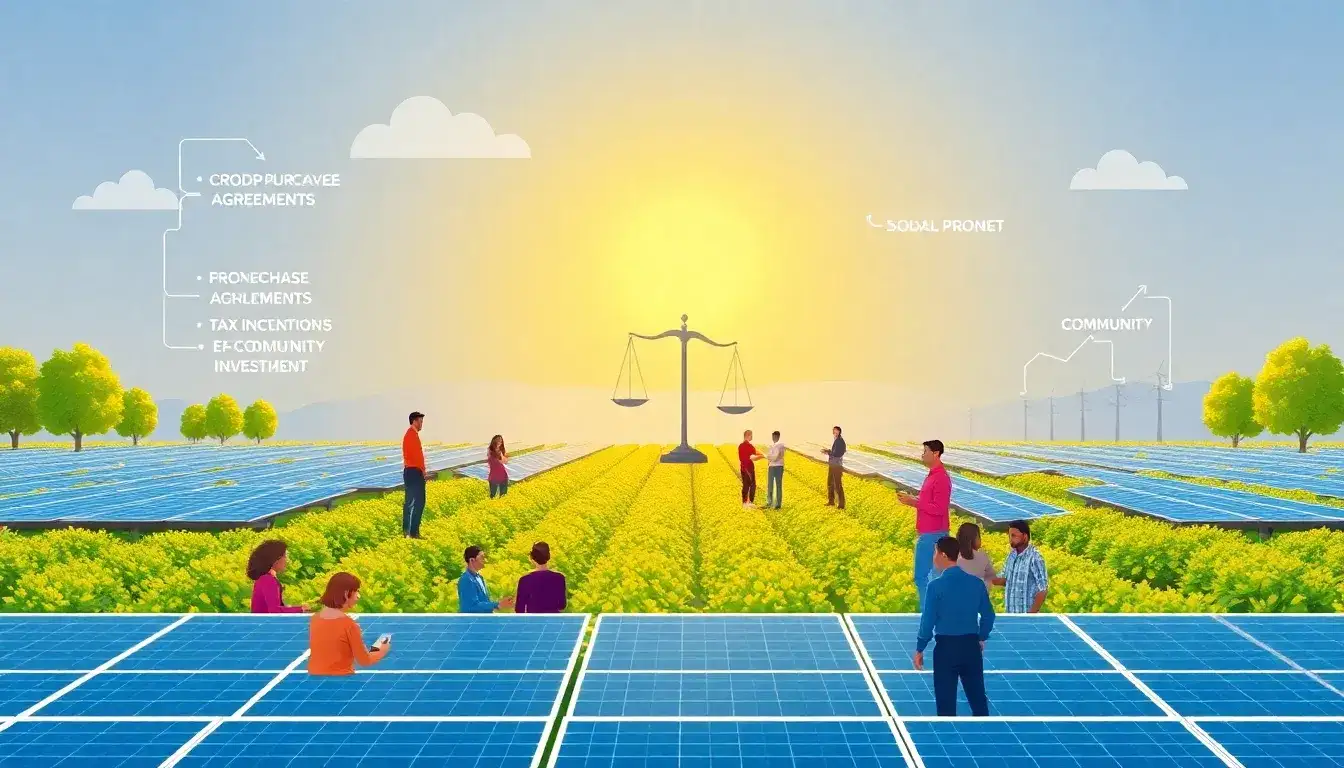
When evaluating the effectiveness of financial models for community solar projects, several models are commonly employed, each with its own strengths and challenges. Here are some of the most effective models:
Common Financial Models for Community Solar
1. Utility-Owned Model
- Description: This is the most common model in the United States, where a local utility owns the solar array. Customers purchase a share of the project and receive credits on their electricity bills proportional to their investment and the generated solar energy.
- Effectiveness: It provides a stable framework with clear regulatory structures but may limit community involvement in ownership.
2. Developer-Owned Model
- Description: A private developer owns and operates the solar project, often selling electricity directly to subscribers or utilities. This model can be effective for rapid scaling due to the developer’s expertise and resources.
- Effectiveness: Offers flexibility in project management and can adapt quickly to market conditions.
3. Special Purpose Entity (SPE) Model
- Description: This model involves creating an SPE to own and operate the community solar project. It allows for diverse ownership structures, including partnerships with tax-motivated investors.
- Effectiveness: Facilitates complex financial structures and can utilize tax incentives effectively.
4. Nonprofit Model
- Description: Nonprofit organizations often lead these projects, focusing on serving low-to-moderate-income communities and may rely on grants or donations.
- Effectiveness: Provides access to renewable energy for underserved communities with philanthropic support.
5. Cooperative or Community-Owned Model
- Description: A group of individuals or businesses collectively own and operate the solar project, often forming an SPE for share purchases.
- Effectiveness: Encourages community engagement and can provide long-term ownership benefits.
6. Third-Party Owned Model
- Description: A third-party investor owns the solar assets, selling electricity to subscribers and potentially transferring ownership after several years to maximize tax benefits.
- Effectiveness: Offers adaptability and can rapidly scale community solar initiatives.
Effectiveness Considerations
- Adaptability: The Third-Party Owned Model is noted for its flexibility and adaptability, making it effective for rapid expansion.
- Community Engagement: The Utility-Owned and Cooperative Models encourage community participation, though in different ways.
- Financial Incentives: The use of SPEs in models like the Special Purpose Entity Model can effectively leverage federal tax incentives.
Ultimately, the most effective model depends on local regulations, community goals, and available financial resources.
Original article by NenPower, If reposted, please credit the source: https://nenpower.com/blog/what-financial-models-are-most-effective-for-community-solar-projects/

