

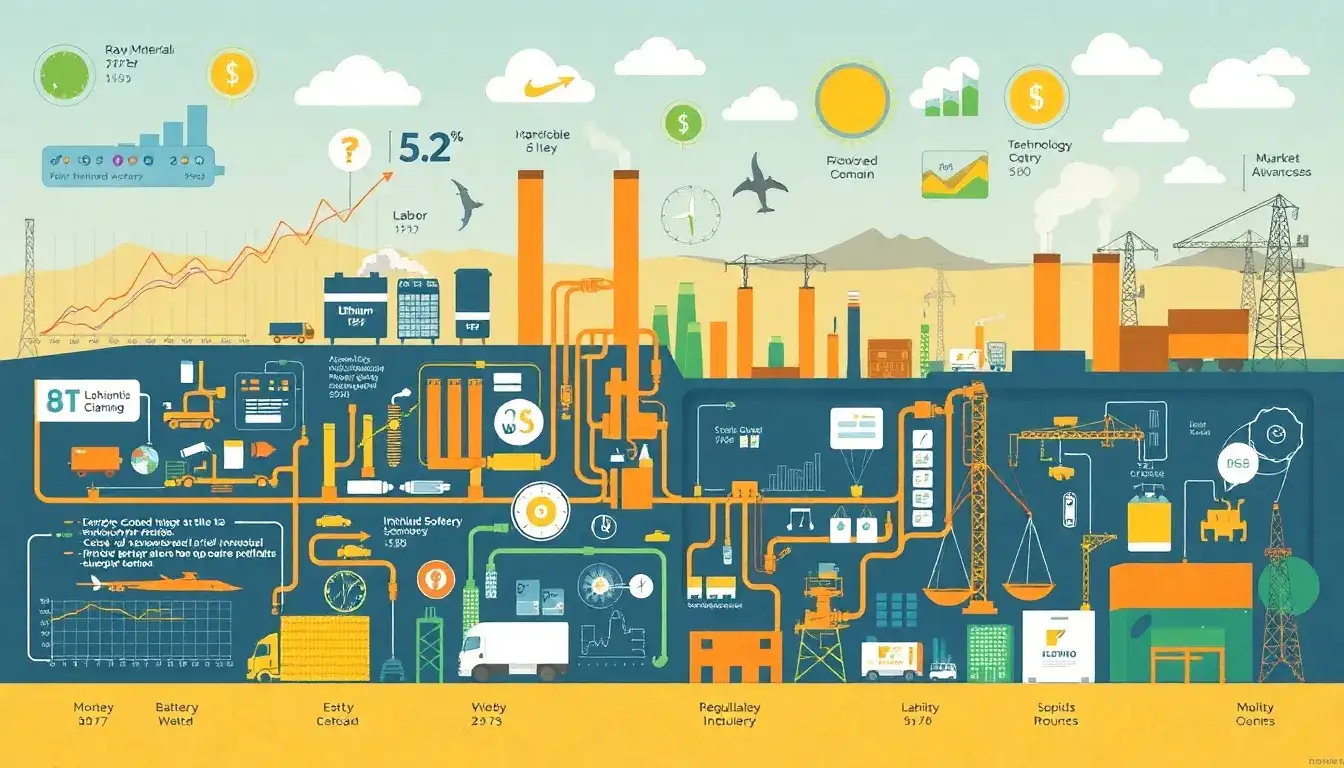
The cost variability of lithium-ion batteries (LIBs) for utility-scale storage is influenced by a combination of factors related to raw materials, manufacturing, technology, and market dynamics:
Key Factors Influencing Cost Variability
1. Raw Material Costs and Supply Chain Dynamics
- Prices of critical raw materials such as lithium, nickel, and cobalt strongly impact the battery cost. Fluctuations in lithium prices, for instance, are driven by demand from the electric vehicle (EV) sector, geopolitical factors, tariffs, export bans, and supply chain robustness.
- Since lithium-ion batteries heavily rely on these materials, any change in their market price significantly affects the overall battery cost.
- Supply chain constraints or geopolitical instability in lithium-producing countries add further volatility to material costs.
2. Manufacturing Costs
- The complexity of battery assembly, quality control, and procurement contributes to manufacturing expenses. Higher efficiency in manufacturing processes can help reduce these costs.
- Economies of scale in production volume also play a critical role: larger production scales tend to decrease the per-unit cost of batteries, improving affordability.
3. Technology Improvements and Research & Development (R&D)
- Investments in R&D lead to breakthroughs in battery chemistry, energy density, and manufacturing techniques, which drive down costs over time.
- For example, increasing cell charge density and improving energy capacity characteristics have historically contributed to significant cost reductions.
- Continuous innovation is crucial to maintain cost decline trends and enhance battery performance.
4. Battery Design and Performance Parameters
- Variations in battery capacity, size, and performance specifications influence pricing for utility-scale applications.
- The composition of electrode materials and optimization of battery chemistry also impact costs.
5. Market Demand Dynamics
- The surge in EV market demand drives demand for lithium-ion batteries and influences raw material prices and production scaling.
- As EV adoption grows, the demand for batteries for stationary storage and utility-scale applications also rises, contributing to price shifts.
Summary Table of Major Cost Drivers
| Factor | Description | Impact on Cost |
|---|---|---|
| Raw Material Prices | Lithium, nickel, cobalt prices influenced by demand/supply | High volatility, large cost swings |
| Manufacturing Costs | Production complexity, assembly, quality control | Significant portion of cost |
| Economies of Scale | Higher output reduces cost per unit | Cost reduction with volume |
| Technology & R&D | Advances in chemistry, energy density, and manufacturing | Long-term cost decline |
| Battery Design & Performance | Capacity, electrode composition, and specifications | Cost variability by design |
| Market Demand (EV growth) | EV-driven demand impacts lithium and battery market | Influences raw material availability and pricing |
These factors collectively determine the variability in lithium-ion battery costs for utility-scale storage, with raw material prices and manufacturing efficiency being particularly influential. Ongoing R&D and economies of scale are key to sustaining cost reductions in the sector.
Original article by NenPower, If reposted, please credit the source: https://nenpower.com/blog/what-factors-influence-the-cost-variability-of-lithium-ion-batteries-for-utility-scale-storage/

