

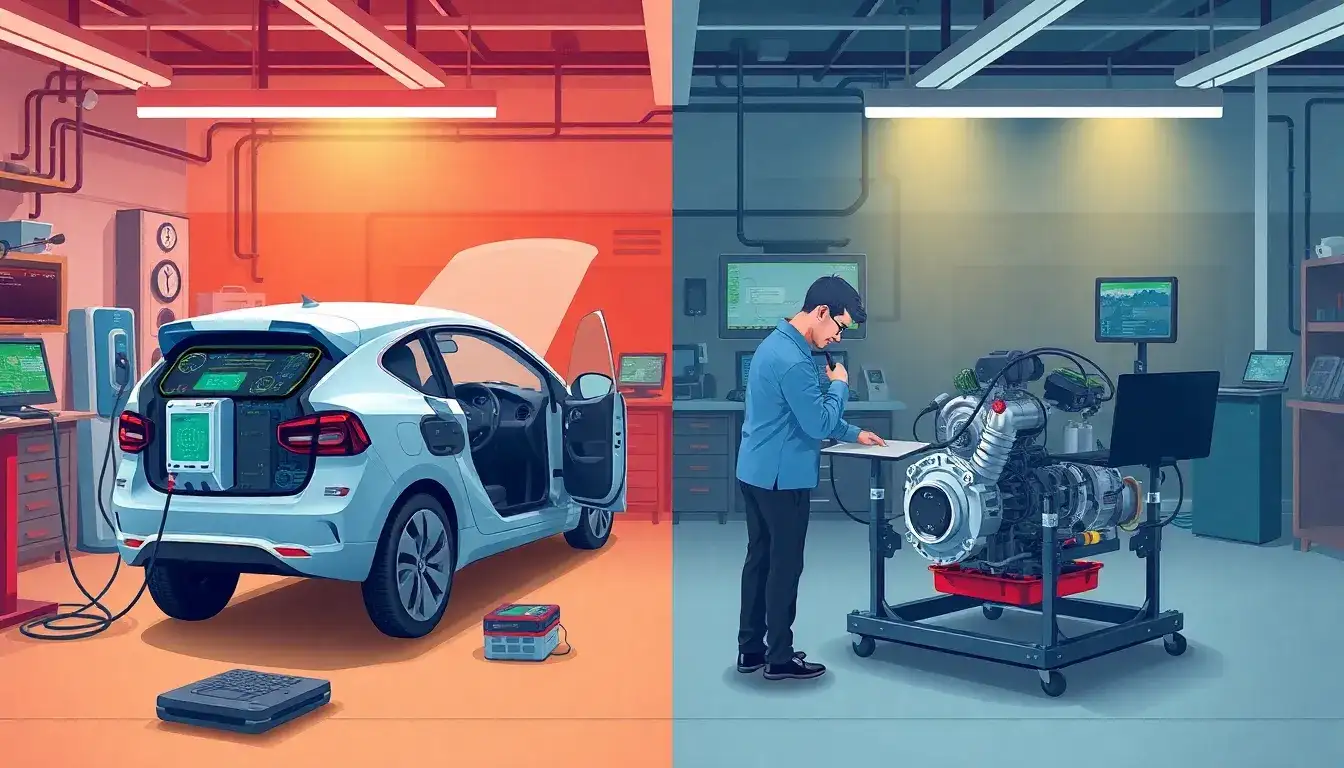
Technicians face several distinct diagnostic challenges when working with Plug-in Hybrid Electric Vehicles (PHEVs) compared to Hybrid Electric Vehicles (HEVs), primarily due to their more complex powertrain integrations and advanced electrical systems:
1. Dual powertrain complexity
PHEVs combine larger battery capacities with internal combustion engines and electric motors, requiring technicians to master both high-voltage EV systems and conventional drivetrain diagnostics. HEVs typically involve less intricate battery-electric integration, focusing more on regenerative braking and engine-assist functions.
2. Advanced high-voltage safety protocols
PHEVs operate with higher-voltage battery systems (often 400V+) compared to many HEVs, necessitating specialized insulation monitoring and enhanced safety precautions during diagnostics. Technicians must verify full system isolation before working on electrical components.
3. Sophisticated charging system diagnostics
PHEVs introduce unique challenges like AC/DC charging port troubleshooting, onboard charger diagnostics, and grid compatibility issues absent in HEVs. These systems require specialized test equipment to evaluate charging waveforms and communication protocols.
4. Complex battery management
While both suffer battery degradation challenges, PHEVs face accelerated cell balancing issues due to deeper discharge cycles and thermal management system diagnostics that are more critical given their extended electric-only operation.
5. Cross-system interference
PHEVs’ expanded electronic architectures increase susceptibility to RF interference from components like high-power inverters and rapid-switching chargers. Technicians must isolate electromagnetic noise affecting sensors and control modules.
6. Software dependence
PHEVs require more frequent ECM/PCM reprogramming and advanced cybersecurity protocols during diagnostics compared to HEVs, particularly for charging-related firmware updates.
Diagnostic Tools Comparison
| Tool/Requirement | PHEV Emphasis | HEV Focus |
|---|---|---|
| Scan Tools | Bi-directional charging system controls | Basic hybrid mode monitoring |
| Oscilloscopes | Charging waveform analysis | Ignition/combustion system analysis |
| Service Information | Charging infrastructure specs | Regenerative braking schematics |
| Training Modules | High-voltage handling certification | Basic hybrid safety protocols |
Technicians must adapt to PHEVs’ combined diagnostic workflows that blend traditional combustion engine troubleshooting with EV-specific protocols, requiring continuous training on emerging technologies.
Original article by NenPower, If reposted, please credit the source: https://nenpower.com/blog/what-diagnostic-challenges-do-technicians-face-with-phevs-compared-to-hevs/

