

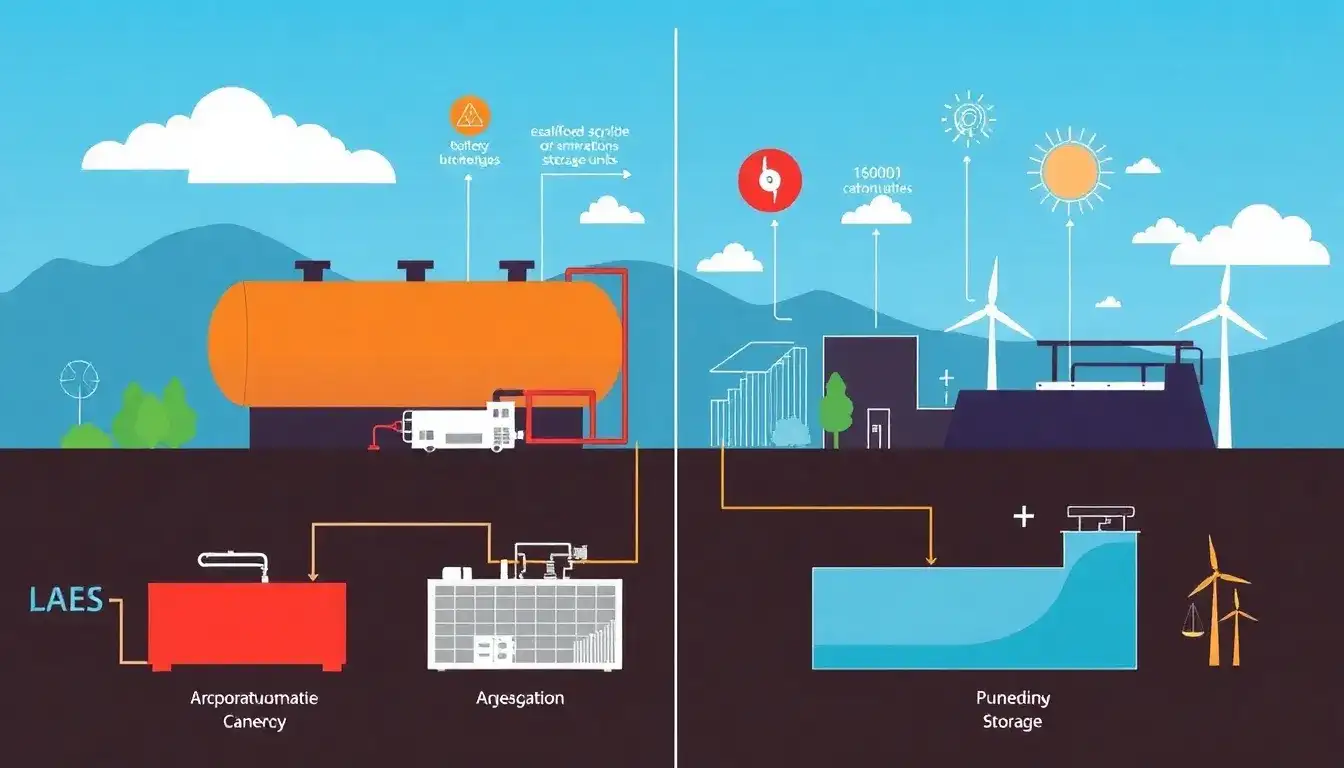
To address the scalability challenges of Liquid Air Energy Storage (LAES) compared to other energy storage technologies, it’s essential to consider several factors, including economics, technology, and market integration. However, the query may have a typo as LDES (Long-Duration Energy Storage) rather than LAES is more commonly discussed in the context of scalability challenges. Assuming the focus is on LAES as a form of LDES, here are the challenges:
Scalability Challenges of LAES
1. Economic Challenges
- Cost Barriers: High upfront capital costs for large-scale deployment are a major hurdle. LAES requires expensive infrastructure like compressor stations and storage facilities.
- Market Mechanisms: Ensuring fair compensation for services like energy arbitrage and capacity provision in markets is crucial for economic viability.
2. Technological Challenges
- Efficiency: LAES systems may have lower round-trip efficiencies compared to other storage technologies, impacting scalability due to increased energy consumption.
- Maturity: While LAES is a developing technology, it still requires further innovation to reduce costs and improve performance.
3. Integration and Policy Challenges
- Regulatory Frameworks: Lack of clear policies and regulatory support can hinder large-scale adoption by introducing uncertainty for investors.
- Market Integration: Integration into existing energy systems and infrastructure can be complex, requiring adjustments in both grid management and operational protocols.
Comparison with Other Energy Storage Technologies
| Energy Storage Technology | Scalability Challenges | Advantages |
|---|---|---|
| LAES (Liquid Air Energy Storage) | High capital costs, efficiency issues, regulatory uncertainties | Scalable to large capacities, zero emissions, can use existing infrastructure |
| Battery Storage (e.g., Li-ion) | Cost, supply chain issues for raw materials, environmental concerns | High efficiency, rapid deployment capabilities, well-established market |
| Pumped Hydro Storage (PHS) | Geographical limitations, high upfront costs, environmental impacts | High capacity, long lifespan, mature technology |
| Long-Duration Energy Storage (LDES) | Cost-effectiveness, market value recognition, technological maturity | Can offer multiple grid services, supports renewable integration, potential for high capacity |
Overall, while LAES offers potential for large-scale energy storage with environmental benefits, its scalability is impacted by economic, technological, and policy challenges. These challenges must be addressed through innovations, market reforms, and strategic investments to make LAES more competitive and widely adopted.
Original article by NenPower, If reposted, please credit the source: https://nenpower.com/blog/what-are-the-scalability-challenges-of-laes-compared-to-other-energy-storage-technologies/

