

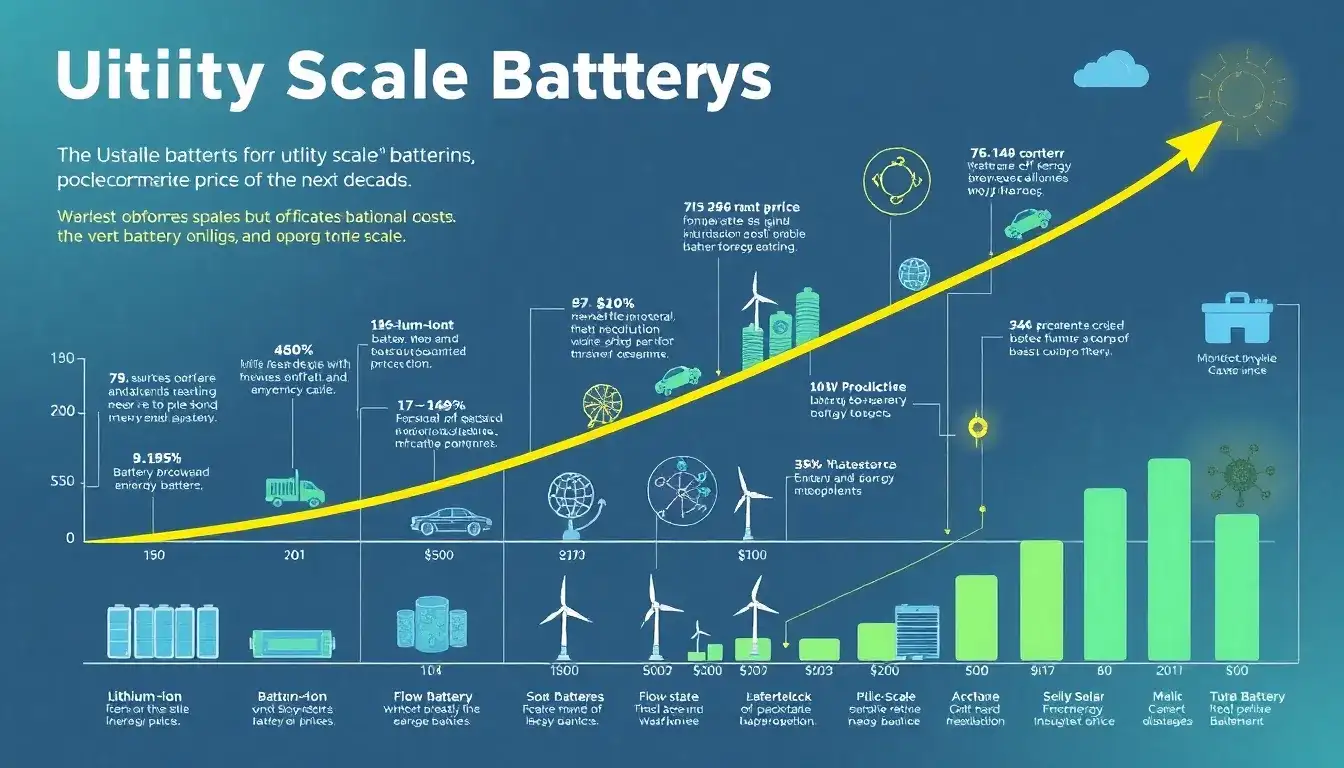
Over the next decade, the projected cost trends for utility-scale batteries are expected to continue declining, though there are factors that could influence these projections.
Cost Projections Overview
- Lithium-Ion Batteries: The cost of lithium-ion battery packs has already dropped significantly. By 2024, the cost was around $115/kWh, and it is expected to decrease further, reaching below $100/kWh by 2025 and potentially around $70/kWh by 2030.
- Long-term Projections: NREL’s projections indicate that for a 4-hour lithium-ion battery system, by 2030, the costs could be $255/kWh (low projection), $326/kWh (mid projection), and $403/kWh (high projection). By 2050, these costs are projected to be $159/kWh (low), $237/kWh (mid), and $380/kWh (high).
- Alternative Chemistries: Sodium-ion batteries and other alternatives are emerging as cost-effective options, particularly for long-duration storage, due to their lower production costs and improved safety features.
Factors Influencing Cost Trends
- Market Growth and Economies of Scale: The growth of the overall battery industry across various sectors is expected to lead to long-term cost reductions.
- Policy Changes and Economic Conditions: Increased tariffs and changes in tax credits, as well as shifts in energy policies, could impact the cost and viability of these systems.
Market and Sector Developments
- Market Expansion: The market for lithium-ion battery energy storage systems is expected to continue growing, reaching significant values by 2035.
- Technological Advancements: Advances in battery technologies, such as LFP and sodium-ion batteries, are expected to further reduce costs and improve performance.
Original article by NenPower, If reposted, please credit the source: https://nenpower.com/blog/what-are-the-projected-cost-trends-for-utility-scale-batteries-over-the-next-decade/

