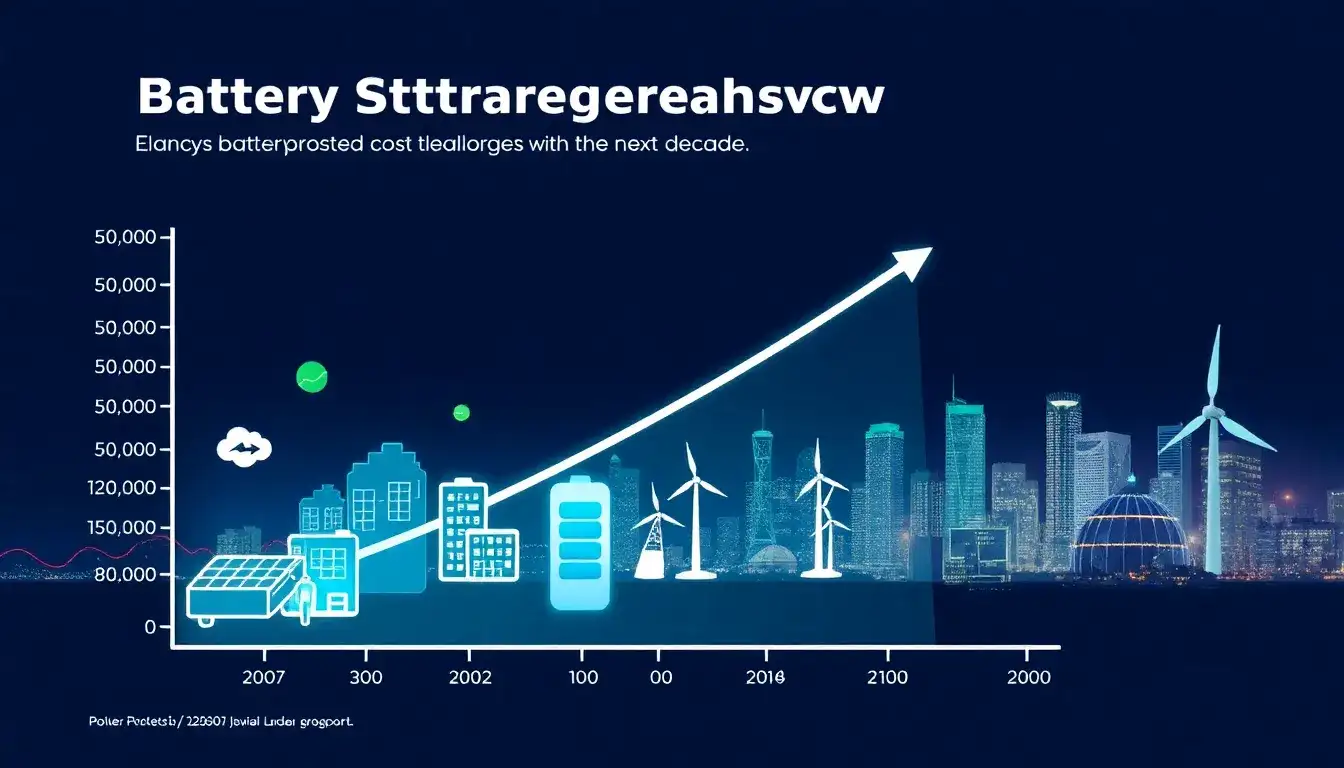
The projected cost trends for battery storage systems over the next decade indicate continued declines, driven by technological advancements and market forces, though near-term fluctuations may occur.
Key Projections
- 2025 Outlook: Prices are expected to remain stable with 5-10% fluctuations due to supply chain dynamics and policy changes. Lithium-ion battery costs for residential/industrial systems range between $200-$400/kWh, while utility-scale systems face uncertainties tied to trade policies (e.g., potential U.S. tariffs on Chinese LFP batteries).
- Long-Term Reduction: Utility-scale lithium-ion BESS costs could drop ~40% by 2030, from $160/kWh to below $100/kWh, driven by larger cell sizes and higher energy density. NREL projects 4-hour system costs of $159-$348/kWh by 2050, though 2030 estimates vary between $245-$403/kWh depending on technology and policy trajectories.
- Market Growth: The global BESS market is forecast to grow at an 11.1% CAGR, reaching $65.3B by 2035 from $18.5B in 2025, as economies prioritize grid resilience and renewable integration.
Drivers
- Technology: Advances in LFP and emerging chemistries (e.g., sodium-ion, flow batteries) reduce costs and diversify supply chains.
- Policy: Incentives like the U.S. Inflation Reduction Act (30-50% tax credits) and China’s renewable mandates accelerate adoption.
- Market Competition: Asian manufacturers (CATL, BYD) drive price wars, lowering costs globally.
Risks
- Trade Barriers: U.S.-China tariffs or export bans on battery materials could inflate prices.
- Regulatory Delays: Permitting and grid interconnection challenges may slow deployments.
By 2035, hybrid solar-storage systems are expected to become the lowest-cost electricity option in many regions due to these trends.
Original article by NenPower, If reposted, please credit the source: https://nenpower.com/blog/what-are-the-projected-cost-trends-for-battery-storage-systems-over-the-next-decade/