

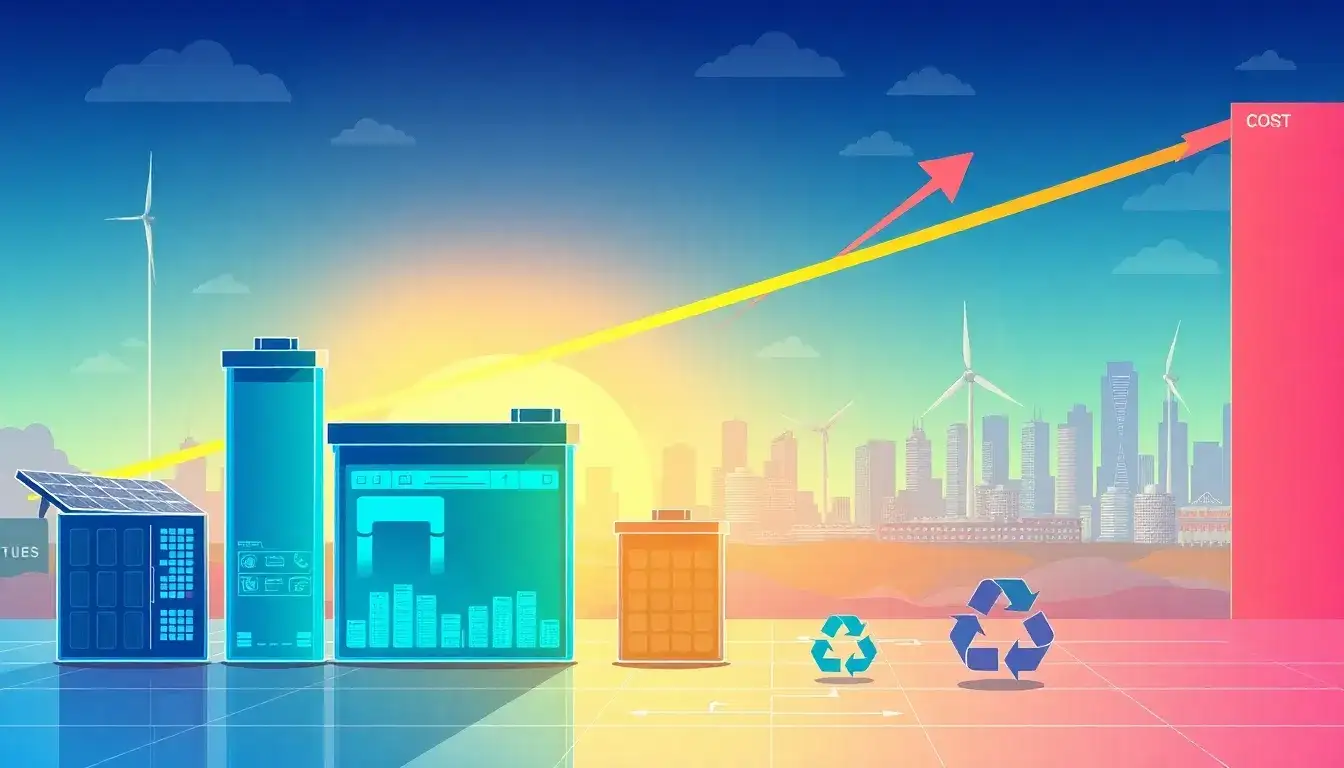
Projected cost reductions for battery storage over the next decade show significant declines, driven mainly by advancing technology, economies of scale, and growing manufacturing capacity, particularly in China.
Cost Reduction Projections Overview
- Capital Expenditure (CAPEX) Reductions (2022–2035) for Utility-Scale Battery Storage:
- Conservative Scenario: 18% reduction (about 1.4% per year)
- Moderate Scenario: 37% reduction (about 2.9% per year)
- Advanced Scenario: 52% reduction (about 4.0% per year)
These projections are based on analyses of lithium-ion battery systems, particularly 60 MW with 4-hour duration configurations.
- Further Reductions (2035–2050):
- Conservative Scenario: 4% total reduction (0.3% per year)
- Moderate Scenario: 22% total reduction (1.5% per year)
- Advanced Scenario: 31% total reduction (2.1% per year).
- Levelized Cost of Electricity (LCOE) Projections:
- Battery storage LCOE fell by about a third in 2024 to $104 per MWh.
- In 2025, LCOE for battery storage is expected to reduce by 11% to approximately $93 per MWh.
- By 2035, BloombergNEF expects battery storage LCOE to reach around $53 per MWh, nearly half of current costs.
Drivers of Cost Reductions
- The battery pack component is expected to see the largest share of cost reductions compared to balance of system and installation components.
- Global manufacturing capacity, especially China’s abundant clean tech production, is a key driver behind cost declines.
- Advances in battery chemistry and materials science (e.g., Lithium Iron Phosphate – LFP technologies) continue to reduce manufacturing costs.
- Economies of scale and competition among vendors are helping to push prices down.
Market and Policy Considerations
- Although some short-term price fluctuations may occur due to supply chain disruptions, tariffs, and market dynamics, the long-term trend is downward.
- Trade barriers could temporarily stall cost declines but are unlikely to reverse the overall trend of cost reduction.
Summary Table of Projected Battery Storage CAPEX and LCOE Reductions by 2035
| Metric | Current (2024) | Projected 2035 | Approximate Reduction (%) |
|---|---|---|---|
| CAPEX (Utility-Scale BESS) | Baseline | 48-82% of baseline* | 18-52% reduction** |
| LCOE ($/MWh) Battery Storage | $104 | $53 | ~49% reduction |
*Range depends on scenario: Conservative to Advanced.
**From 2022 baseline to 2035, depending on innovation scenario.
In conclusion, battery storage costs are expected to fall substantially—up to around 50% in LCOE terms—over the next decade, driven by technology innovation, manufacturing scale, and global market dynamics. This trend supports broader adoption and integration of battery storage in energy systems worldwide.
Original article by NenPower, If reposted, please credit the source: https://nenpower.com/blog/what-are-the-projected-cost-reductions-for-battery-storage-over-the-next-decade/

