

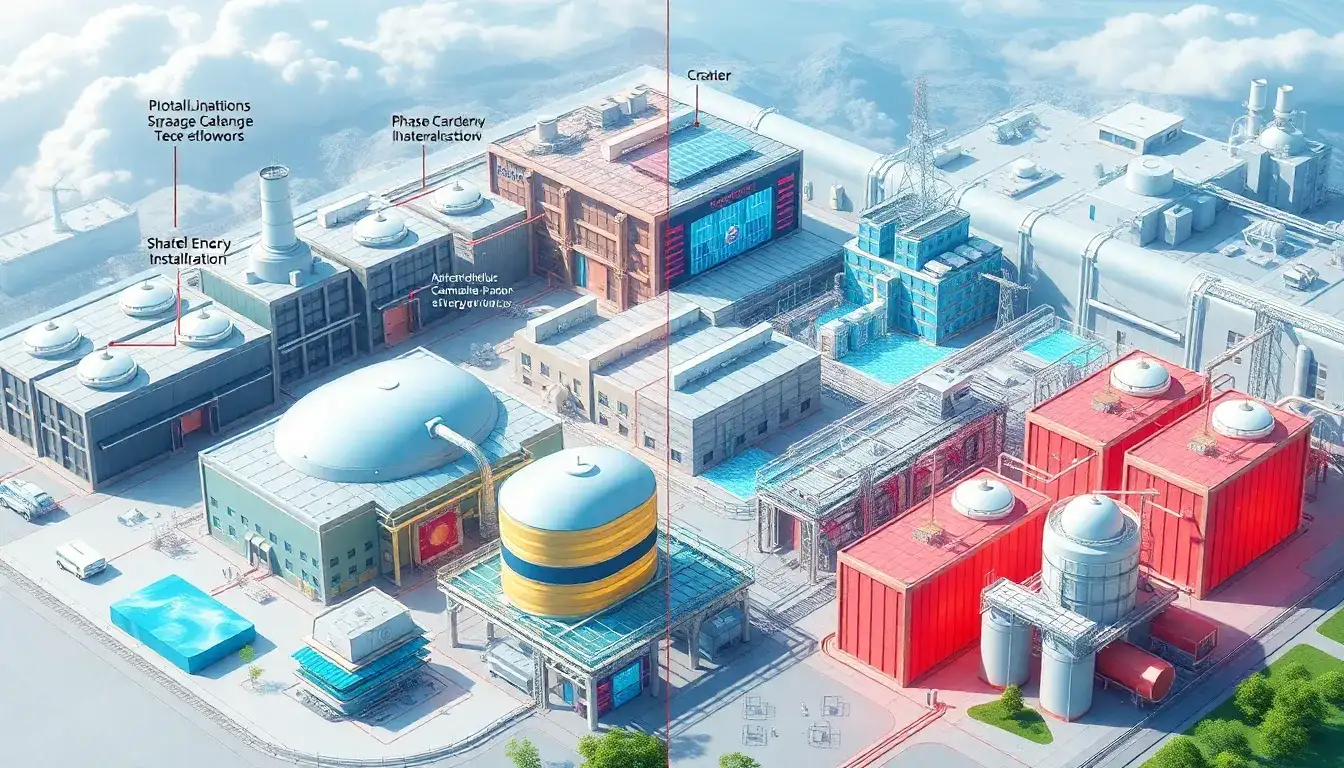
Thermal energy storage (TES) systems, which include sensible, latent, and thermochemical storage methods, face several scalability challenges. Here are some of the key issues:
Scalability Challenges for TES Systems
1. Material-Related Challenges
- Sensible Heat Storage: Requires large volumes of materials like water or rocks, which can be impractical for large-scale applications due to space constraints and low energy density.
- Latent Heat Storage: Phase Change Materials (PCMs) offer higher energy densities but suffer from low thermal conductivity and supercooling issues, complicating scaling.
- Thermochemical Storage: Demands materials capable of withstanding high temperatures and pressures, with reversibility being crucial, which complicates large-scale deployment.
2. Economic Scalability
The cost of implementing TES, especially at large scales, is a significant challenge. High upfront costs make it difficult for widespread adoption without substantial investment.
3. Logistical Scalability
- Physical Space: Large TES systems require substantial land or infrastructure, which can be difficult to find, especially in urban areas.
- Grid Integration: Integrating TES into existing energy grids requires sophisticated control systems and compatibility with fluctuating grid demands.
4. Technological Scalability
- Scaling efficient heat transfer and maintaining uniform temperature distribution across large systems is technologically demanding.
- The need for advanced materials and technologies that can improve efficiency while reducing costs remains a significant challenge.
5. Regulatory and Environmental Considerations
Zoning regulations and environmental concerns can limit the available sites for large-scale TES installations.
Overcoming these challenges will be crucial to ensure that TES systems can support large-scale renewable energy integration and sustainable energy futures.
Original article by NenPower, If reposted, please credit the source: https://nenpower.com/blog/what-are-the-potential-scalability-challenges-for-thermal-energy-storage-systems/

