

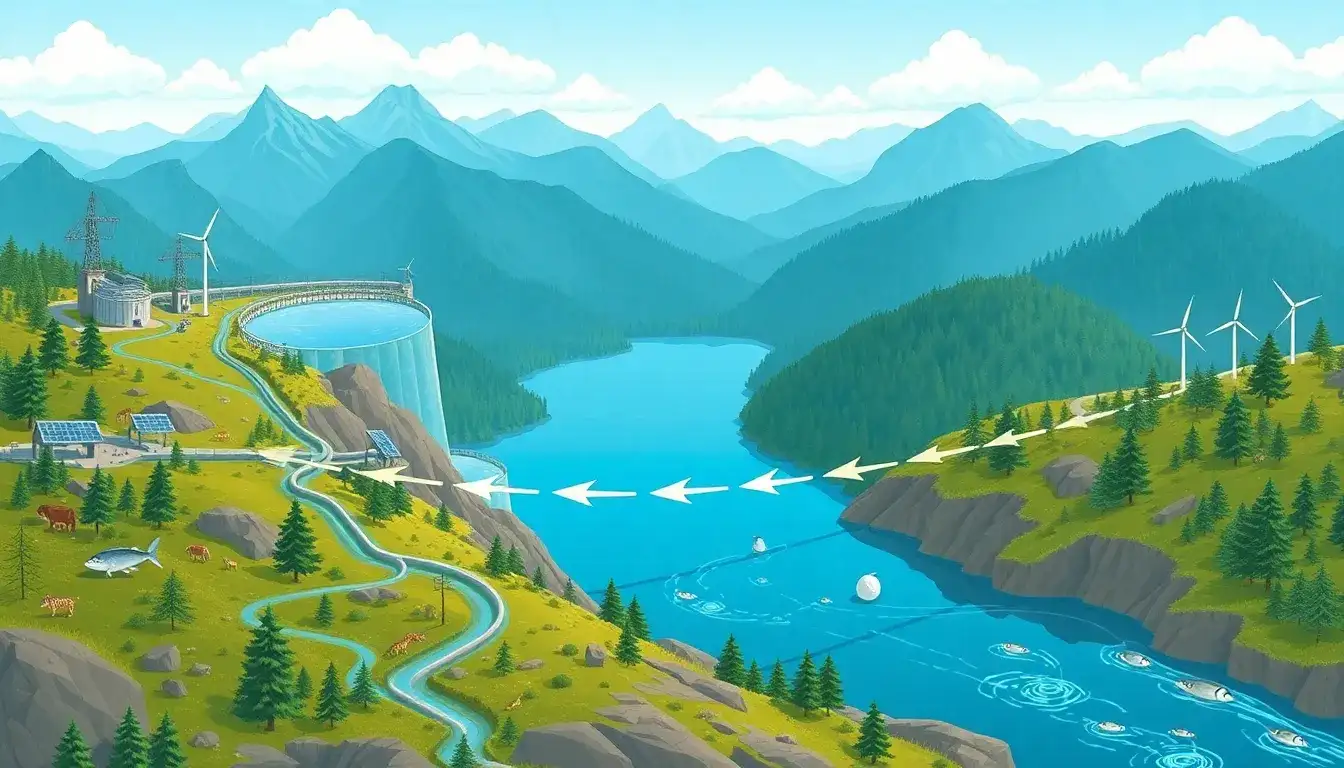
The potential long-term environmental effects of closed-loop pumped storage hydropower (PSH) facilities are generally fewer and more localized compared to traditional open-loop PSH systems, though some specific impacts remain.
Key Environmental Effects and Comparisons:
- Localized and Shorter-Duration Impacts: Closed-loop PSH operates off-stream, meaning it is not continuously connected to naturally flowing water bodies. This greatly reduces impacts on aquatic ecosystems and terrestrial habitats since water is cycled within a contained system rather than drawn directly from natural streams or rivers. As a result, aquatic resource impacts, such as habitat disruption and altered flow regimes, tend to be minimal or absent in closed-loop designs.
- Greater Siting Flexibility: Because closed-loop systems do not depend on continuous natural water flow, they offer more options for location siting. This flexibility can avoid sensitive environmental areas and further minimize ecological disruption compared to open-loop projects, which are limited to river or lake sites.
- Potential Geological and Groundwater Impacts: Some closed-loop PSH projects, especially those using groundwater or underground reservoirs, may have increased impacts on geology, soils, and groundwater systems compared to open-loop projects. For example, excavation or underground water circulation could affect subsurface water quality or local geologic stability. These effects need careful management and mitigation planning.
- Water Sourcing and Rights: Unlike open-loop systems which use existing surface water bodies, closed-loop facilities depend on initial water filling and potentially groundwater for evaporation losses, which can introduce complexities related to water rights and sourcing. This may lead to regulatory and environmental challenges, especially in water-scarce regions.
- Greenhouse Gas Emissions: Life cycle assessments indicate that PSH, including closed-loop systems, tends to have very low greenhouse gas emissions compared to other forms of energy storage, supporting their long-term environmental sustainability.
Summary:
| Environmental Aspect | Closed-Loop PSH | Open-Loop PSH |
|---|---|---|
| Aquatic habitat impact | Minimal due to off-stream operation | Higher due to continuous water use |
| Terrestrial habitat impact | Reduced, localized | More extensive |
| Geological and groundwater effects | Possibly higher in groundwater-based systems | Generally lower |
| Water sourcing complexity | Potential challenges with groundwater and initial fill | Uses natural flowing water |
| Greenhouse gas emissions | Low life cycle emissions | Low but slightly variable |
| Siting flexibility | Higher due to independence from natural waterways | More limited |
In conclusion, closed-loop PSH facilities present lower long-term ecological risk to aquatic and terrestrial environments compared to open-loop systems due to their contained water cycles and off-stream siting. However, they may pose greater localized impacts to geology and groundwater systems that require monitoring and mitigation. Their flexible siting and low emissions profile position them as environmentally preferable options for energy storage when properly designed and managed.
Original article by NenPower, If reposted, please credit the source: https://nenpower.com/blog/what-are-the-potential-long-term-environmental-effects-of-closed-loop-psh-facilities/

