

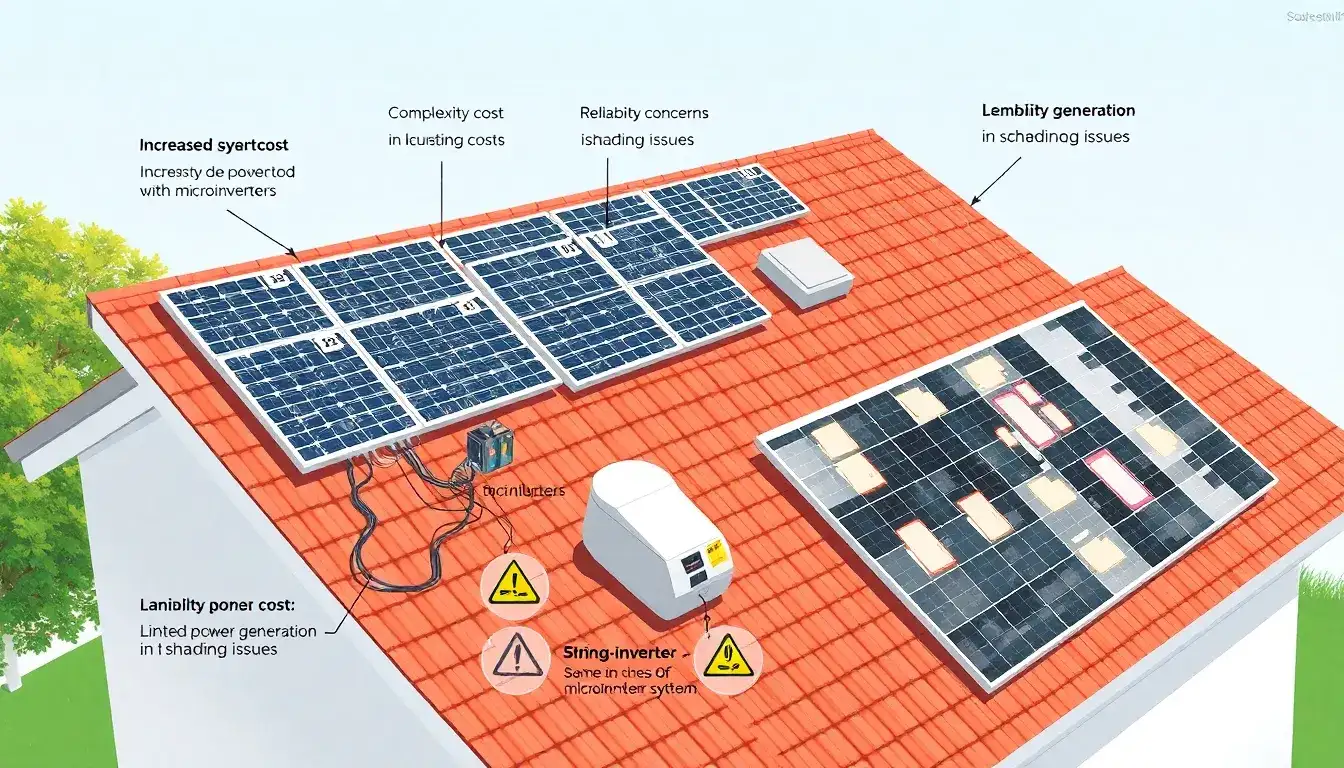
The potential downsides of using microinverters in a solar system include the following:
- Higher upfront costs: Microinverters typically cost more than traditional string inverters because each solar panel requires its own inverter, increasing the total number of components and thus the initial system expense.
- More points of failure: Since there is a microinverter attached to each panel, the system has many individual components that could potentially fail. Although a failure affects only one panel rather than the whole system, the increased number of devices theoretically raises the overall risk of component failure.
- Maintenance difficulty: Microinverters are installed on the roof behind each solar panel, which makes accessing them for repairs or replacements more complicated. Technicians often need to remove the solar panel to service the microinverter, leading to higher labor costs and more challenging maintenance compared to string inverters that are usually mounted near the electrical panel and easier to service.
- Lower power output relative to panel rating (clipping): Microinverters sometimes have a lower power conversion capacity than the peak output of their paired panels, causing “clipping,” where excess power from the panel cannot be converted, potentially limiting full utilization of the panel’s capability.
- Potential reliability concerns with quality variance: Poor-quality microinverters can have higher failure rates. It is critical to choose reputable brands and high-quality units to avoid premature failures, especially since microinverters are exposed to harsh roof conditions and heat.
- Hardware bulk and lightning attraction: With a microinverter for each panel, the system involves a lot of hardware mounted on the roof, which not only increases complexity but may also attract lightning strikes, posing risks particularly on wooden roofs or in storm-prone areas.
- Lack of extensive long-term data: Microinverters have not been used as long or as widely as string inverters, so long-term performance data and durability over multiple decades are less established.
In summary, while microinverters provide superior energy harvest especially in shading or complex roof layouts and offer panel-level monitoring and optimization, their downsides mainly involve higher costs, more complex maintenance, more potential failure points, and some concerns over power clipping and reliability depending on quality.
Original article by NenPower, If reposted, please credit the source: https://nenpower.com/blog/what-are-the-potential-downsides-of-using-microinverters-in-a-solar-system/

