

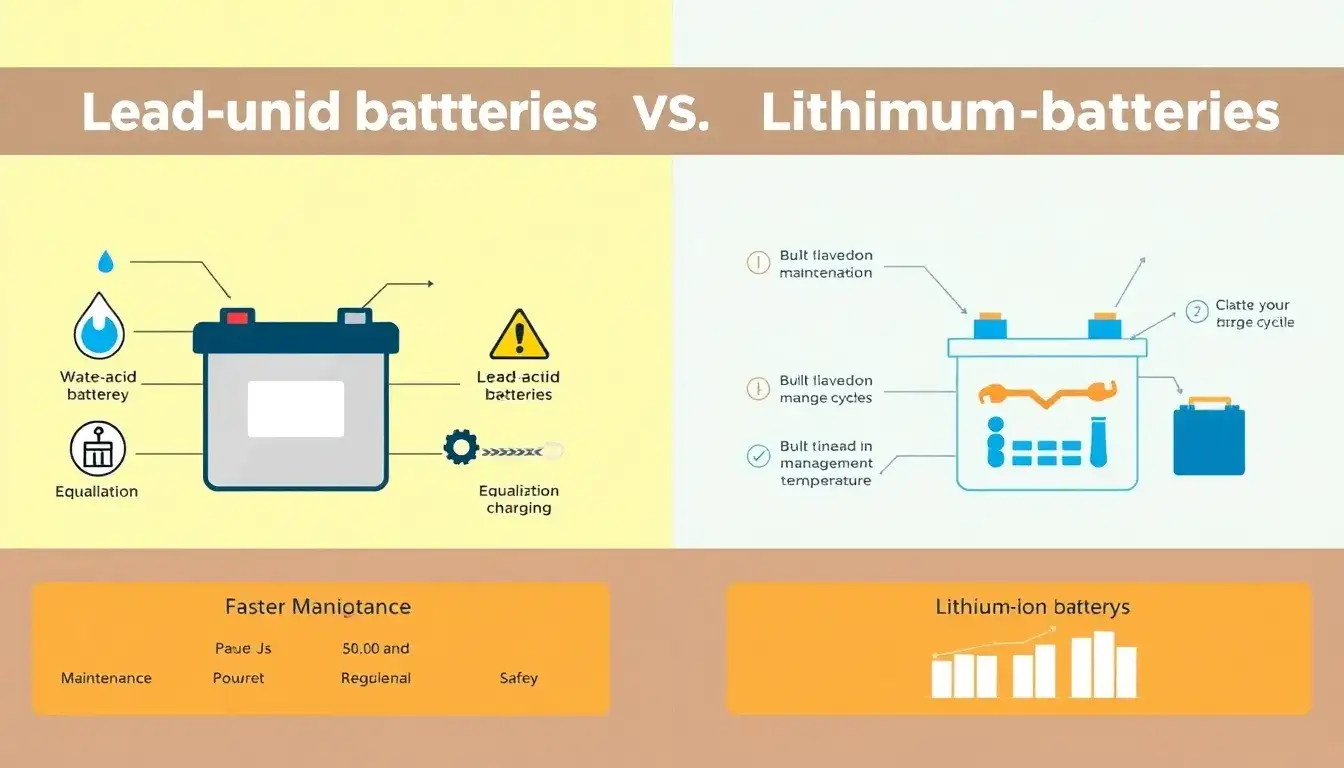
Maintenance Requirements for Lead-Acid Batteries vs. Lithium-Ion Batteries
Lead-Acid Battery Maintenance
Key Requirements:
- Regular Inspections: Check for physical damage, acid leaks, and corrosion on terminals.
- Electrolyte Level Management: Regularly check and maintain the electrolyte level; top up with distilled water as needed.
- Terminal Cleaning: Use baking soda and water to clean terminals, and apply dielectric grease to prevent future corrosion.
- Cooling Time: Allow batteries to cool for about two hours after charging.
- Vibration Protection: Use vibration-absorbing mounts to protect against shocks and vibrations.
- Equalization Charges: Perform equalization charges periodically to maintain cell balance.
- Environmental Conditions: Keep batteries in a well-ventilated area away from high temperatures.
Lithium-Ion Battery Maintenance
Key Requirements:
- Charging Practices: Avoid deep discharges (preferably keep charge between 20% and 80% if not in use).
- Temperature Control: Operate within optimal temperature ranges (usually between 0°C and 35°C).
- Protection from Physical Damage: Store and handle with care to avoid mechanical shocks.
- Update Firmware: Regularly update battery management system (BMS) firmware if applicable.
- Li-Ion Battery Balancing: Some lithium-ion batteries require cell balancing, but this is typically managed automatically by the BMS.
- Avoid Overcharging: Avoid leaving the battery constantly plugged in at 100% charge for extended periods.
- Quality Management: Use high-quality charging devices and follow recommended charging protocols.
Comparison Summary
| Maintenance Aspect | Lead-Acid Batteries | Lithium-Ion Batteries |
|---|---|---|
| Inspections | Regular for electrolyte level, corrosion, and damage | Minimal, mainly for damage and performance issues |
| Electrolyte Management | Required, top up with distilled water as needed | Not Required, sealed systems |
| Terminal Maintenance | Frequent cleaning required to prevent corrosion | Minimal maintenance needed for connectors |
| Cooling Period | Recommended 2-hour cooling period after charging | No specific cooling period required |
| Charging Practices | Charge and equalization needed for longevity | Avoid deep discharges and overcharging |
| Protection | Requires protection from shocks and vibrations | Requires protection from physical damage and high temperatures |
| Environmental Conditions | Ventilation required, temperature control important | Temperature control important |
| Technology Support | Less reliance on technology for maintenance | Often relies on built-in management systems (BMS) |
Overall, lead-acid batteries require more hands-on maintenance compared to lithium-ion batteries, which are generally more self-sustaining but need careful charging practices and environmental management to maximize their lifespan.
Original article by NenPower, If reposted, please credit the source: https://nenpower.com/blog/what-are-the-maintenance-requirements-for-lead-acid-batteries-versus-lithium-ion-batteries/

