

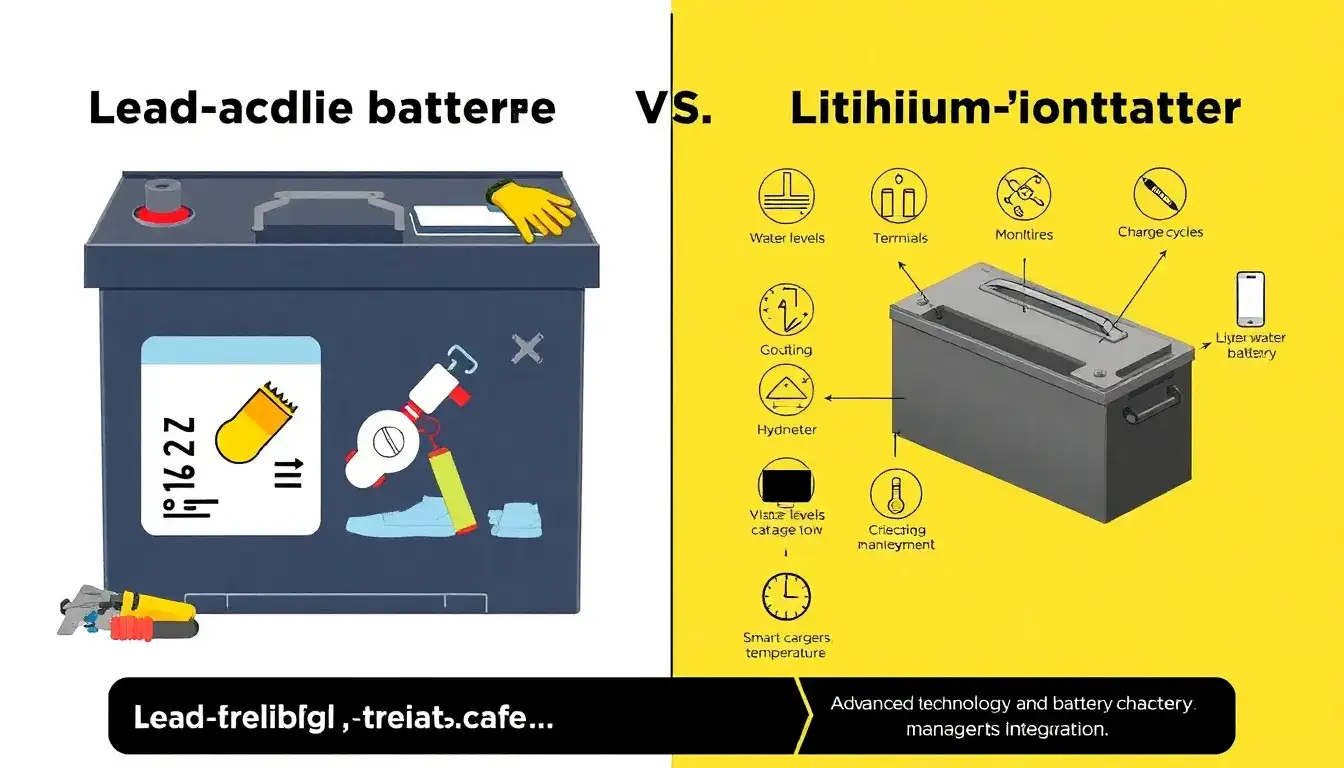
Maintenance Requirements: Lead-Acid vs. Lithium-Ion Batteries
Lead-Acid Batteries
Maintenance Requirements for Lead-Acid Batteries:
- Electrolyte Level Maintenance: Regularly check and maintain electrolyte levels using distilled water. Overwatering or underwatering can damage the battery.
- Cleaning: Clean the terminals with a baking soda and water solution to prevent corrosion. Apply a thin layer of dielectric grease afterward to protect the terminals.
- Visual Inspection: Regularly inspect for cracks, acid leaks, and terminal corrosion. Ensure cables are securely connected.
- Mounting and Protection: Secure batteries on vibration-absorbing mounts to protect against shocks and vibrations, especially in automotive or industrial applications.
- Charging Practices: Use a smart charger to avoid overcharging and undercharging. Perform periodic equalization charges to prevent sulfation.
- Ventilation: Ensure good ventilation during charging due to the release of hydrogen and oxygen gases.
Lithium-Ion Batteries
Maintenance Requirements for Lithium-Ion Batteries:
- Minimal Maintenance: Lithium-ion batteries require almost no maintenance, with no need for electrolyte checks or watering.
- Basic Checks: Regularly inspect plugs, cables, and chargers for issues.
- Operating Conditions: Keep batteries at room temperature and avoid deep discharges to ensure long-term performance.
- No Cleaning Required: Unlike lead-acid batteries, lithium-ion batteries do not require cleaning of terminals.
Comparison Summary
| Feature | Lead-Acid Batteries | Lithium-Ion Batteries |
|---|---|---|
| Maintenance Requirements | High: Regular checks, watering, cleaning | Low: Minimal checks, no watering needed |
| Charging Time | Longer (8 hours + cooling period) | Faster (1-4 hours) |
| Lifespan | Approximately 1500 cycles | Approximately 2000-3000 cycles |
| Energy Density | Lower energy density | Higher energy density |
| Operational Flexibility | Must be upright, limited orientation | Flexible orientation, less space required |
Overall, lithium-ion batteries offer a significant advantage in terms of maintenance simplicity and operational flexibility compared to lead-acid batteries.
Original article by NenPower, If reposted, please credit the source: https://nenpower.com/blog/what-are-the-maintenance-requirements-for-lead-acid-batteries-compared-to-lithium-ion-batteries/

