

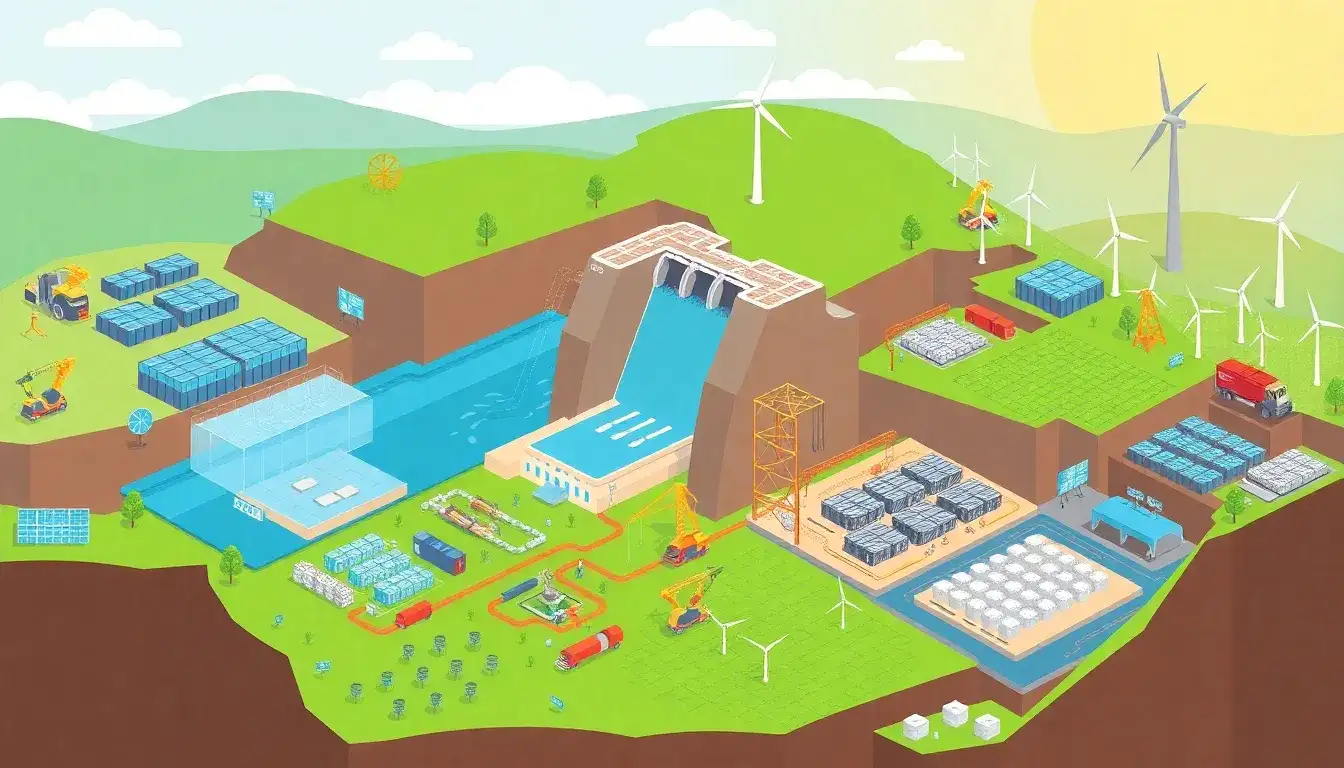
The main types of long-duration energy storage (LDES) technologies can be broadly categorized into four primary groups:
1. Mechanical Energy Storage
- Stores energy as potential energy through tension or position.
- Common examples include pumped hydropower and gravity-based systems.
- Currently the most widespread form globally; for example, aboveground pumped hydropower accounts for 96% of utility-scale energy storage in the U.S.
- Mechanical systems typically offer large capacity and long storage durations.
2. Thermal Energy Storage
- Stores energy in the form of heat.
- Uses materials or systems that can absorb and release thermal energy over long durations.
- Thermal storage is gaining traction as it can integrate well with both renewable electricity and heat demands.
3. Chemical Energy Storage
- Stores energy within chemical bonds.
- Includes technologies such as hydrogen storage and metal-air batteries (e.g., iron-air, zinc-air).
- Chemical storage can offer very long durations, potentially extending to seasonal storage, though often at earlier commercial readiness stages.
4. Electrochemical Energy Storage (Batteries)
- Converts electrical energy into chemical energy and vice versa.
- Includes various battery chemistries such as flow batteries, redox flow batteries, metal-air batteries, and other advanced battery types.
- Designed for durations typically exceeding 4 hours, with advantages like scalability, safety, longer cycle life, and lower self-discharge compared to lithium-ion batteries.
- While lithium-ion batteries dominate short-duration storage, they are less economically viable for long-duration applications (over 8 hours) due to cost, safety, and sustainability concerns.
Summary Table of LDES Types
| Type | Energy Form Stored | Examples | Key Advantages | Typical Duration |
|---|---|---|---|---|
| Mechanical | Potential energy (position, tension) | Pumped hydropower, gravity storage | Large capacity, mature technology | 10+ hours to days |
| Thermal | Heat | Molten salt, phase change materials | Integration with heat and power | 10+ hours to days |
| Chemical | Chemical bonds | Hydrogen, metal-air batteries | Very long duration, scalable | Multi-day to seasonal |
| Electrochemical | Chemical reactions | Flow batteries, redox flow, metal-air batteries | Scalable, long cycle life, safer than Li-ion for long duration | 4+ hours to days |
These four categories cover most commercially available and pre-commercial long-duration energy storage technologies today. Mechanical storage currently leads in deployment scale, but electrochemical, chemical, and thermal options are rapidly advancing to provide flexible, reliable, and cost-effective LDES solutions crucial for grid resiliency and deep decarbonization.
Original article by NenPower, If reposted, please credit the source: https://nenpower.com/blog/what-are-the-main-types-of-long-duration-energy-storage-technologies/

