

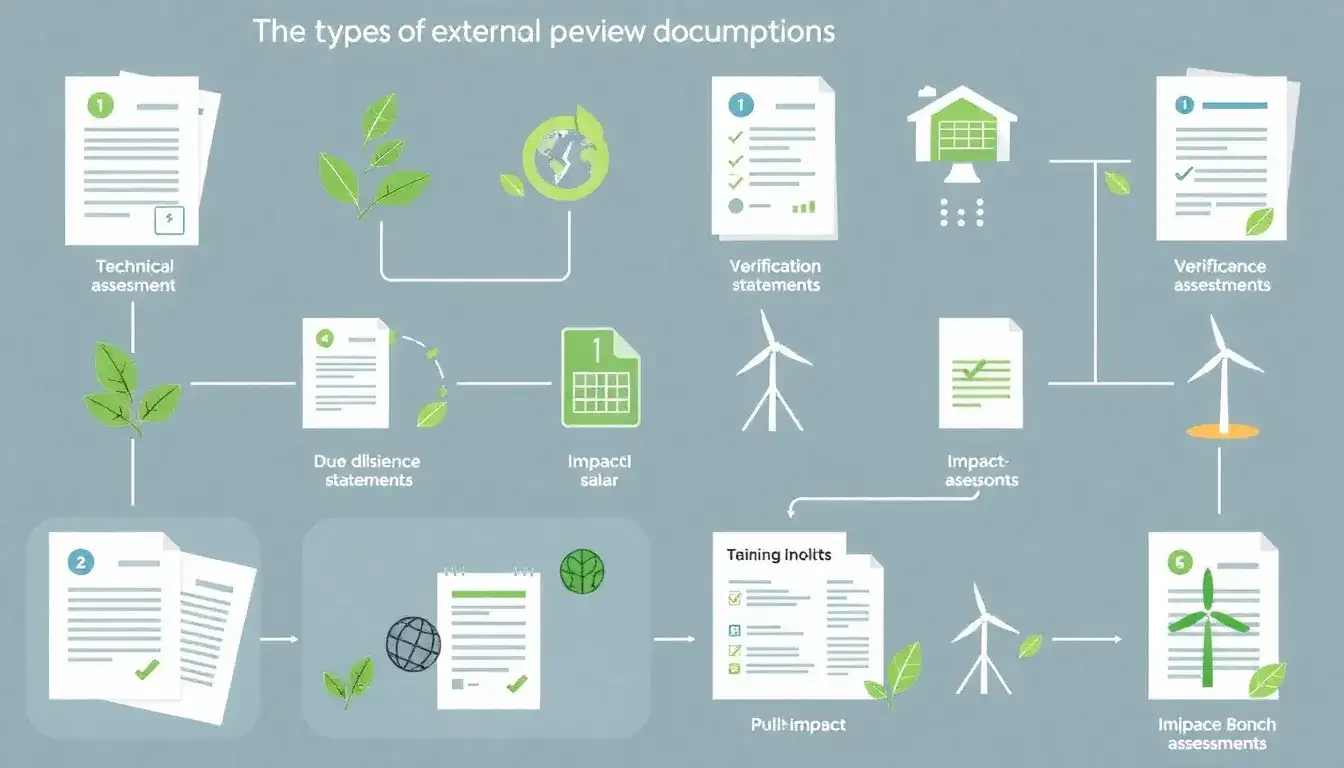
The Climate Bonds Initiative utilizes various external review documents to enhance the transparency and credibility of green bonds. These reviews are crucial for ensuring that bonds are aligned with environmental standards, such as the Climate Bonds Standard and the Green Bond Principles. The main types of external review documents are:
-
Second Party Opinion (SPO):
- Purpose: Provides an assessment of the issuer’s green bond framework and evaluates the “greenness” of eligible projects/assets.
- Providers: ESG service providers like CICERO, DNV-GL, Sustainalytics, Vigeo Eiris, and ISS-Oekom.
- Example: DNV GL SPO commissioned by Arise AB.
-
Third Party Assurance Report:
- Purpose: Confirms compliance with renowned frameworks such as Green Bond Principles or Green Loan Principles.
- Providers: Accounting and audit firms like Deloitte and KPMG.
- Example: KPMG Assurance Report commissioned by IDBI Bank.
-
Green Bond Rating:
- Purpose: Assesses the bond’s alignment with Green Bond Principles and evaluates its green credentials.
- Providers: Rating agencies such as Moody’s, S&P Global Ratings.
- Example: Moody’s Green Bond Rating assigned to Banco Nacional de Costa Rica’s USD500m green bond.
-
Climate Bonds Certification Verification:
- Purpose: Ensures that the use of proceeds adheres to the Climate Bonds Standard and sector-specific criteria.
- Providers: Verifiers approved by the Climate Bonds Standard and Certification Scheme.
- Example: Oekom’s independent verification statement for ABN Amro’s EUR500m green bond.
-
Post-Issuance Reviews:
- These include assurance reports on the actual allocation of proceeds, impact reporting, and post-issuance verification of Climate Bonds Certification.
Original article by NenPower, If reposted, please credit the source: https://nenpower.com/blog/what-are-the-main-types-of-external-review-documents-used-in-the-climate-bonds-initiative/

