

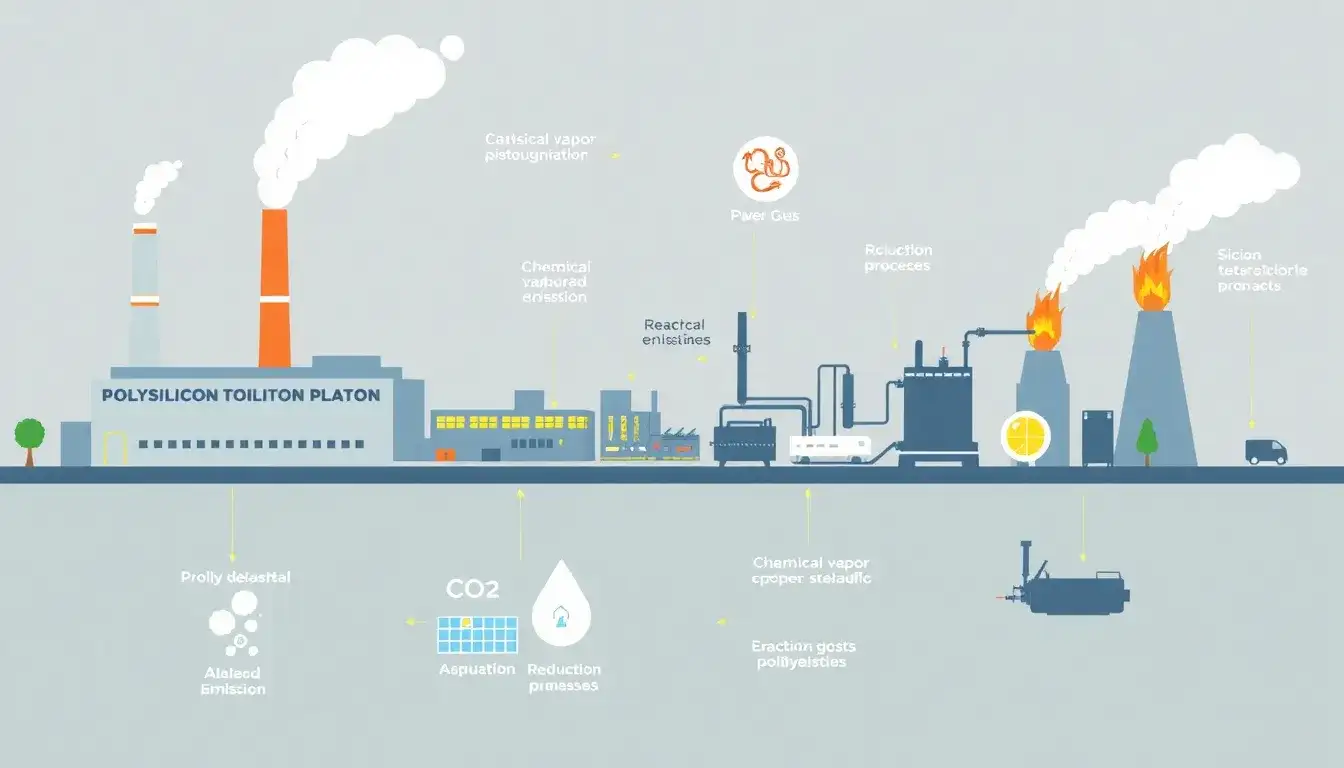
The main sources of emissions in the polysilicon production process stem primarily from the energy-intensive steps required to refine and purify silicon, especially when fossil fuel-based electricity is used.
Key Emission Sources in Polysilicon Production
- Energy Consumption and Power Source:
Polysilicon production requires extremely high temperatures (1,500–2,000°C) to refine silicon from quartz, making it highly energy-intensive. Most of this energy historically comes from coal-fired power plants, especially in China, which produces over 90% of the world’s polysilicon. This reliance on coal-fired electricity is a major contributor to greenhouse gas (GHG) emissions during production. - Manufacturing Process Steps:
The standard method for producing polysilicon is the Siemens process, where metallurgical-grade silicon (about 99% pure) is converted into a high-purity polysilicon (99.999999% purity). This involves heating quartz to produce metallurgical-grade silicon, then converting it into a gas that is deposited onto seed rods in a superheated reactor. Each phase—silicon smelting, electron beam refining, and directional solidification—contributes to emissions. - Major Contributors Within Production Steps:
Analysis shows that the highest CO2 emissions in polysilicon production come from:- Electron beam refining (~38.5% of emissions)
- Metallurgical silicon smelting (~20.9%)
- Secondary directional solidification (~15.8%)
- Primary directional solidification (~14.5%)
These processes consume significant electric power, making electricity usage a sensitive and critical emission factor.
- Raw Material Extraction:
The mining and initial processing of raw materials such as quartz also contribute to emissions but are less significant compared to the energy used in purification steps.
Summary Table of Emission Sources
| Source | Description | Approximate Contribution to Emissions |
|---|---|---|
| Coal-fired electricity | Powering furnaces and refining equipment | Major source (~90% of polysilicon energy comes from coal in China) |
| Electron beam refining | Purifying polysilicon via electron beams | ~38.5% of total production CO2 emissions |
| Metallurgical silicon smelting | Producing metallurgical-grade silicon from quartz | ~20.9% of emissions |
| Directional solidification | Solidifying silicon into usable form | ~30% combined from primary and secondary phases |
| Raw material mining and processing | Quartz extraction and preparation | Minor, but contributes to overall footprint |
In summary, the dominant sources of emissions in polysilicon production are the high electricity demands for silicon smelting, electron beam refining, and directional solidification, particularly when powered by carbon-intensive coal electricity. Cleaner energy sources, such as hydropower, can significantly reduce these emissions.
Original article by NenPower, If reposted, please credit the source: https://nenpower.com/blog/what-are-the-main-sources-of-emissions-in-the-polysilicon-production-process/

