

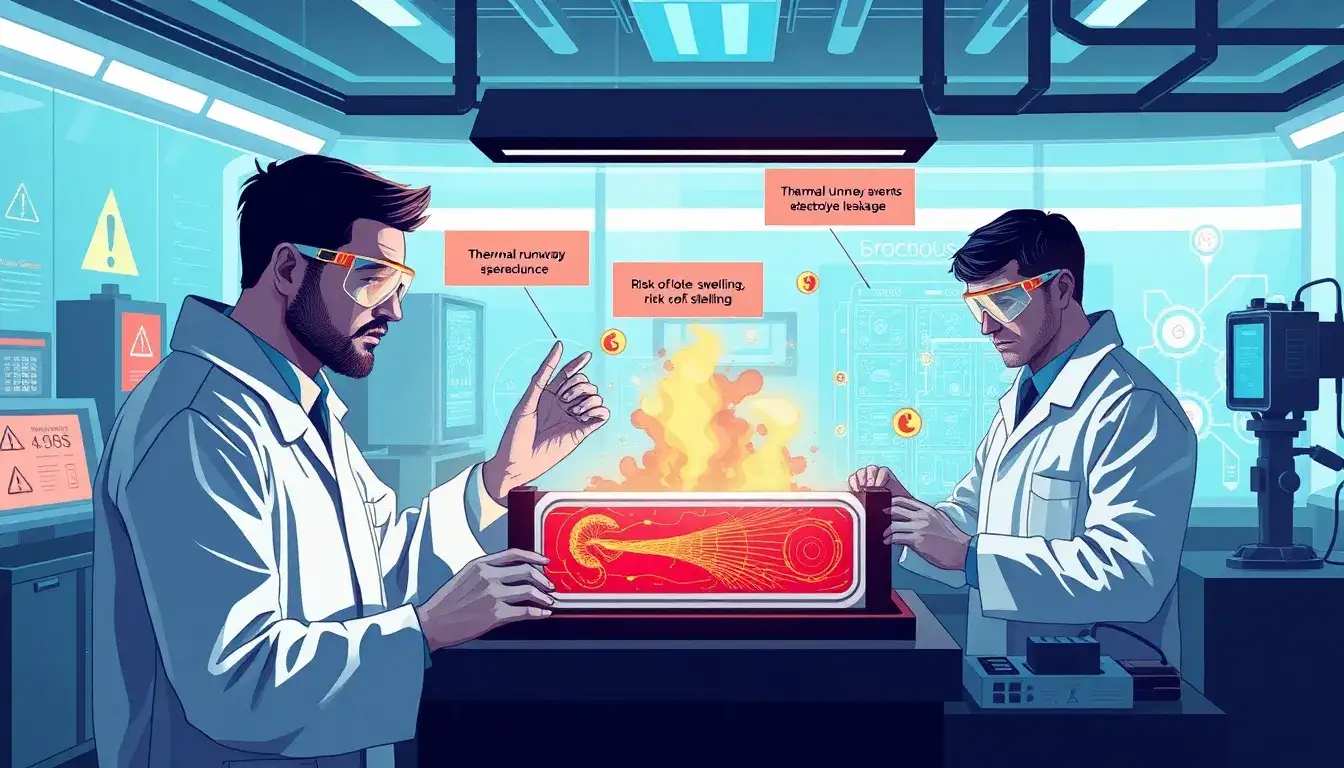
The main safety challenges associated with lithium-sulfur (Li-S) batteries stem primarily from the reactive nature of lithium metal and material instability during battery operation:
- Lithium Metal Reactivity and Safety Risks
Lithium metal used in the anode of Li-S batteries is highly reactive and can lead to safety concerns such as flammability and potential thermal runaway. This instability arises because lithium readily reacts with the electrolyte and forms lithium dendrites during battery cycling. These dendrites can cause short circuits, leading to battery failure and possible fire hazards. Researchers are actively working on developing safer electrolytes and protective coatings to stabilize lithium and prevent dendrite growth, but this remains a key safety challenge. - Polysulfide Shuttle Effect Causing Material Loss and Instability
A chemical process unique to Li-S batteries is the formation of polysulfide compounds during discharge. These compounds dissolve in the electrolyte and shuttle between the cathode and anode, causing loss of active sulfur material and deposition on the anode. This “shuttle effect” accelerates capacity fade and causes instability in the battery, indirectly impacting safety by degrading cell performance and potentially creating uneven lithium deposition. - Volume Expansion and Mechanical Stress
Sulfur cathodes undergo large volume changes during cycling, which can cause mechanical stress and damage to the battery structure. This expansion can lead to swelling of pouch cells and physical deformation, raising the risk of failure or short circuits, thus posing safety risks. Protective coatings and engineered interlayers are being investigated to buffer these volume changes and improve mechanical stability. - Short Cycle Life and Degradation
Li-S batteries tend to degrade faster than traditional lithium-ion batteries. This rapid degradation limits long-term usability and can result in unpredictable battery behavior, which is a safety concern especially in high-demand applications. - Challenges in Electrolyte Stability
The electrolyte in Li-S batteries must be carefully engineered to balance chemical stability with ionic conductivity. Electrolytes that are too reactive can worsen polysulfide dissolution and lithium metal instability, increasing safety risks like electrolyte decomposition and thermal events. New electrolyte additives are being explored to form protective interfacial films that reduce these reactions and improve safety.
In summary, the principal safety challenges of lithium-sulfur batteries arise from lithium metal’s high reactivity and dendrite formation, polysulfide shuttle effects causing material loss and instability, volume expansion damaging cell integrity, and electrolyte stability issues. Ongoing research focuses on safer electrolytes, protective coatings, and structural designs to mitigate these risks and unlock the potential of Li-S technology for commercial use.
Original article by NenPower, If reposted, please credit the source: https://nenpower.com/blog/what-are-the-main-safety-challenges-associated-with-lithium-sulfur-batteries/

