

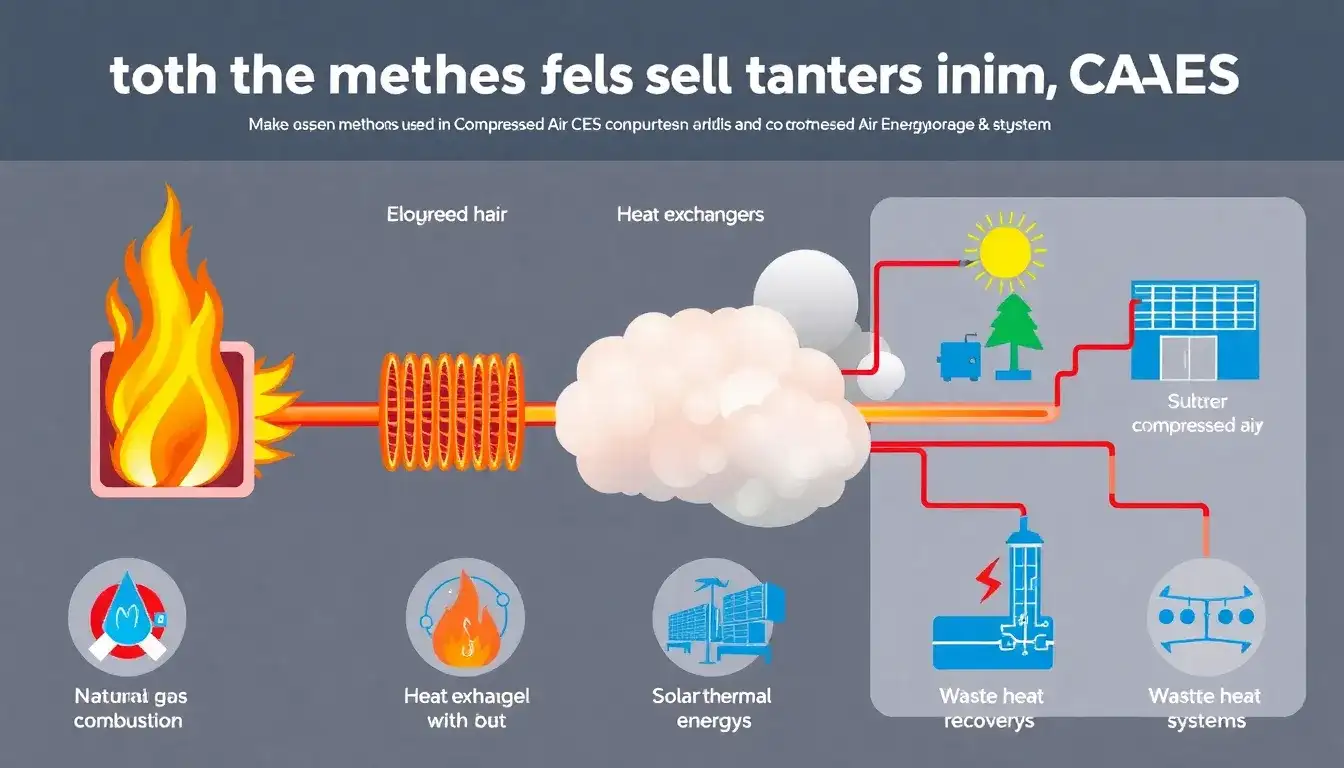
The main methods used to heat the air in Compressed Air Energy Storage (CAES) systems are:
1. Adiabatic Heating
- In adiabatic CAES, the heat generated during the compression of air is captured and stored in a Thermal Energy Storage (TES) system (e.g., in solids like concrete or stone, or fluids such as hot oil or molten salts), rather than being released and lost.
- When the compressed air is expanded to generate power, this stored heat is returned to the air, reheating it and improving efficiency. The compressor air discharge temperature can exceed 600 °C before being stored.
- This method avoids burning additional fuel, thus being emission-free and more energy efficient, with round-trip efficiencies over 70% reported in advanced systems.
- Heat can be stored in packed beds or other thermal storage media designed to minimize heat loss during storage.
- Adiabatic CAES is still under development and not widely deployed at a utility scale yet.
2. Diabatic Heating (Combustion-Based)
- In traditional diabatic CAES systems, the air is reheated by burning a fuel (such as natural gas or hydrogen) before expansion in the turbine.
- This combustion heats the air to the required temperature for turbine operation as the compressed air itself cools down during storage.
- This method is simpler but less energy efficient and involves emissions due to fuel combustion.
3. Isothermal and Near-Isothermal Methods (Research Stage)
- These methods aim to control the air temperature closely during compression and expansion by managing heat exchange continuously, keeping temperatures nearly constant to reduce thermal losses and improve efficiency.
- These are currently under research and development and not widely commercialized.
Summary Table of Heating Methods in CAES
| Method | Heating Source | Heat Storage | Efficiency & Emissions | Deployment Status |
|---|---|---|---|---|
| Adiabatic | Stored compression heat | Thermal Energy Storage | >70% efficiency, emission-free | Pilot/Development stage |
| Diabatic | Fuel combustion (natural gas, hydrogen) | None (heat added on demand) | Lower efficiency, emits CO2 | Commercial in some plants |
| Isothermal/Near-Isothermal | Continuous heat exchange control | Heat exchangers | Potential for high efficiency | Experimental/Research |
These methods highlight the trade-offs between efficiency, emissions, complexity, and technological readiness in heating the air within CAES systems.
Original article by NenPower, If reposted, please credit the source: https://nenpower.com/blog/what-are-the-main-methods-used-to-heat-the-air-in-caes-systems/

