

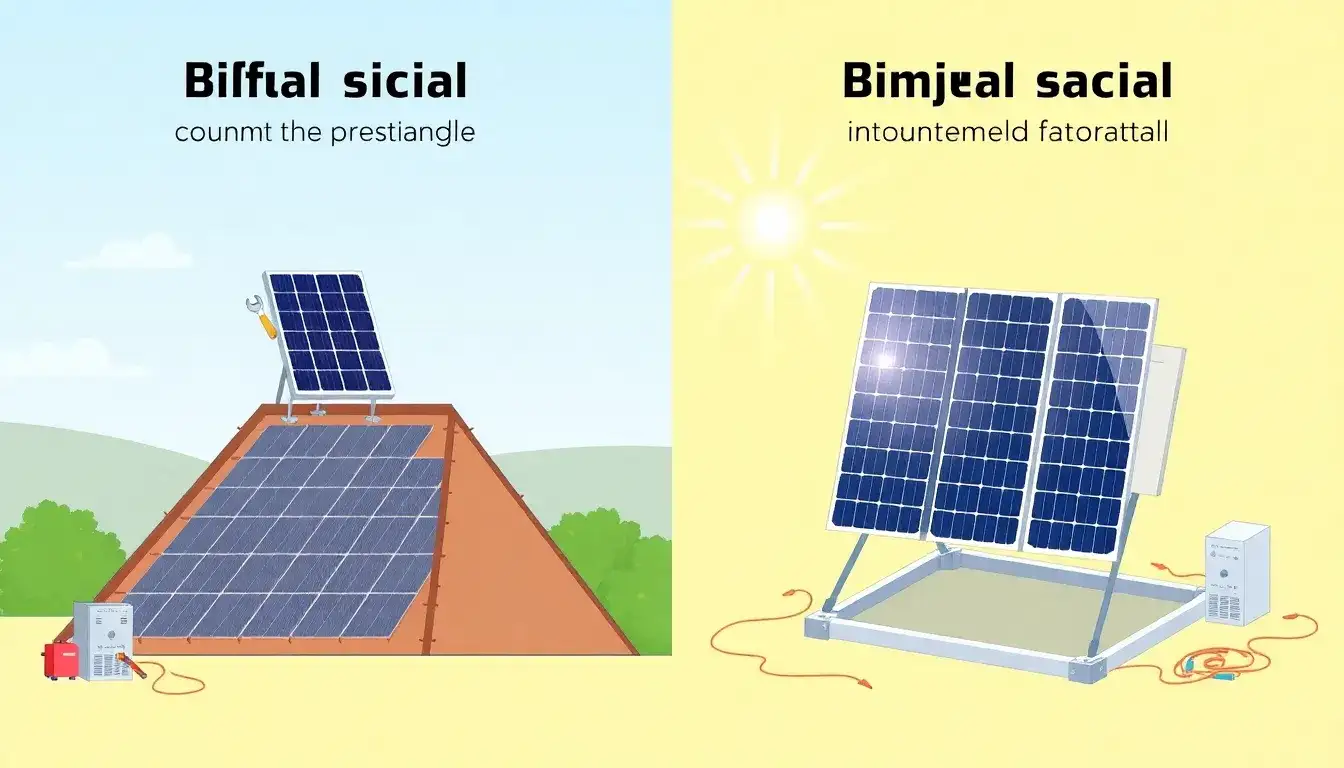
Key Installation Differences
1. Mounting Requirements
Bifacial panels require elevated installations or specialized racking to allow light reflection underneath, while monofacial panels work with standard rooftop mounting systems.
2. Surface Considerations
Bifacial panels need reflective surfaces (e.g., white gravel, concrete) beneath them for optimal rear-side energy capture. Monofacial panels don’t require specific ground treatments.
3. Weight and Flexibility
Bifacial panels are heavier and less flexible, requiring sturdier structural supports. Monofacial panels are lighter and more adaptable to curved surfaces.
4. Installation Complexity
Bifacial systems involve higher installation costs due to specialized labor and mounting hardware. Monofacial panels are quicker to install using conventional methods.
5. Space Utilization
Bifacial panels perform best in open spaces with clearance underneath, making them ideal for ground-mounted solar farms. Monofacial panels dominate rooftop installations where space constraints exist.
| Factor | Bifacial | Monofacial |
|---|---|---|
| Installation Type | Elevated/ground-mounted | Standard rooftop |
| Surface Prep | Reflective base required | No special requirements |
| Structural Support | Heavy-duty racking | Conventional racks |
| Installation Cost | Higher | Lower |
| Optimal Use Case | Commercial solar farms | Residential rooftops |
Original article by NenPower, If reposted, please credit the source: https://nenpower.com/blog/what-are-the-main-installation-differences-between-bifacial-and-monofacial-panels/

