

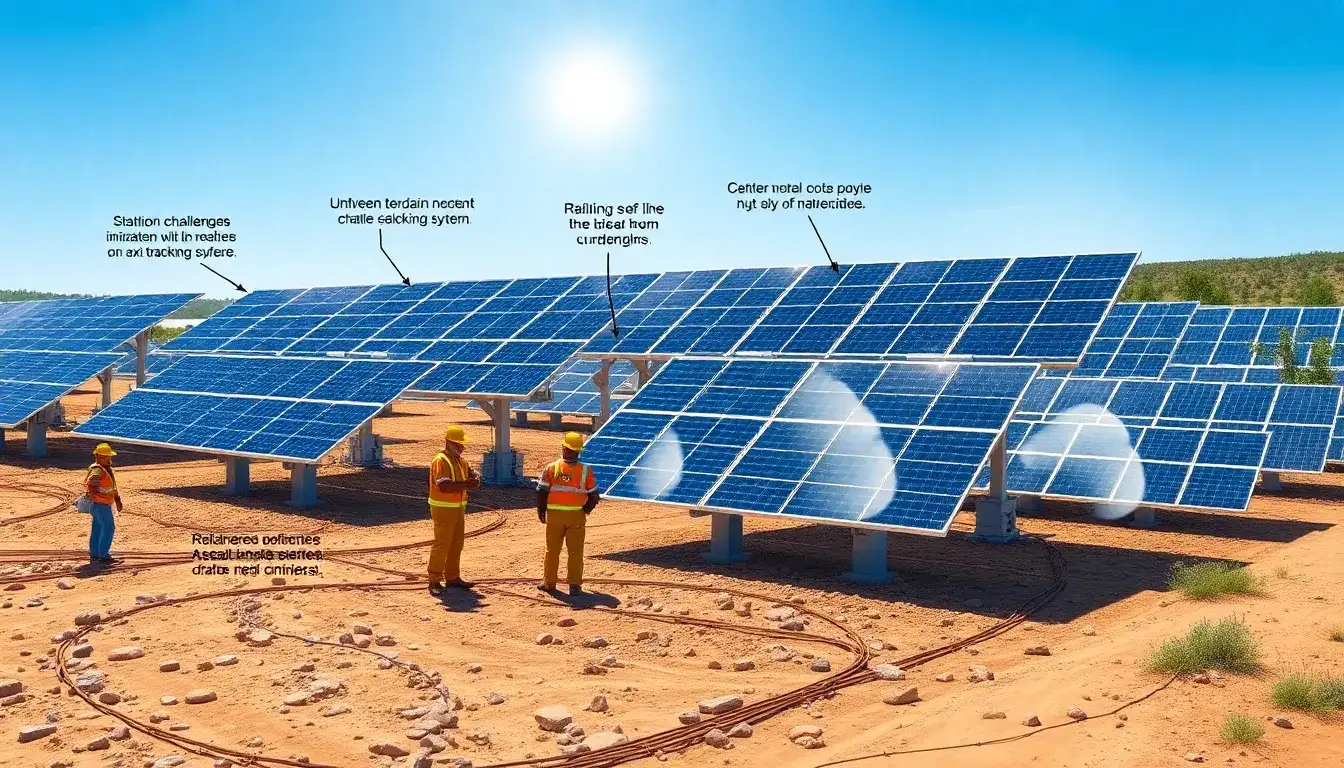
Bifacial solar panels present unique installation challenges that require careful planning and expertise. Here are the primary issues:
Installation Complexity
- Mounting requirements: Bifacial panels need specialized racking systems to elevate them (typically ≥1 meter) for rear-side light capture, increasing material and labor costs.
- Tilt and orientation: Optimal tilt angles and orientation must account for both front and rear irradiance, requiring precise site analysis.
- Structural considerations: Their dual-glass design makes them heavier, necessitating reinforced supports to handle weight and wind loads.
Environmental Dependencies
- Albedo requirements: Performance heavily relies on reflective surfaces (e.g., white gravel, snow) beneath panels. Non-reflective surfaces (e.g., dark roofs) significantly reduce energy gain.
- Shading sensitivity: Unlike monofacial panels, shading on either side (even from mounting hardware) impacts output, requiring meticulous site planning to avoid obstructions.
Electrical and Mechanical Design
- Wiring and inverters: Bifacial systems may produce unexpected power spikes, requiring oversized conductors, fuses, and inverters to avoid overload.
- Monitoring complexity: Standard monitoring tools often fail to account for rear-side generation, necessitating specialized equipment.
Maintenance Demands
- Dual-sided cleaning: Dirt accumulation on both surfaces reduces efficiency, increasing maintenance frequency compared to monofacial panels.
- Snow/ice management: Rear-side ice buildup in cold climates is harder to remove, often requiring steeper tilt angles.
Cost and Logistics
- Higher upfront costs: Equipment (racking, inverters) and installation labor costs are 5-17% higher than monofacial systems, depending on tracking systems.
- Transport challenges: Heavier panels require specialized handling and equipment during transport.
| Challenge | Bifacial Impact | Mitigation Strategies |
|---|---|---|
| Mounting Height | Higher elevation needed for rear-side light capture | Use reinforced, adjustable racking systems |
| Albedo Dependency | Non-reflective surfaces reduce energy gain by 10-30% | Install reflective ground covers or coatings |
| Shading Sensitivity | Partial shading on either side causes disproportionate output drops | Conduct 3D shading analysis pre-installation |
| Inverter Mismatch | Unexpected power surges may exceed inverter capacity | Deploy power optimizers or oversize inverters |
| Maintenance | Dual-sided soiling requires twice the cleaning effort | Install automated cleaning systems or frequent schedules |
These challenges necessitate professional installation and site-specific engineering to maximize the technology’s advantages.
Original article by NenPower, If reposted, please credit the source: https://nenpower.com/blog/what-are-the-main-installation-challenges-for-bifacial-solar-panels/

