

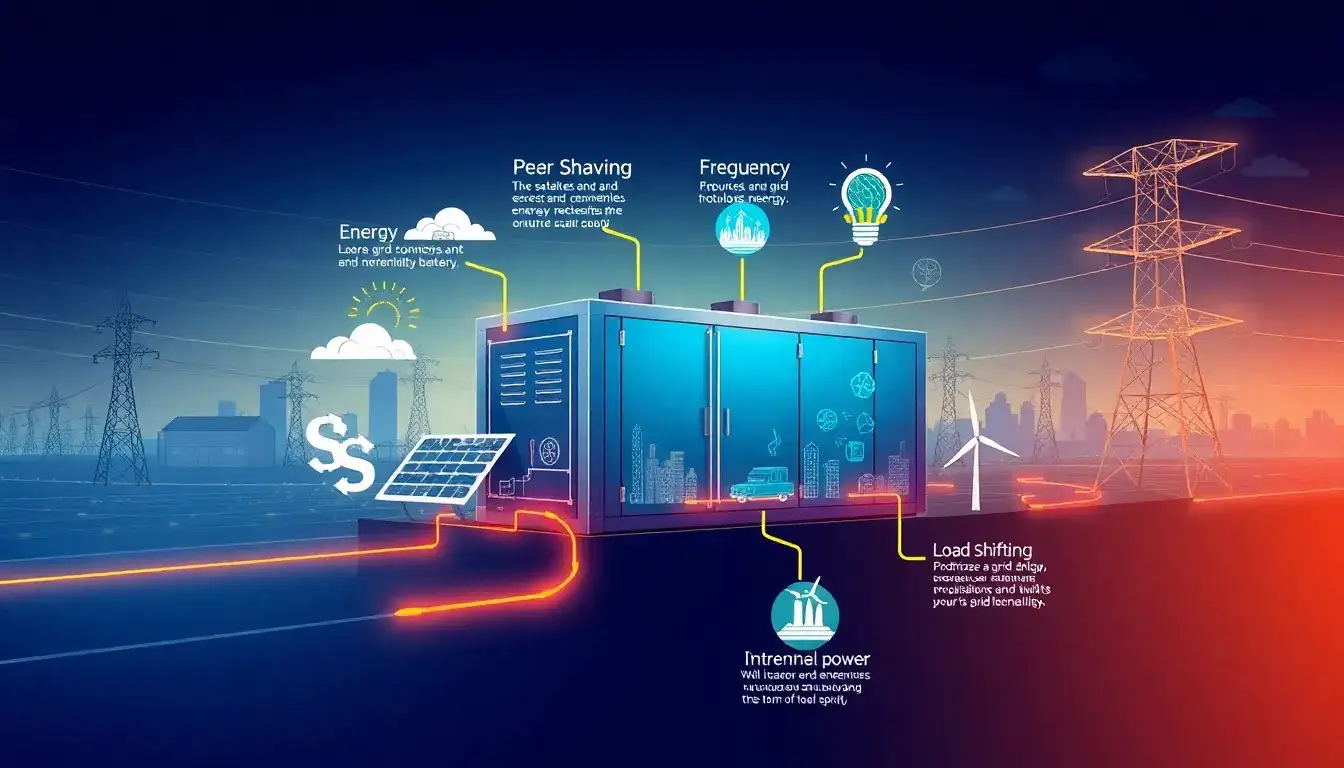
Utility-scale battery storage systems provide critical grid services across three primary categories:
Energy Services
- Capacity and resource adequacy: Stores surplus energy for rapid discharge during peak demand, improving price stability and reliability during extreme weather or outages.
- Solar firming and renewables shifting: Smoothes intermittent renewable generation by filling gaps caused by weather or time-of-day variability.
- Energy arbitrage: Charges during low-cost periods and discharges when electricity prices rise, reducing overall energy costs.
- Curtailment mitigation: Captures excess renewable energy that would otherwise be wasted and shifts it to high-demand periods.
Ancillary Services
- Frequency regulation: Instantaneously injects or absorbs power to maintain grid frequency near 60 Hz, preventing disruptions.
- Voltage support: Stabilizes voltage levels through rapid power adjustments, enhancing grid reliability.
- Ramping/spinning reserve: Provides immediate backup power during sudden generation or demand changes, outperforming conventional thermal plants in response speed.
Transmission and Distribution (T&D) Services
- T&D upgrade deferral: Reduces strain on infrastructure by supplying power locally, delaying costly grid upgrades.
- Peak shaving: Lowers demand on transmission lines during high-usage periods, optimizing existing grid capacity.
- Loss mitigation: Improves efficiency by delivering power closer to demand centers, reducing line losses.
These services enable higher renewable energy penetration while maintaining grid stability and reducing operational costs.
Original article by NenPower, If reposted, please credit the source: https://nenpower.com/blog/what-are-the-main-grid-services-provided-by-utility-scale-batteries/

