

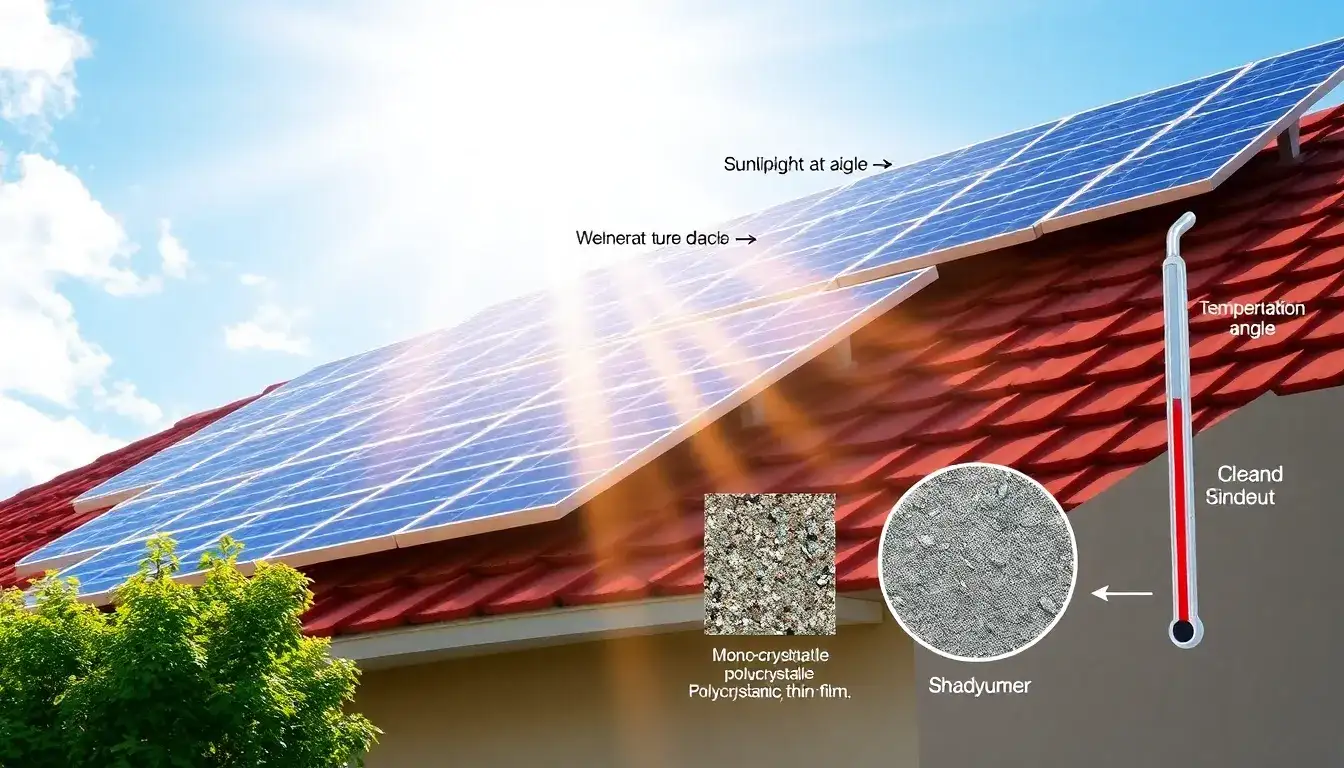
The efficiency of solar panels is influenced by several key factors, which can be broadly categorized into environmental, design, and installation factors. Here are the main factors affecting solar panel efficiency:
Environmental Factors
- Sunlight Intensity: Higher sunlight intensity increases the efficiency of solar panels by enhancing electron excitation within the semiconductor material. This varies by time of day, season, and geographical location.
- Temperature: High temperatures reduce solar panel efficiency due to a decrease in voltage. Typically, efficiency decreases by 0.3% to 0.5% per degree Celsius above 25°C.
- Weather Conditions: Cloud cover and pollution can decrease sunlight intensity, impacting panel efficiency.
Design and Material Factors
- Solar Cell Technology: Monocrystalline cells offer higher efficiency compared to polycrystalline or thin-film cells due to their purer silicon structure.
- Material Quality: Impurities in the cell material can lead to recombination, reducing efficiency.
- Spectral Response: Panels capturing a broader spectrum of light (including infrared and ultraviolet) tend to be more efficient.
Installation Factors
- Orientation and Tilt: Panels facing south (in the northern hemisphere) with a tilt angle matching the installation latitude maximize sun exposure.
- Shading and Obstructions: Dust, dirt, and debris can block sunlight, reducing efficiency. Regular cleaning and optimal placement help mitigate these factors.
- Wiring and Electrical Losses: High-quality wiring with low resistance reduces electrical losses.
- Reflection and Absorption Losses: Anti-reflective coatings help reduce reflected light and increase energy absorption.
Inverter Efficiency
- Inverter Type: Microinverters can improve overall system efficiency by optimizing individual panel performance and reducing energy losses during conversion.
Original article by NenPower, If reposted, please credit the source: https://nenpower.com/blog/what-are-the-main-factors-that-influence-the-efficiency-of-solar-panels/

