

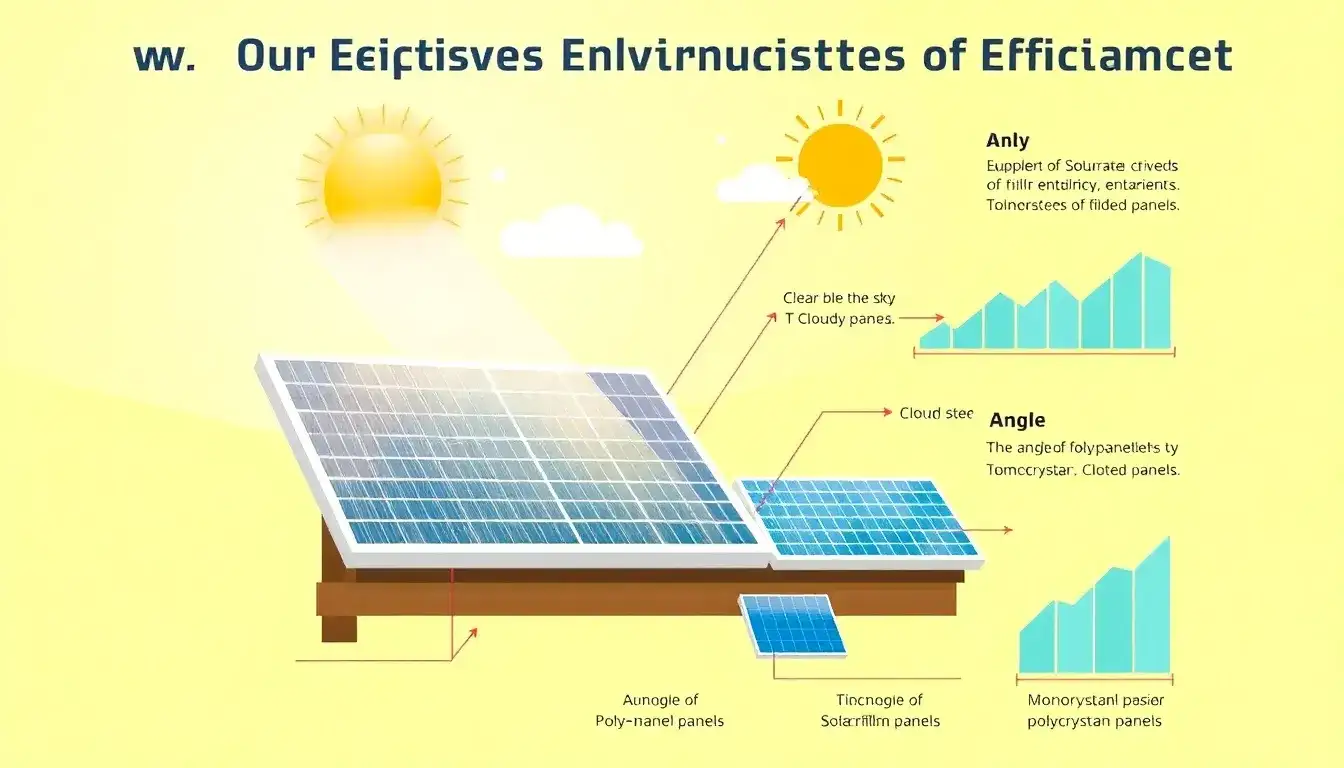
The efficiency of solar panels is influenced by several key factors, which can be broadly categorized into environmental, technical, and design-related aspects. Here are the main factors that influence solar panel efficiency:
Environmental Factors
- Sunlight Intensity (Irradiance): Higher irradiance leads to more electricity production. Optimal placements are crucial to maximize sunlight exposure throughout the day.
- Temperature: Solar panels perform best at temperatures between 15°C and 35°C. Higher temperatures reduce efficiency, often by 10% to 25%.
- Weather Conditions: Rain and shading can significantly impact efficiency by obscuring sunlight.
Technical and Material Factors
- Cell Technology and Material Quality: Monocrystalline panels are generally more efficient than polycrystalline or thin-film types. Pure silicon reduces recombination, improving efficiency.
- Efficiency of Inverters and Charge Controllers: Efficient conversion of DC to AC power is crucial. Microinverters can enhance system reliability and efficiency.
- Reflection and Spectral Response: Anti-reflective coatings and a broad spectral response improve efficiency by capturing more sunlight.
Design and Installation Factors
- Orientation and Tilt Angle: Proper alignment and tilt maximize sunlight capture throughout the day.
- Shading and Mismatch Losses: Shading affects efficiency; using power optimizers can minimize these losses.
- Maintenance and Cleaning: Regular cleaning reduces efficiency losses due to dirt accumulation.
Additional Considerations
- Inverter Type: Microinverters offer better performance under partial shading compared to string inverters.
- Heat Management: Proper spacing for air circulation and cooling systems can reduce temperature-related efficiency drop-offs.
Original article by NenPower, If reposted, please credit the source: https://nenpower.com/blog/what-are-the-main-factors-that-influence-solar-panel-efficiency/

