

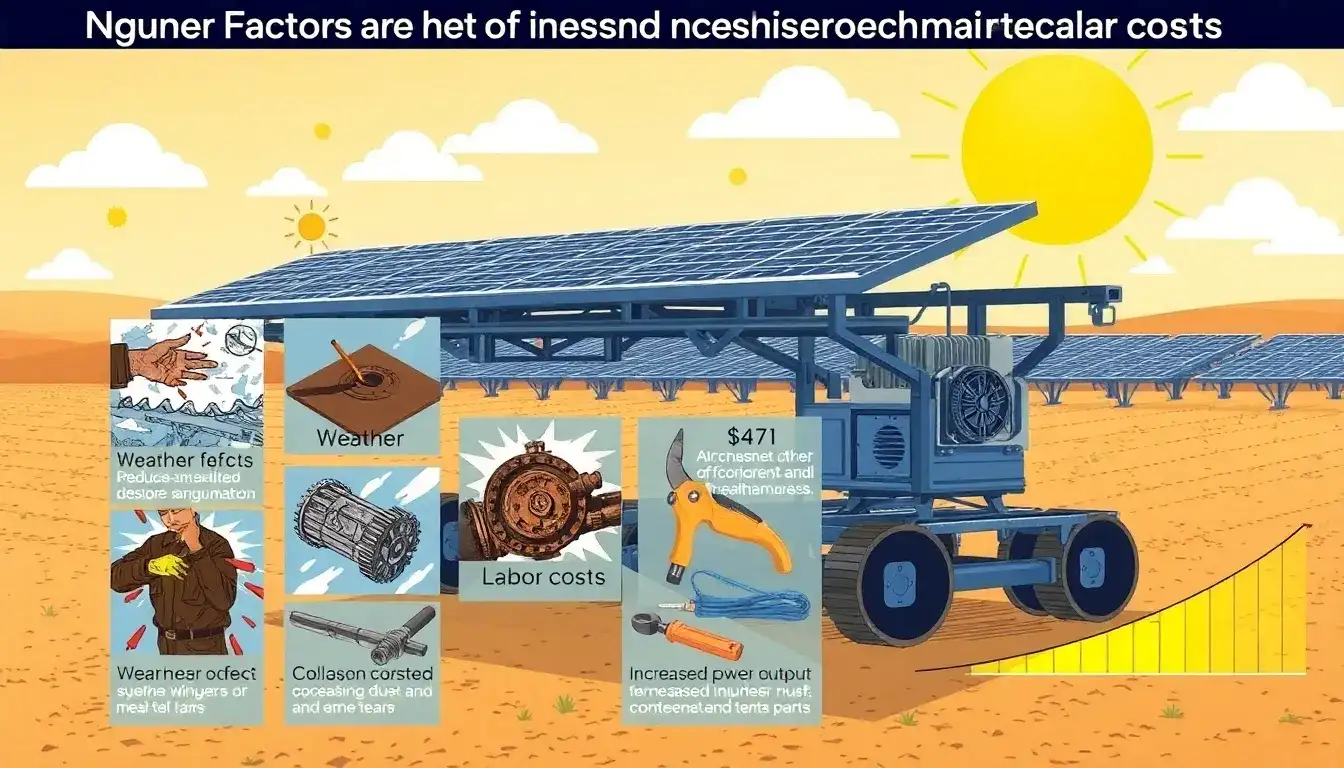
The main factors that increase maintenance costs for solar trackers include:
- Labor and Expertise Requirements: Maintaining solar trackers requires specialized labor such as electrical technicians, general laborers, and licensed electricians. Labor costs are a significant part of overall maintenance expenses, as each service call or repair involves skilled personnel.
- Complexity of Moving Parts: Solar trackers have mechanical components that move panels to follow the sun, unlike fixed-tilt systems. This increases the likelihood of mechanical wear and tear, requiring more frequent inspections, repairs, and part replacements.
- Land and Site Conditions: Trackers often require more land than fixed systems due to their movement range. Uneven or challenging terrains, variable soil stability, and load-bearing capacity can complicate installation and maintenance, raising costs for customized foundation work and ongoing upkeep.
- Vegetation and Pest Management: Trackers are installed in large areas and require continuous vegetation control to prevent shading and obstruction of movement. Pest interference can also impact wiring and tracker operations and necessitates regular maintenance.
- Wiring and Electrical Inspections: The movement of panels and mechanical systems can strain wiring and electrical connections, requiring careful and frequent inspections to secure wiring and ensure electrical safety and efficiency.
- Scale and Project Size: Larger projects benefit from economies of scale, thus having comparatively lower per-unit maintenance costs. Smaller solar tracker installations may face proportionally higher maintenance costs due to less efficient resource allocation.
- Environmental Factors: Wind conditions and weather exposure affect solar trackers more due to their moving parts and structures, potentially increasing repair frequency and associated labor costs.
- Component-Specific Maintenance: While tracker O&M is a smaller portion of total maintenance (about 3%), it includes tasks specific to tracking hardware, which adds to the overall maintenance budget compared to fixed-tilt configurations.
In summary, maintenance costs for solar trackers are driven mainly by the mechanical complexity of tracking systems, site-specific land and environmental conditions, labor intensity, vegetation and pest management, and the scale of the installation. These factors combine to make tracker O&M more involved than fixed-tilt systems, impacting long-term operations costs.
Original article by NenPower, If reposted, please credit the source: https://nenpower.com/blog/what-are-the-main-factors-that-increase-maintenance-costs-for-solar-trackers/

