

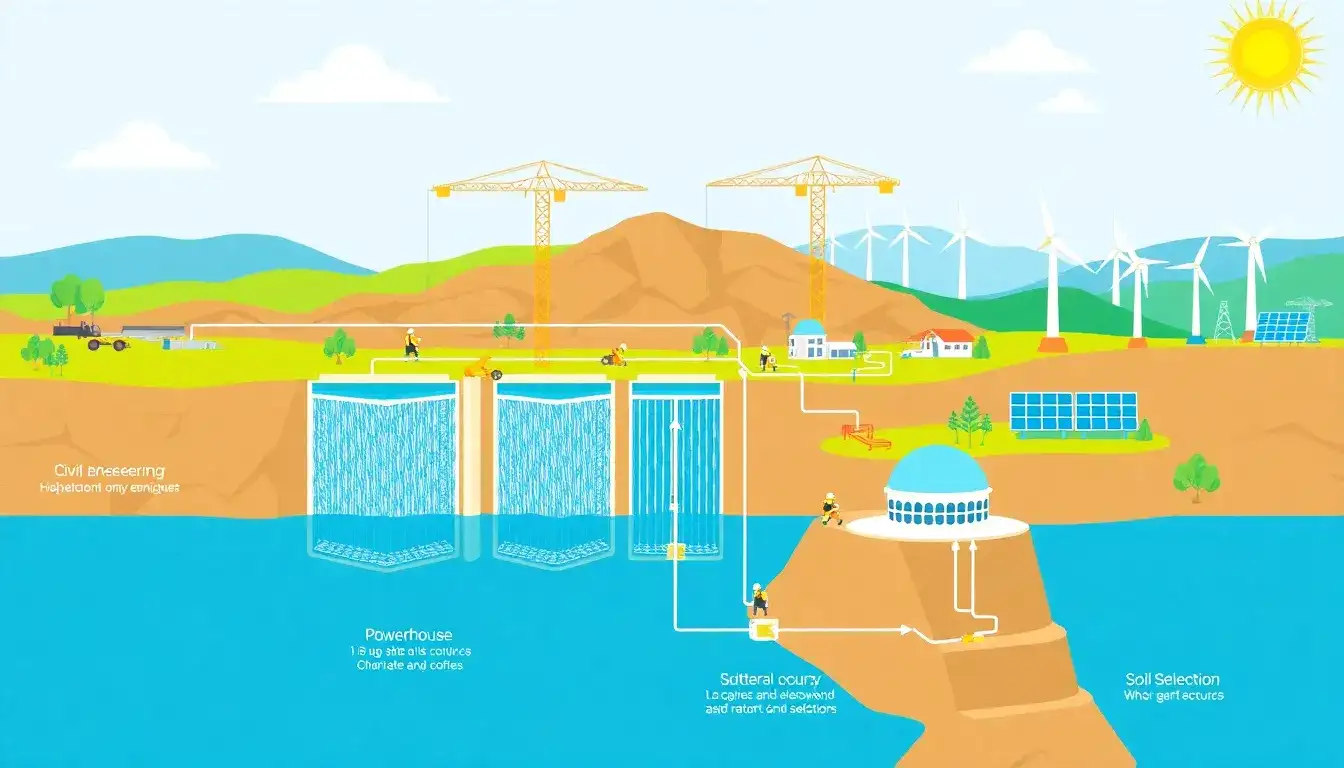
The initial costs of Pumped Storage Hydropower (PSH) facilities are influenced by several key factors related to site-specific characteristics, engineering requirements, and project scope. Based on recent detailed studies and cost models, the main factors include:
Site-Specific Physical Factors
- Geology and Excavation Conditions: Adverse geological conditions can significantly increase costs due to difficult excavation and tunneling requirements. Poor rock quality, fault zones, or complex formations require more extensive reinforcement, which drives up civil works costs.
- Tunnel Length and Storage Head: Longer tunnels and the ratio of tunnel length to storage head affect excavation complexity and costs. Storage head (the vertical height difference between reservoirs) also impacts equipment sizing and civil structure dimensions.
- Terrain and Access: Challenging terrain for access roads and construction logistics can increase costs due to transportation and construction difficulties.
Civil Works and Structural Components
- Reservoirs and Water Conveyance Systems: The construction of upper and lower reservoirs, dams, and water conveyance structures (e.g., tunnels, penstocks) represent the largest portion of capital costs, often around 67% of the total project cost. These components also carry the highest risk in terms of development time and technical challenges.
- Powerhouse and Electromechanical Equipment: The powerhouse structure and installation of turbines, pumps, and generators typically account for around 26-31% of total costs. Electromechanical equipment costs scale with plant capacity and are sensitive to design specifications.
Project Size and Equipment Capacity
- Plant Capacity (kW or MW): Larger capacity plants require more equipment and larger civil structures, increasing costs proportionally. Cost models calculate unit costs per kilowatt or per foot multiplied by the size parameters.
- System Configuration Details: Different design choices, such as closed-loop versus open-loop systems, also influence cost components depending on water source and environmental conditions.
Indirect and Non-Construction Costs
- Engineering, Procurement, and Construction (EPC) Costs: EPC fees and owner’s costs (including permitting, legal, and development expenses) can account for a significant portion of costs, sometimes up to 55% of direct construction costs.
- Contingency and Overhead: Contingency fees to cover unforeseen expenses and overhead costs add further markups on top of direct costs.
- Tax, Profit Margins, and Inflation Adjustments: These financial factors and regional cost differences are also built into cost estimates to reflect actual project economics in a given location and time frame.
Additional Influencing Factors
- Transmission Interconnections: Costs associated with connecting the PSH facility to the grid can be substantial, particularly if long transmission lines are required.
- Utilization Factor: While not a direct cost driver, the utilization rate influences the economic feasibility and may impact design choices that feed back into cost.
Summary Table of Main Cost Factors for PSH Facilities
| Factor | Description | Cost Impact |
|---|---|---|
| Geology & Excavation | Rock quality, tunneling complexity | Significant (increased civil) |
| Tunnel length & Storage head | Length of tunnels relative to water head | Moderate to high |
| Terrain & Access | Difficulty of site access and construction logistics | Moderate |
| Reservoir & Water Conveyance | Construction of dams, reservoirs, tunnels | Largest share (~67%) |
| Powerhouse & Equipment | Turbines, pumps, generators, powerhouse structure | Major share (26-31%) |
| Plant Size & Configuration | Capacity and design type | Proportional to size |
| EPC and Owner Costs | Project management, permitting, legal fees | Large, up to ~55% of direct costs |
| Contingency & Overhead | Risk buffers, administrative costs | Moderate |
| Taxes, Profit Margins, Inflation | Financial adjustments and regional cost variations | Variable |
| Grid Interconnection | Transmission lines and grid connection | Variable, can be substantial |
These factors collectively determine the initial capital expenses of PSH projects. Civil works—particularly reservoirs and water conveyance—along with electromechanical equipment, dominate costs, while indirect costs and site challenges add further variability and risk to final project budgets.
Original article by NenPower, If reposted, please credit the source: https://nenpower.com/blog/what-are-the-main-factors-influencing-the-initial-costs-of-psh-facilities/

