

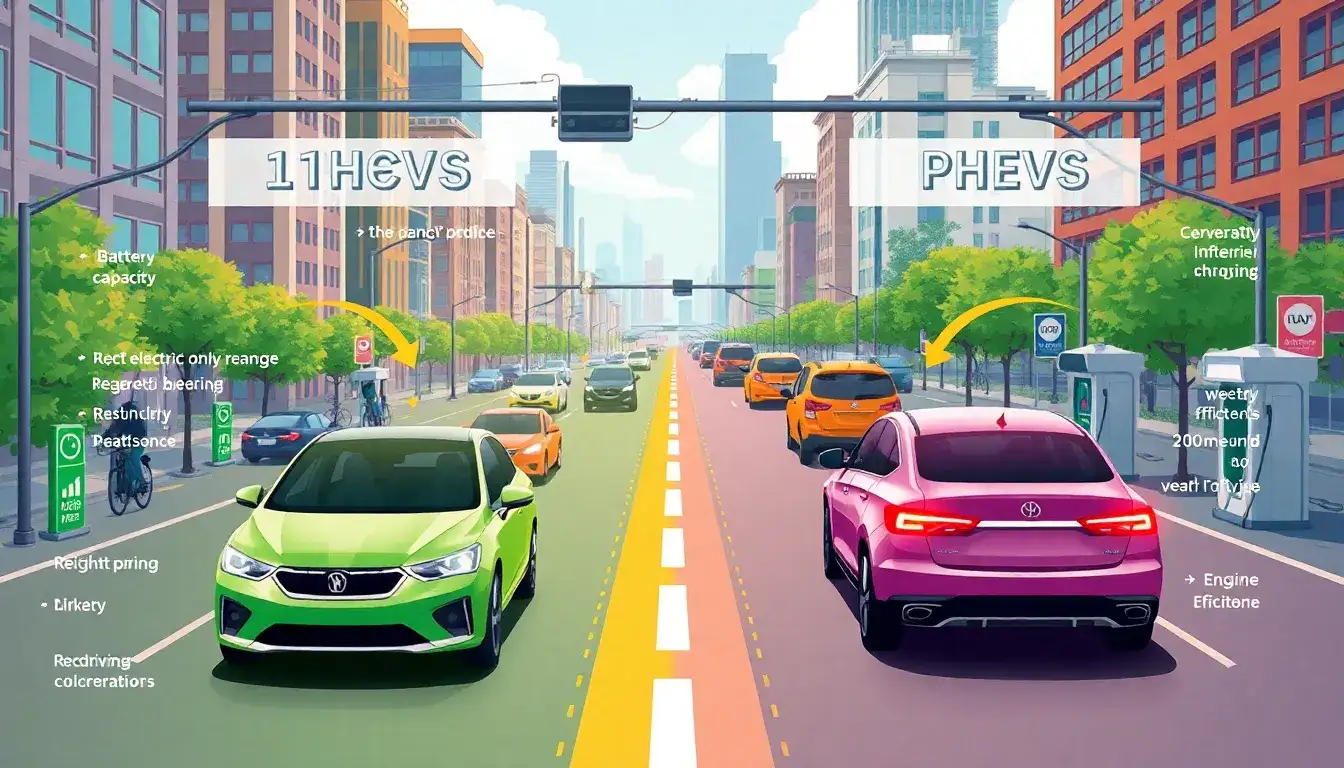
Key Factors Influencing Fuel Efficiency in Cities
1. Electric-Only Range and Usage
- PHEVs have larger batteries than HEVs, enabling them to drive significant distances (typically 25-44 miles) on electric power alone without using gasoline. In city driving—which often involves short trips and frequent stops—this electric range can be leveraged to consume little or no fuel during those trips, drastically improving fuel efficiency.
- HEVs do not have a significant electric-only driving range; their battery and electric motor are designed primarily to assist the gasoline engine for better efficiency, not to fully replace it. Thus, HEVs rely more on gasoline even in city driving but still gain efficiency through regenerative braking and electric motor assist.
2. Driving Patterns and Trip Length
- PHEVs achieve higher fuel efficiency in cities particularly when daily driving distances are within their electric-only range, allowing them to operate mostly on electric power and avoid gasoline consumption.
- For longer trips exceeding the PHEV’s electric range, or when the battery is depleted, PHEVs operate as regular hybrids, and their fuel efficiency converges closer to HEVs.
- HEVs consistently save fuel in stop-and-go city conditions through electric motor assist and regenerative braking but cannot match the zero-gasoline operation of a PHEV on short trips.
3. Powertrain Complexity and Efficiency
- HEVs typically have a simpler powertrain optimized for smooth transition between electric assist and gasoline engine use, often resulting in slightly better fuel economy than a PHEV running purely on gasoline.
- PHEVs generally have more powerful engines and electric motors providing higher combined horsepower, but this can lead to heavier vehicles with more energy consumption when running in hybrid mode.
4. Energy Recovery and Regeneration in Stop-and-Go Traffic
- Both HEVs and PHEVs benefit from regenerative braking, which captures energy during deceleration and stores it in the battery, improving fuel economy in urban driving conditions. However, PHEVs have larger batteries, enabling them to store and reuse more recovered energy in electric driving mode.
5. Fuel Economy Ratings and Real-World Use
- PHEVs’ official fuel economy ratings are often split into electric and gasoline modes, reflecting their dual nature. For example, models like the 2024 Toyota Prius Prime can achieve around 40-50 mpg combined when running on gasoline but much higher efficiency when electric driving is factored in.
- HEVs typically show consistent mpg ratings around 40 mpg city, benefiting from electric assist but without electric-only operation.
Summary Table of Main Differences Affecting City Fuel Efficiency
| Factor | Plug-In Hybrid (PHEV) | Hybrid (HEV) |
|---|---|---|
| Electric-only range | 25–44 miles typically, enabling zero-gasoline city trips | None or very minimal electric-only range |
| Fuel efficiency on short trips | Much higher when operating electrically (up to 90+ MPGe) | Moderate improvement via electric assist |
| Efficiency on longer trips | Drops to HEV-like efficiency once battery depleted | Consistent, moderate efficiency |
| Powertrain complexity | More complex, heavier, higher power outputs | Simpler, optimized for efficiency |
| Energy regeneration | Larger battery captures more regenerative energy | Smaller battery with less electric storage |
In essence, PHEVs tend to be more fuel-efficient than HEVs in city driving if the driver frequently charges the battery and drives mostly within the electric-only range, allowing them to minimize gasoline use. HEVs offer steady fuel savings without needing external charging and generally have slightly better fuel economy when running solely on gasoline due to simpler powertrains. The choice between the two depends on driving habits, length of city trips, and charging opportunities.
Original article by NenPower, If reposted, please credit the source: https://nenpower.com/blog/what-are-the-main-factors-influencing-the-fuel-efficiency-of-phevs-versus-hevs-in-cities/

