

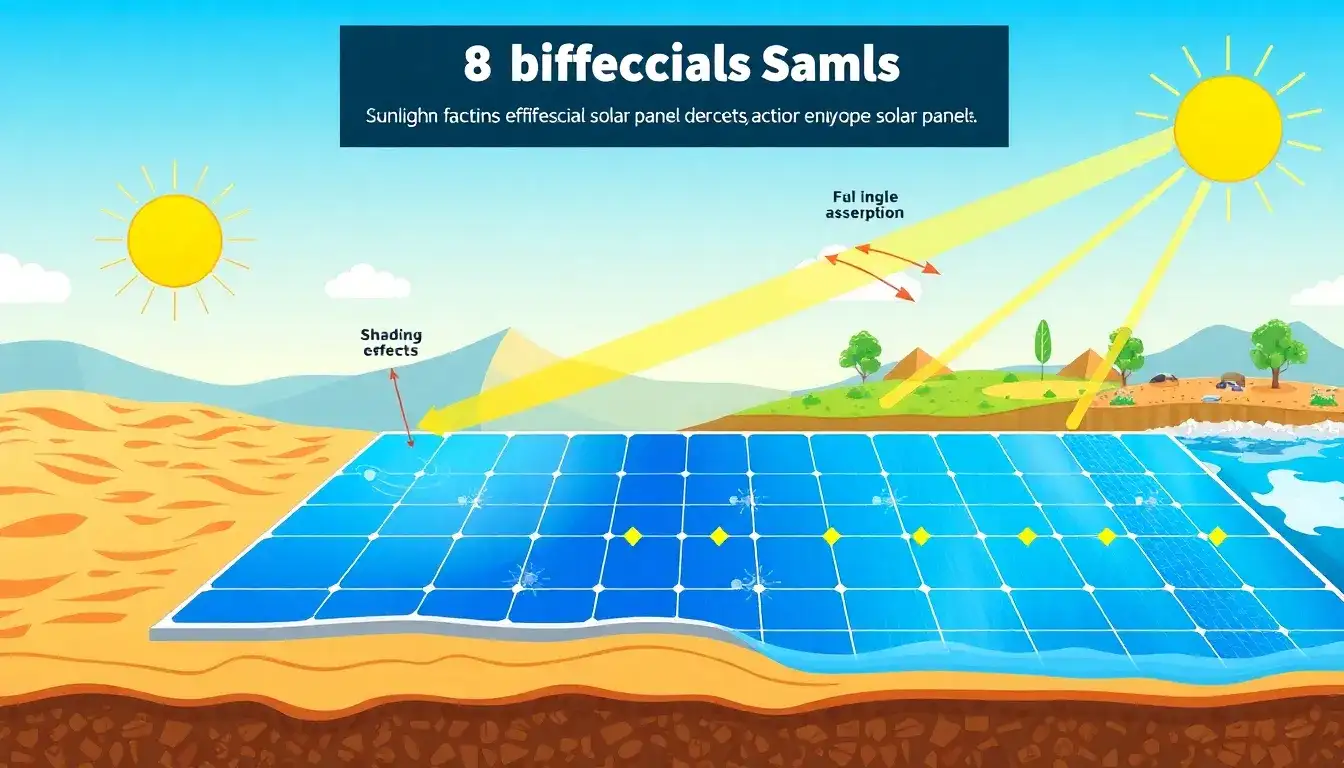
The main factors influencing the efficiency of bifacial solar panels include:
1. Tilt Angle and Installation Orientation
The angle and orientation at which bifacial panels are installed are critical. An optimal tilt increases the rear side’s exposure to reflected sunlight from the ground or nearby surfaces, thus enhancing overall energy capture and efficiency. Adjusting the tilt angle to align with the sun’s seasonal position further maximizes energy yield.
2. Ground Surface Reflectivity (Albedo)
The reflectivity of the surface beneath the panels strongly affects how much light the rear side can capture. Light-colored or reflective surfaces (e.g., sand, white gravel) reflect more sunlight onto the rear side compared to darker surfaces like asphalt or soil, which absorb more light and reduce efficiency gains.
3. Bifaciality Rate of the Solar Cells
This refers to the ratio of the rear-side efficiency to the front-side efficiency of the solar cells. Different cell technologies have bifaciality rates typically ranging from 70% to 95%. A high bifaciality rate means the rear side performs closer to the front side, resulting in higher overall panel efficiency.
4. Panel Design and Materials
Bifacial panels often use double-glass construction to enhance durability and allow light to pass through to the rear cells. They also feature minimal framing and transparent back sheets to reduce shading on the rear side. The mounting system is designed to minimize shading and maximize light capture on both sides.
5. Environmental Conditions and Installation Context
Bifacial panels perform better in diffuse and reflected light conditions, extending their operational hours in low-light scenarios. Usage of solar trackers that follow the sun’s movement can increase energy gains significantly, sometimes boosting energy yield by up to 27% over fixed installations.
Summary Table: Main Factors Affecting Bifacial Solar Panel Efficiency
| Factor | Impact on Efficiency |
|---|---|
| Tilt Angle & Orientation | Maximizes sunlight capture on both sides |
| Ground Reflectivity (Albedo) | Higher reflectivity means more rear-side energy gain |
| Bifaciality Rate | Higher rates improve rear-side efficiency |
| Panel Design & Materials | Enhances light transmission and durability |
| Environmental Conditions | Low-light and tracker use improve overall output |
Understanding and optimizing these factors can significantly improve the performance and energy output of bifacial solar panels compared to traditional monofacial panels.
Original article by NenPower, If reposted, please credit the source: https://nenpower.com/blog/what-are-the-main-factors-influencing-the-efficiency-of-bifacial-solar-panels/

