

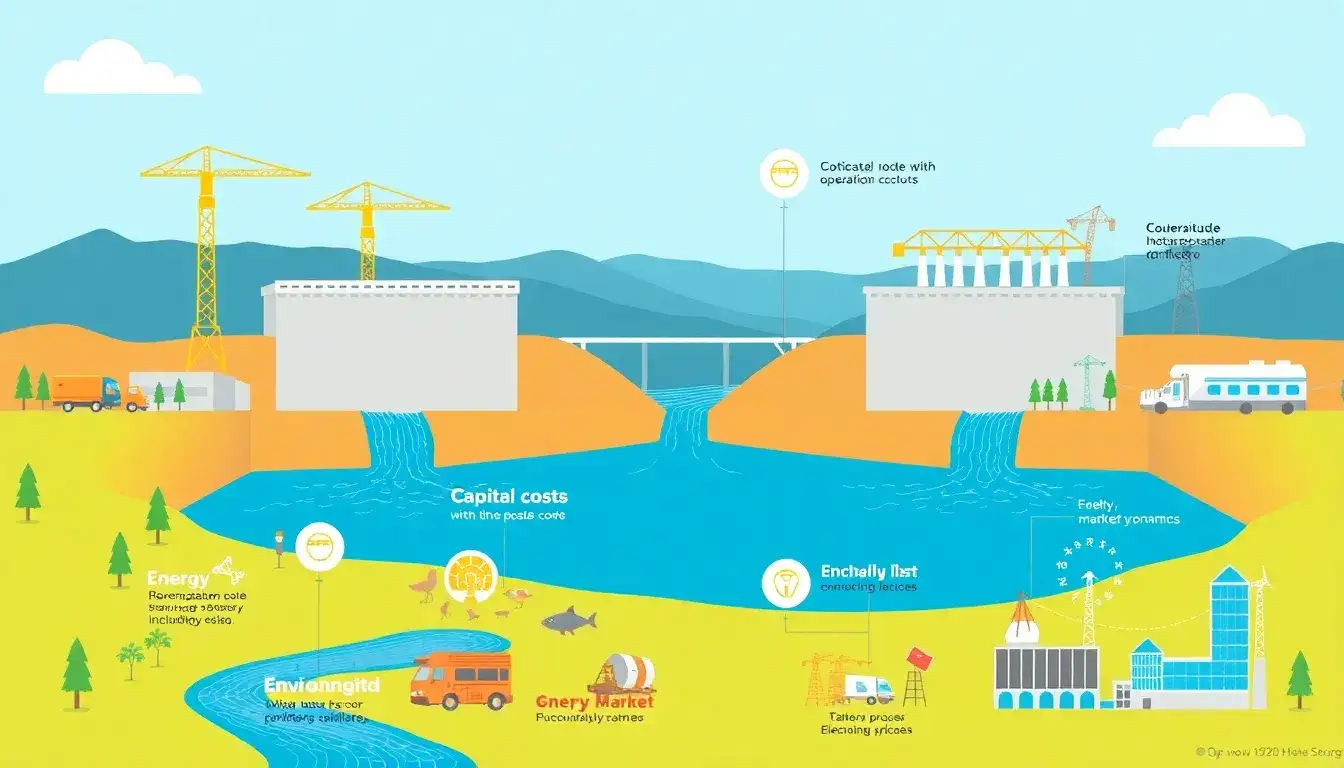
The main factors influencing the cost of pumped hydroelectric energy storage (PHES) include:
1. Site-Specific Characteristics
- Geography and terrain affect construction complexity and costs, including reservoir and dam design.
- Storage head (vertical distance water moves) significantly influences costs; higher heads can reduce tunnel length and construction costs but also require more robust engineering.
- Geology of the location impacts excavation and tunneling expenses.
2. Project Scale and Capacity
- Larger power capacity projects benefit from economies of scale, with system costs per kW decreasing as capacity increases. A 10x power increase can reduce costs by roughly 16-35%, depending on assumptions.
- Typical projects discussed range around 100 to 1,000 MW, with cost scaling factored accordingly.
3. Design Decisions
- Reservoir volume and the number of reservoirs (closed-loop with two new reservoirs vs. using an existing reservoir paired with a new off-river reservoir) influence both costs and environmental impact. Closed-loop systems tend to have lower environmental impacts but sometimes higher costs, while using existing reservoirs can reduce capital costs.
- Construction materials and methods, including drilling vertical shafts (borrowed from oil industry techniques) to house pump-turbines, can reduce excavation costs by about 33%.
4. Capital and Indirect Costs
- Capital costs represent a large portion of total cost and vary widely depending on project specifics. Estimates range from roughly $600/kW up to over $2,200/kW (adjusted for inflation), with a median around $615/kW.
- Indirect costs include contingencies and development expenses not directly related to construction but necessary for project completion.
5. Operation and Maintenance (O&M) and Efficiency
- O&M costs and round-trip efficiency influence the overall cost-effectiveness but are less variable than capital costs. For a 1,000 MW system, these parameters are generally estimated based on past DOE assessments.
Summary Table of Key Cost Influencing Factors
| Factor | Description | Impact on Cost |
|---|---|---|
| Geography & Terrain | Site topography, dam, and reservoir design | Can increase or decrease construction complexity and cost. |
| Storage Head | Height difference for water flow | Higher heads can reduce tunnel length but require advanced engineering. |
| Scale & Capacity | Project MW size | Larger scale reduces cost per kW substantially. |
| Reservoir Type | Closed-loop vs. existing reservoir use | Closed-loop less environmental but potentially higher cost. |
| Construction Methods | Use of modern drilling, materials | Can reduce excavation costs by ~33%. |
| Capital & Indirect Costs | Material, labor, equipment, contingencies | Capital cost varies widely; median ~$615/kW. |
| O&M & Efficiency | Operational expenses and system efficiency | Impact cost-effectiveness, less variable. |
These factors collectively determine the capital and overall costs of pumped hydroelectric energy storage projects, making each project’s feasibility highly dependent on site and design specifics.
Original article by NenPower, If reposted, please credit the source: https://nenpower.com/blog/what-are-the-main-factors-influencing-the-cost-of-pumped-hydroelectric-energy-storage/

