

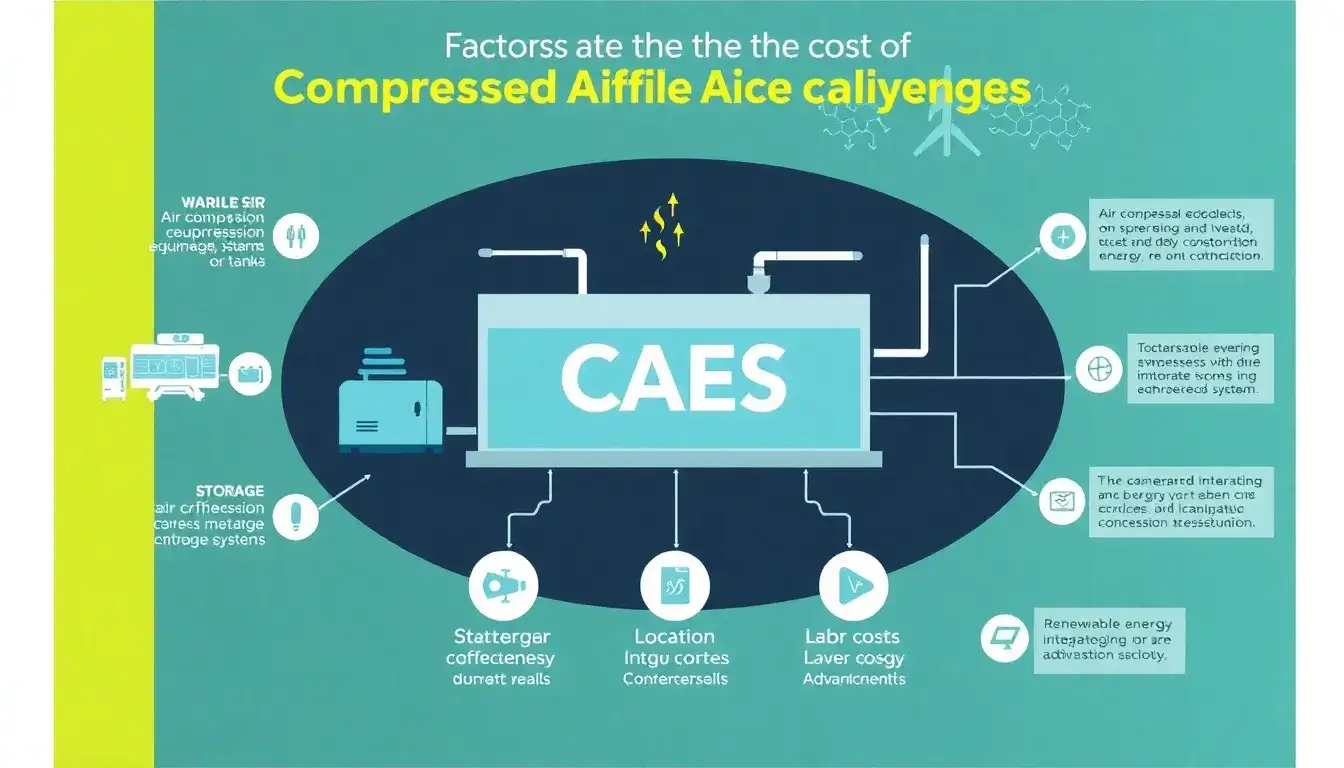
The cost of Compressed Air Energy Storage (CAES) systems is influenced by several key factors:
-
Capital Costs ($/kW):
- Major Equipment Costs: These include the cost of compressors, turbines, motor-generators, and recuperators.
- Civil Procurement and Construction: Costs associated with creating underground storage caverns or facilities.
- Indirect Costs: Engineering, procurement, and construction (EPC) fees, contingencies, and overheads can significantly impact overall costs.
-
Efficiency and Round-Trip Losses:
- CAES typically has a round-trip efficiency ranging from 55% to 80%, which affects overall cost-effectiveness. Lower efficiency means higher operational costs due to energy losses during storage and retrieval.
-
Location and Geological Factors:
- Availability of suitable geological formations (e.g., salt domes or caverns) is crucial for storing compressed air. This can limit deployment to specific regions.
-
Market and Economic Factors:
- Interest Rates (WACC): Higher Weighted Average Cost of Capital (WACC) increases the cost of CAES systems.
- Scalability and Economies of Scale: Larger projects can reduce costs per kWh due to economies of scale, but these benefits are more pronounced in regions like China where policies support large-scale deployments.
-
Maintenance and Operating Costs:
- CAES systems have higher maintenance costs compared to technologies like lithium-ion batteries due to the presence of moving parts. Operation and maintenance costs are generally around 1% or higher per year.
-
Energy Storage Duration:
- CAES is more cost-effective for long-duration storage (e.g., 24 hours), where costs can be as low as 30-40c/kWh for extended durations.
Original article by NenPower, If reposted, please credit the source: https://nenpower.com/blog/what-are-the-main-factors-influencing-the-cost-of-caes-systems/

