

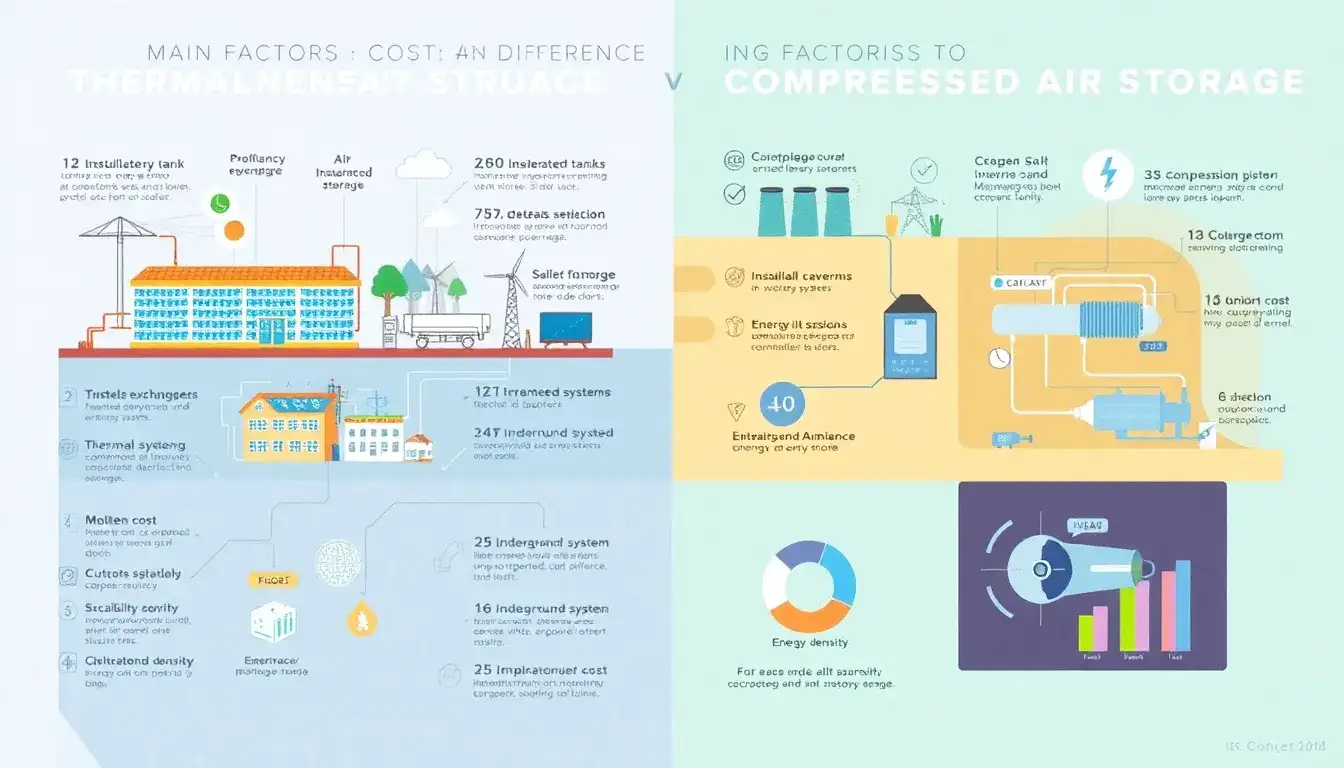
The main factors influencing the cost differences between thermal energy storage (TES) and compressed air energy storage (CAES) are:
Capital Expenditure (Capex) Differences
- Installed system capex: Thermal energy storage has a lower average installed system cost globally, at about $232/kWh, compared to compressed air storage’s $293/kWh. This difference in capex accounts for much of the cost gap between TES and CAES.
- Geographic cost variation: China’s significant adoption and development of large-scale projects have driven down costs for both technologies, but especially for CAES, where commercialization is more advanced due to favorable policies. Outside China, costs for both TES and CAES are higher, but the disparity is greater for CAES (68% higher outside China) compared to TES (54% higher outside China).
Technology Maturity and Commercialization
- Adoption scale and experience: TES technologies benefit from somewhat broader adoption and slightly longer commercialization phases than CAES in many markets, allowing for cost reductions through scale and learning.
- Complexity of technology: CAES generally requires more complex infrastructure, including air compression, storage (often underground caverns), and expansion equipment, which can increase capital and operational costs relative to TES systems, which often utilize simpler thermal storage media like molten salts or phase-change materials.
Efficiency and Operational Parameters
- Efficiency: CAES systems typically have lower round-trip efficiency (around 63%), which influences the economics by requiring more input energy per unit stored and retrieved. TES systems often have higher efficiencies, especially in well-optimized configurations, improving their cost-effectiveness.
- Duration and application: Both TES and CAES are favored for long-duration storage (8 hours or more), but TES can be tailored for specific applications (e.g., industrial heat storage or power generation), potentially allowing for lower system costs and better integration in some cases.
Supply Chain and Scale Effects
- Supply chain maturity: Lithium-ion battery technologies benefit from large EV and electronics markets driving down costs, while TES and CAES have more specialized supply chains which are still maturing. TES systems generally rely on established materials like molten salts, while CAES depends on specialized infrastructure which may limit rapid cost reduction.
- Scale of projects: Large-scale projects, especially in China, have helped reduce CAES costs through gigawatt-hour projects, but globally these projects remain less common relative to TES systems, affecting overall average costs.
Summary Table of Key Cost Factors
| Factor | Thermal Energy Storage (TES) | Compressed Air Energy Storage (CAES) |
|---|---|---|
| Average Global Capex (2024) | ~$232/kWh | ~$293/kWh |
| Efficiency | Generally higher than CAES | ~63% round-trip efficiency |
| Technology Complexity | Lower (thermal media and heat exchangers) | Higher (compression, storage caverns, expansion turbines) |
| Geographic Cost Influence | 54% higher outside China | 68% higher outside China |
| Commercial Maturity | More commercial projects globally | Advanced in China, less mature elsewhere |
| Supply Chain | Relies on established thermal materials | Specialized infrastructure and components |
In conclusion, the primary cost differences arise from the technical complexity and infrastructure requirements of CAES versus the relatively simpler and more mature TES systems, along with geographic market maturity, scale of deployment, and efficiency differences impacting overall economics.
Original article by NenPower, If reposted, please credit the source: https://nenpower.com/blog/what-are-the-main-factors-influencing-the-cost-differences-between-thermal-energy-storage-and-compressed-air-storage/

