

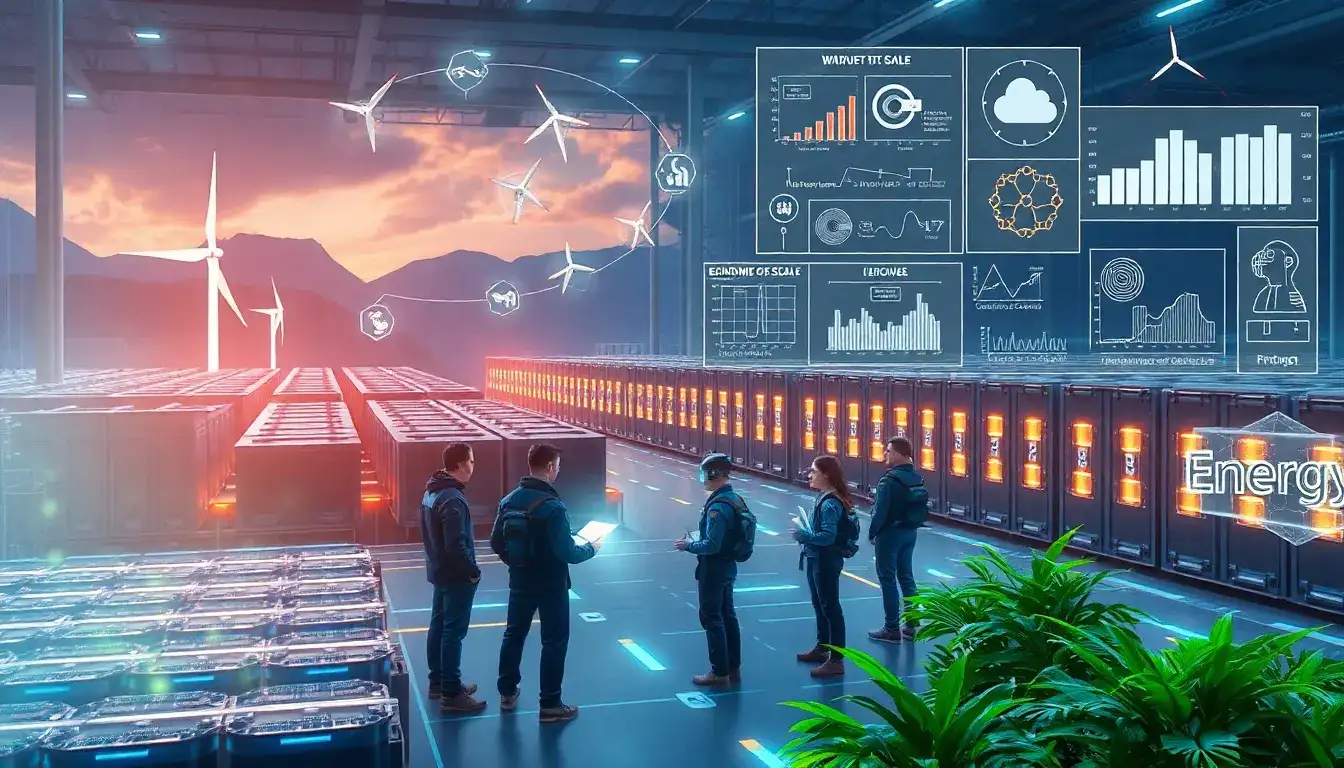
The main factors driving the decline in battery storage costs are multifaceted and stem from technological, manufacturing, market, and material dynamics:
1. Manufacturing Overcapacity and Economies of Scale
- There is currently significant overcapacity in battery cell manufacturing globally, with production capacity exceeding demand by over 2.5 times in 2024. This overcapacity forces manufacturers to reduce prices to sell their output, driving prices down.
- As production volume scales up, economies of scale reduce the per-unit cost of battery manufacturing. Larger production runs enable cost efficiencies in raw material procurement, labor, and processes.
2. Advances in Battery Chemistry and Technology
- Adoption of lower-cost battery chemistries, particularly lithium-iron-phosphate (LFP) batteries, which use less expensive and more abundant materials, has contributed to price declines.
- Ongoing research and development in battery materials and manufacturing processes, including silicon anodes, solid-state electrolytes, and new cathode materials, improve battery performance and reduce costs.
- Innovations such as dry electrode coating and next-generation cell manufacturing techniques further drive down production costs.
3. Lower Raw Material Prices and Improved Supply Chains
- Metal and component prices, including lithium, cobalt, and nickel, have seen periods of decline or stabilization, contributing directly to lower battery pack costs. However, raw material prices remain volatile and subject to geopolitical factors.
- Improvements in supply chain robustness and localization reduce logistics and procurement costs.
4. Market Competition and Diversification
- The rapidly growing and increasingly competitive battery market, particularly with strong capacity and competition in China, pressures manufacturers to lower prices.
- Slower growth in electric vehicle (EV) sales, the biggest demand driver for batteries, has led manufacturers to seek broader markets, such as stationary energy storage, intensifying competition and pricing pressure.
5. System-Level Improvements and Integration
- Advances in manufacturing and installation of battery energy storage systems (BESS), including inverters and balance of system components, contribute to overall cost reductions, though the majority of cost declines come from the battery pack itself.
- Longer-duration storage systems benefit from cost behaviors that reduce energy storage costs per kilowatt-hour.
6. Policy and Regulatory Influence
- Though less emphasized, government incentives, subsidies, and regulations encouraging renewable energy integration and battery adoption help improve market conditions and encourage cost reductions indirectly.
Summary Table of Key Factors Driving Battery Storage Cost Decline
| Factor | Description |
|---|---|
| Manufacturing Overcapacity & Economies of Scale | Excess production capacity and larger manufacturing scale reduce per-unit costs |
| Battery Chemistry & Technology Innovations | Shift to cheaper chemistries (e.g., LFP), new materials, and advanced manufacturing techniques |
| Lower Raw Material Prices | Decreases in lithium, cobalt, nickel prices and better supply chain management |
| Market Competition & Diversification | Intense competition and diversification into stationary storage markets |
| System & Integration Improvements | Enhanced manufacturing and installation efficiency for energy storage systems |
| Policy and Regulatory Support | Incentives and regulations supporting renewable storage development |
In essence, the dramatic cost decline (approximately 89-90% over the last decade) in lithium-ion battery storage is driven by a combination of overcapacity, economies of scale, advances in battery technology and chemistry, raw material price trends, and a highly competitive global market landscape, particularly centered in China. These trends are expected to continue, albeit at a moderated pace, with ongoing innovation and manufacturing improvements playing a key role in future cost reductions.
Original article by NenPower, If reposted, please credit the source: https://nenpower.com/blog/what-are-the-main-factors-driving-the-decline-in-battery-storage-costs/

