

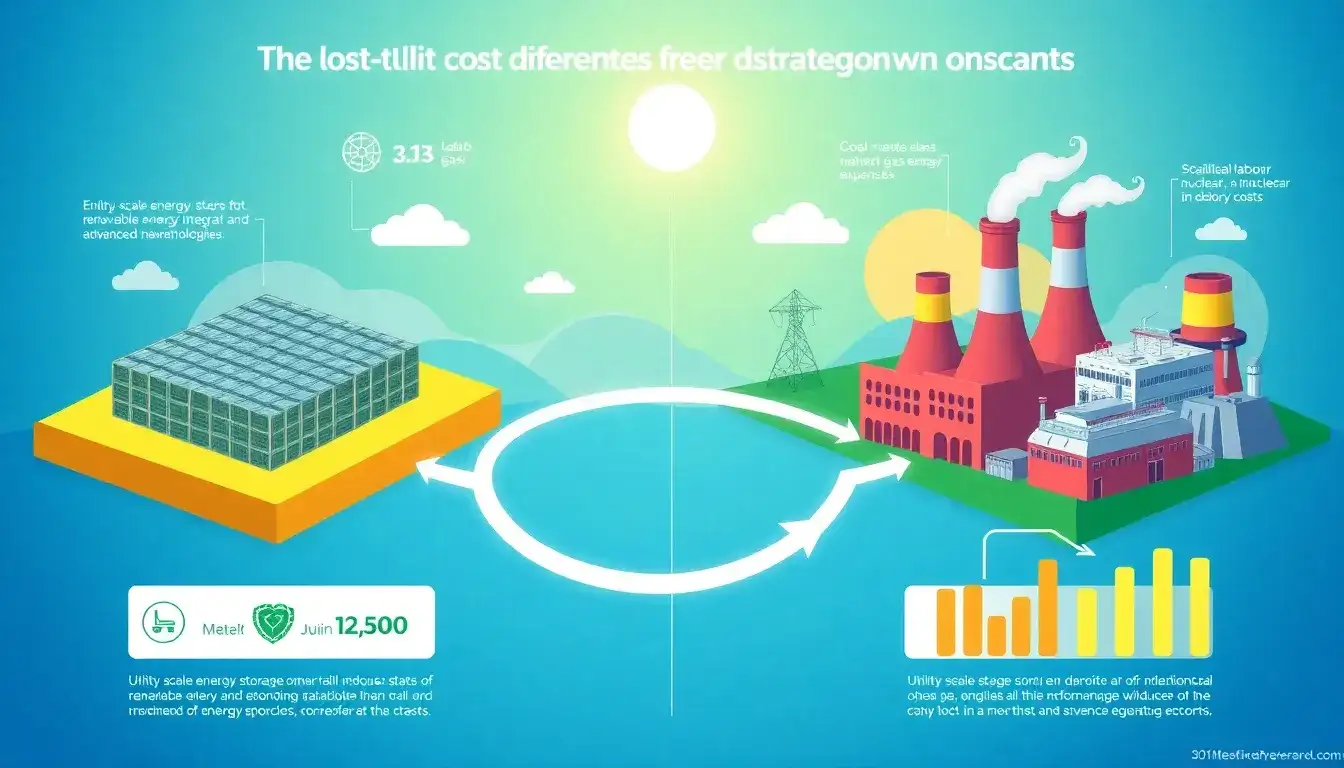
Utility-Scale Energy Storage Cost Drivers
- Battery Pack Costs: The core component is often lithium-ion battery (LIB) packs, whose costs vary based on capacity and duration. For example, LIB costs typically range from $100 to $300 per kWh depending on scale and technology specifics.
- Power Conversion Systems (PCS): Essential for converting DC from batteries to AC for grid integration, the PCS (inverters, transformers) can add $50 to $150 per kW. For large systems (e.g., 50 MW), this is a multi-million dollar cost.
- Balance of System (BOS) Components: Includes battery management, cooling, wiring — these add roughly 20-30% to the overall battery storage system cost.
- Installation and Integration: Specialized labor, site preparation, and integration with grid infrastructure drive additional costs, ranging from $50 to $100 per kW for battery storage systems. Also, “soft costs” such as systems integration, controls, communication, EPC (engineering, procurement, and construction) and development expenses further increase total costs to roughly twice the base battery pack cost.
- Duration Impact on Costs: Increasing storage duration (2 to 10 hours) affects costs differently — capital costs per kWh tend to decrease with longer duration, but system costs per kW generally increase due to scaling of power components.
Traditional Power Plant Cost Drivers
Traditional power plants (coal, natural gas, nuclear, hydro) primarily incur costs based on construction of large generation assets including turbines, boilers, reactors, and associated infrastructure. These are capital-intensive and characterized by:
- Large upfront fixed costs tied to physical generation equipment.
- Fuel costs contributing to operational expense.
- Long lifetimes with economies of scale reducing levelized costs.
Why Costs Differ Between the Two
| Factor | Utility-Scale Energy Storage | Traditional Power Plants |
|---|---|---|
| Capital Cost Composition | Battery packs, PCS, BOS, installation, integration | Turbines, boilers/reactors, heat systems, infrastructure |
| Cost Drivers by Energy vs Power | Both energy capacity ($/kWh) and power capacity ($/kW) important; duration affects cost structure | Mostly power capacity ($/kW) focused; fuel affects O&M costs |
| System Complexity | High due to battery management, controls, grid integration, rapid cycling | Complex but more mature technology with established supply chains |
| Operational Costs | Lower fuel costs, but battery degradation and replacement costs | Fuel costs and maintenance significant over lifetime |
| Technology Maturity and Scale | Costs vary widely with technology maturity and scale; still rapidly evolving | Generally stable and mature cost structures |
Additional long-duration storage technologies like thermal or compressed air storage have higher installed capital costs than lithium-ion batteries but are advancing commercially in certain regions, affecting comparative economics.
In summary, utility-scale energy storage costs are driven by the initial high cost of battery packs, power electronics, auxiliary systems, and integration complexity, with costs sensitive to storage duration and scale. In contrast, traditional power plants are dominated by large capital investments in generation hardware and fuel costs. This fundamental difference in technology components and system design is the principal reason for the cost differences between utility-scale storage and traditional generation assets.
Original article by NenPower, If reposted, please credit the source: https://nenpower.com/blog/what-are-the-main-factors-driving-the-cost-differences-between-utility-scale-energy-storage-and-traditional-power-plants/

