

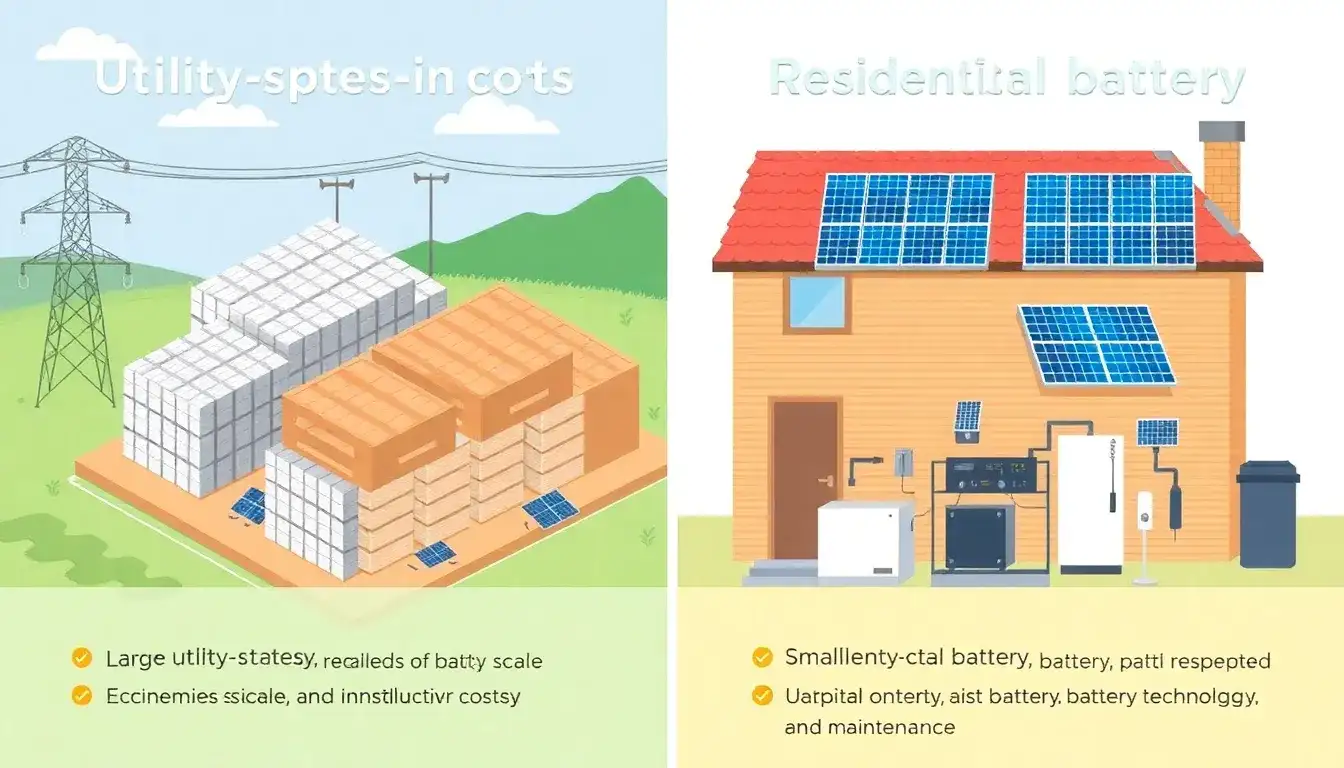
The cost components of utility-scale and residential battery storage systems differ significantly due to their scale and functionality. Here are the main differences:
Utility-Scale Battery Storage Systems
- Large Initial Investment: Utility-scale systems require substantial upfront costs because they store vast amounts of energy, often in the range of megawatt-hours (MWh) to gigawatt-hours (GWh).
- Cost Per kWh: Utility-scale systems generally have lower costs per kWh. For example, projections suggest costs around $245/kWh to $403/kWh in 2030.
- Economies of Scale: The larger size allows for better economies of scale, reducing costs per unit of power capacity.
- Complexity and Maintenance: Despite higher initial costs, utility-scale systems can offer significant long-term savings through optimized efficiency and reduced maintenance costs per kWh.
Residential Battery Storage Systems
- Smaller Capacity and Higher Cost per kWh: Residential systems have smaller capacities, typically a few kWh, with higher costs per kWh. For instance, battery pack costs are around $283/kWh for residential systems.
- Component Costs: Residential systems include costs for components like battery packs, inverters, and installation labor, with profit margins and supply chain costs added.
- Energy Independence and Savings: Although the initial cost is high, residential systems provide homeowners with energy independence and potential savings on utility bills.
Key Differences
- Scale and Cost Efficiency: Utility-scale systems benefit from economies of scale, reducing costs per kWh, while residential systems are more expensive per kWh.
- Functionality and Application: Utility-scale systems support grid stability and backup power for critical infrastructure, whereas residential systems focus on individual energy independence and bill savings.
- Maintenance and Operations: Utility-scale systems often have more complex maintenance but can achieve better efficiency and lower maintenance costs per unit over time.
Original article by NenPower, If reposted, please credit the source: https://nenpower.com/blog/what-are-the-main-differences-in-the-cost-components-between-utility-scale-and-residential-battery-storage-systems/

