

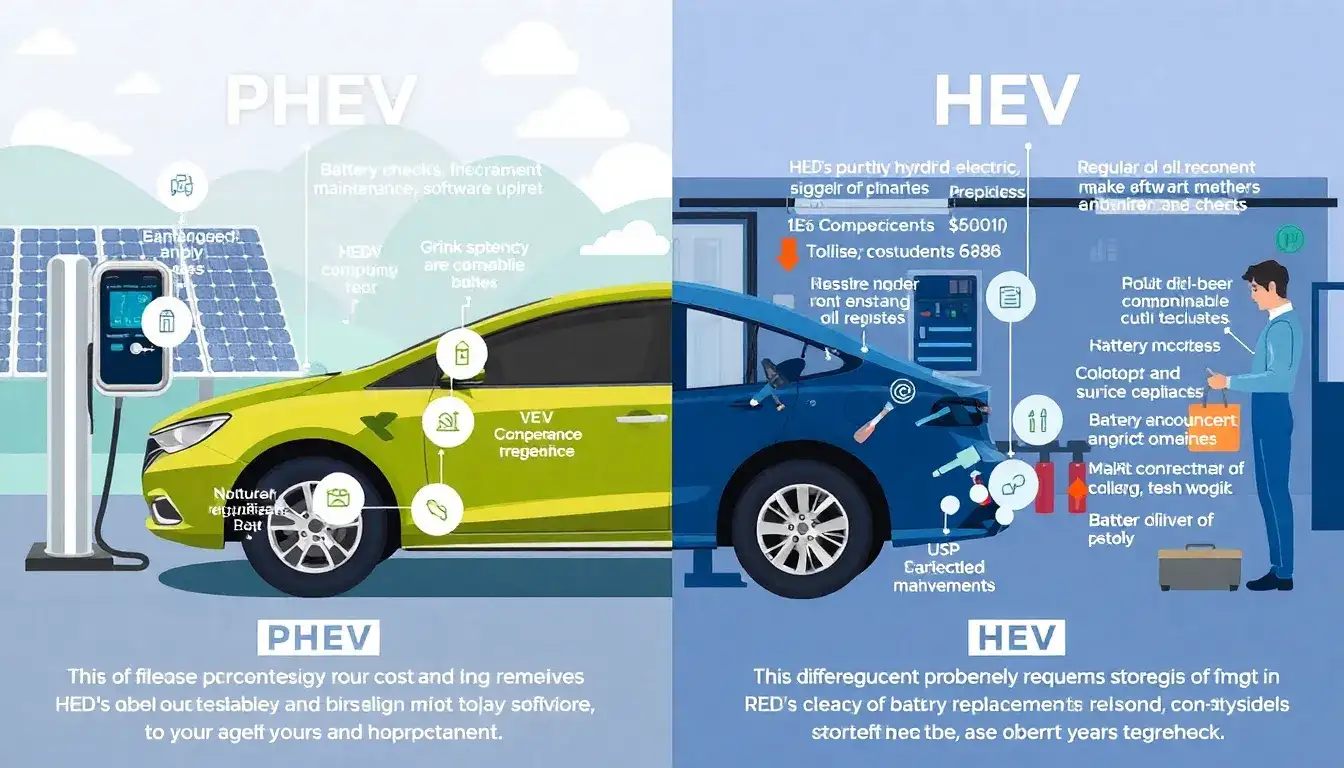
The primary differences in maintenance requirements between Plug-in Hybrid Electric Vehicles (PHEVs) and Hybrid Electric Vehicles (HEVs) stem from their battery size, charging methods, and the presence of internal combustion engines (ICEs) in both, but with some variations in complexity.
Common Maintenance Aspects for Both PHEVs and HEVs
- Both PHEVs and HEVs have internal combustion engines combined with electric drivetrains, so they require many of the same traditional maintenance tasks as conventional vehicles. This includes engine oil and filter changes, transmission fluid changes, and cooling system maintenance related to the ICE component.
- Both vehicle types benefit from regenerative braking, which reduces brake wear and extends the life of brake components compared to conventional vehicles, but brake pads, rotors, and brake fluid will still require periodic replacement.
- The electrical components such as the battery, electric motor, and electronics generally require minimal scheduled maintenance.
Key Differences in Maintenance Between PHEVs and HEVs
- Battery Size and Charging: PHEVs have larger batteries than HEVs because they support extended all-electric driving and can be recharged from external power sources via charging ports. This larger battery capacity means PHEV batteries may require more attention to cooling system maintenance (coolant checks and occasional flushes) to maintain battery health and efficiency.
- Battery Maintenance and Monitoring: Due to the larger and more complex battery in PHEVs, maintenance involves more frequent monitoring of battery health, state of charge, and management systems to optimize longevity. PHEVs may have additional software updates and cooling system inspections related to battery care.
- Charging Infrastructure Dependency: PHEVs require regular plug-in charging, so maintenance of the charging port, onboard charger, and associated electronics is necessary, whereas HEVs do not have external charging and rely mainly on regenerative braking and ICE for battery charging.
- Engine Usage and Wear: Since HEVs rely more on their combustion engine for propulsion and battery charging, their engine might experience different wear patterns compared to a PHEV, which can run more frequently in electric-only mode. This can affect the frequency and type of engine maintenance between the two, though routine ICE maintenance (oil changes, filters) remains essential for both.
Summary Table of Maintenance Differences Between PHEVs and HEVs
| Maintenance Aspect | PHEVs | HEVs |
|---|---|---|
| Battery Size | Larger battery for longer electric range | Smaller battery, primarily assists ICE |
| Battery Cooling Maintenance | Regular coolant checks and occasional flushes | Less intensive cooling system maintenance |
| Charging | Requires plug-in charging port maintenance | No external charging port |
| Engine Maintenance | ICE maintenance similar but may run less | ICE maintenance standard due to constant use |
| Brake Wear | Reduced due to regenerative braking | Reduced due to regenerative braking |
| Electrical System | More complex electrical system with charging | Simpler electrical system |
In conclusion, while PHEVs and HEVs share many conventional maintenance needs due to their internal combustion engines, PHEVs require additional maintenance related to their larger batteries, external charging systems, and enhanced battery cooling. Both still have significantly less maintenance complexity than traditional ICE vehicles but more than all-electric vehicles, which have no ICE components and fewer fluids to service.
Original article by NenPower, If reposted, please credit the source: https://nenpower.com/blog/what-are-the-main-differences-in-maintenance-requirements-between-phevs-and-hevs/

