

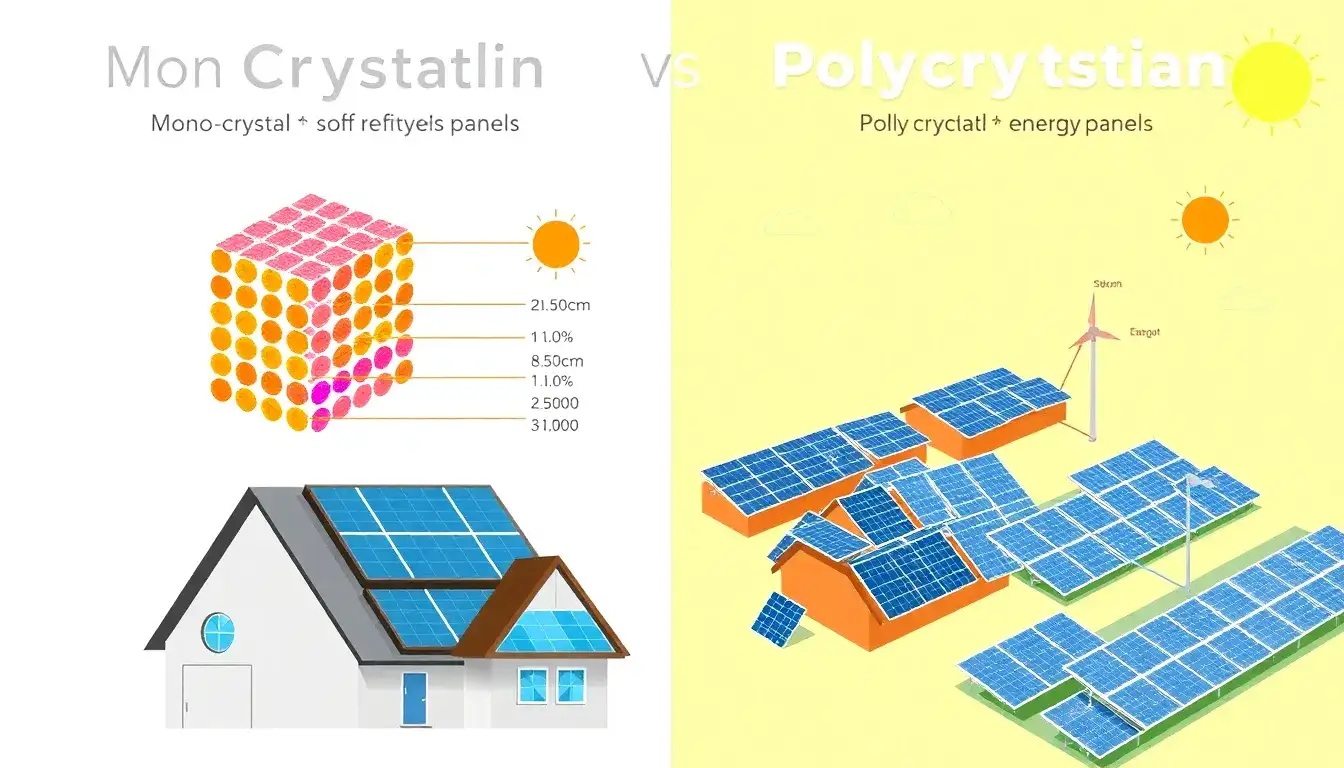
Monocrystalline and polycrystalline solar panels differ significantly in efficiency due to their silicon structures:
Efficiency Comparison
- Monocrystalline panels: Achieve 15-20% efficiency due to single-crystal silicon, allowing better electron movement and higher power output per square foot.
- Polycrystalline panels: Typically range from 13-16% efficiency, as fragmented silicon crystals reduce electron mobility.
Key Efficiency Factors
- Space efficiency: Monocrystalline requires fewer panels for equivalent output.
- Temperature coefficient: Monocrystalline loses -0.3% to -0.5% efficiency per °C rise, outperforming polycrystalline’s -0.3% to -1% loss.
- Low-light performance: Monocrystalline generates more power under dim conditions.
Performance Over Time
Monocrystalline panels degrade slower (0.3-0.8%/year) vs. polycrystalline (~1%/year), extending their functional lifespan.
| Feature | Monocrystalline | Polycrystalline |
|---|---|---|
| Efficiency | 15-20% | 13-16% |
| Cost per Watt | Higher | Lower |
| Lifespan | ~40 years | ~35 years |
| Aesthetics | Uniform black | Speckled blue |
Original article by NenPower, If reposted, please credit the source: https://nenpower.com/blog/what-are-the-main-differences-in-efficiency-between-monocrystalline-and-polycrystalline-solar-panels/

