

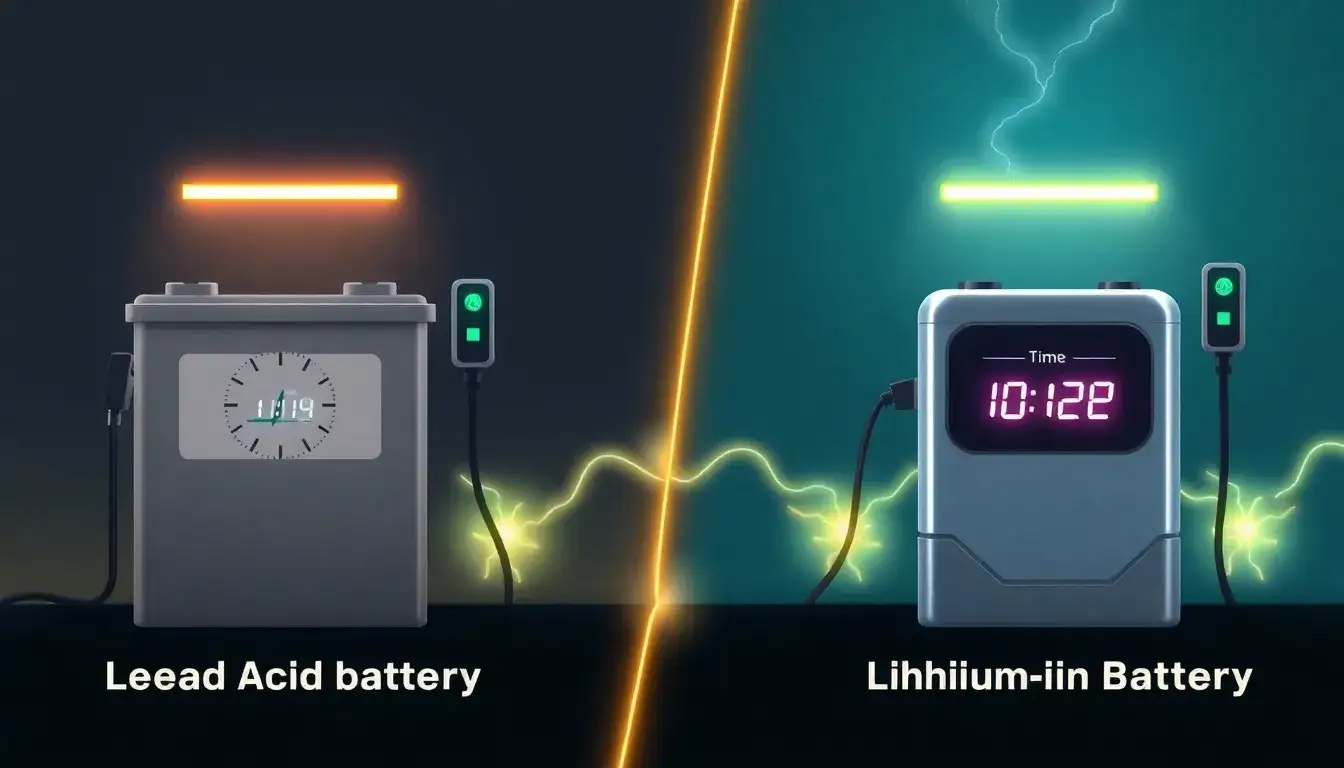
Charging Times: Lead-Acid vs. Lithium-Ion Batteries
Lead-Acid Batteries:
- Lead-acid batteries have lower energy density and slower charge acceptance rates.
- They generally require much longer charging times, often several hours to fully charge.
- Due to their slower charge acceptance, lead-acid batteries are not compatible with fast charging technology commonly used in modern EVs.
- They also suffer from reduced charging efficiency and greater degradation if charged too quickly.
- Typically used in older or low-performance electric vehicles and golf carts, not commonly found in contemporary passenger EVs.
Lithium-Ion Batteries:
- Lithium-ion batteries have a much higher energy density, allowing more energy storage in a smaller, lighter package.
- They accept charging at much faster rates, enabling rapid or fast charging that can add substantial range in 30 minutes or less.
- Modern lithium-ion EVs can typically charge from 10% to 80% in about 20 to 40 minutes using DC fast chargers with power levels from 50 kW up to 300 kW or more.
- For example, the 2023 Genesis Electrified GV70 with a 77.4 kWh lithium-ion battery can charge from 10% to 90% in just 24 minutes using fast charging, delivering a peak charging rate of 239 kW.
- Charging times vary with battery size and charger power but are generally much faster than lead-acid batteries. A typical 60 kWh lithium-ion battery EV can charge from empty to full in under 8 hours on a 7 kW home charger, with rapid chargers adding 100 miles of range in about 35 minutes.
Summary of Key Differences
| Feature | Lead-Acid Batteries | Lithium-Ion Batteries |
|---|---|---|
| Typical charging time | Several hours to many hours (slow charging) | 30 minutes to a few hours (fast charging) |
| Compatibility with fast charging | Poor compatibility, slow charging only | Fully compatible, supports high power fast charging |
| Energy density | Low | High |
| Battery size and weight | Larger and heavier for same capacity | Smaller and lighter |
| Usage in modern EVs | Rare, mostly obsolete | Standard in almost all modern EVs |
Therefore, lithium-ion battery EVs offer significantly faster and more practical charging times compared to lead-acid battery EVs, making them the preferred choice in contemporary electric vehicles.
Original article by NenPower, If reposted, please credit the source: https://nenpower.com/blog/what-are-the-main-differences-in-charging-times-between-electric-vehicles-with-lead-acid-batteries-and-those-with-lithium-ion-batteries/

