

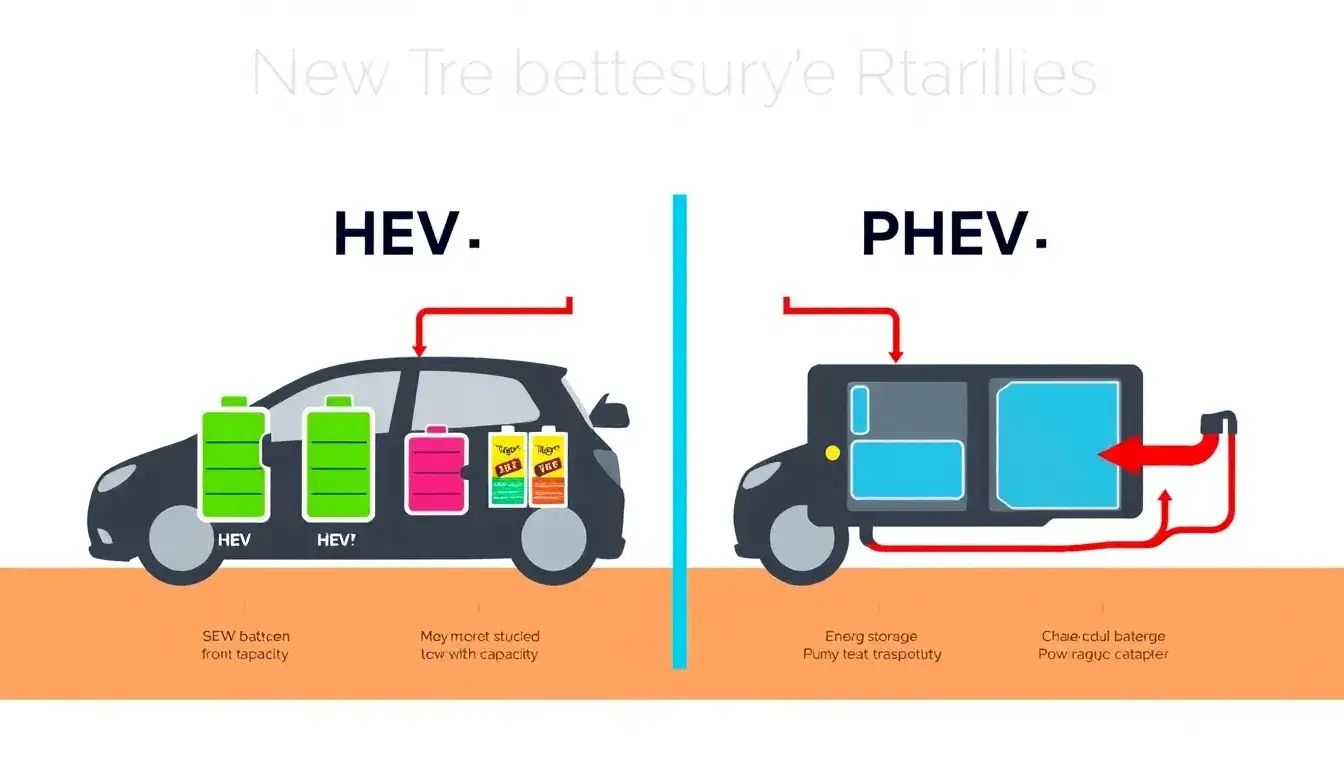
The main differences in battery sizes between Hybrid Electric Vehicles (HEVs) and Plug-in Hybrid Electric Vehicles (PHEVs) can be summarized as follows:
1. Battery Capacity
- HEVs: These vehicles typically have smaller battery capacities, ranging from about 0.9 to 2 kWh. They are designed to support the internal combustion engine by providing additional power during acceleration and recapturing energy during braking, but they cannot propel the vehicle solely on electric power for significant distances.
- PHEVs: These vehicles have larger battery capacities, often ranging from 7 kWh to over 18 kWh, depending on the model. They can run solely on electric power for longer distances before switching to hybrid mode once the battery is depleted.
2. Electric Range
- HEVs: Since they have smaller batteries, they cannot cover long distances on electric power alone. They are primarily gasoline-powered vehicles with electric support.
- PHEVs: Due to their larger batteries, they can cover notable distances using only electric power. The electric-only range can vary significantly, but it is generally in the range of 20 to over 40 miles for most models.
3. Purpose and Usage
- HEVs: The primary function of their batteries is to assist the gasoline engine in improving fuel efficiency and reducing emissions.
- PHEVs: The larger batteries allow for extended periods of electric-only driving, making them suitable for daily commutes that might be covered entirely on electric power.
In summary, PHEVs have significantly larger battery capacities than HEVs, enabling them to drive longer distances on electric power alone, which is not possible with HEVs.
Original article by NenPower, If reposted, please credit the source: https://nenpower.com/blog/what-are-the-main-differences-in-battery-sizes-between-hevs-and-phevs/

