

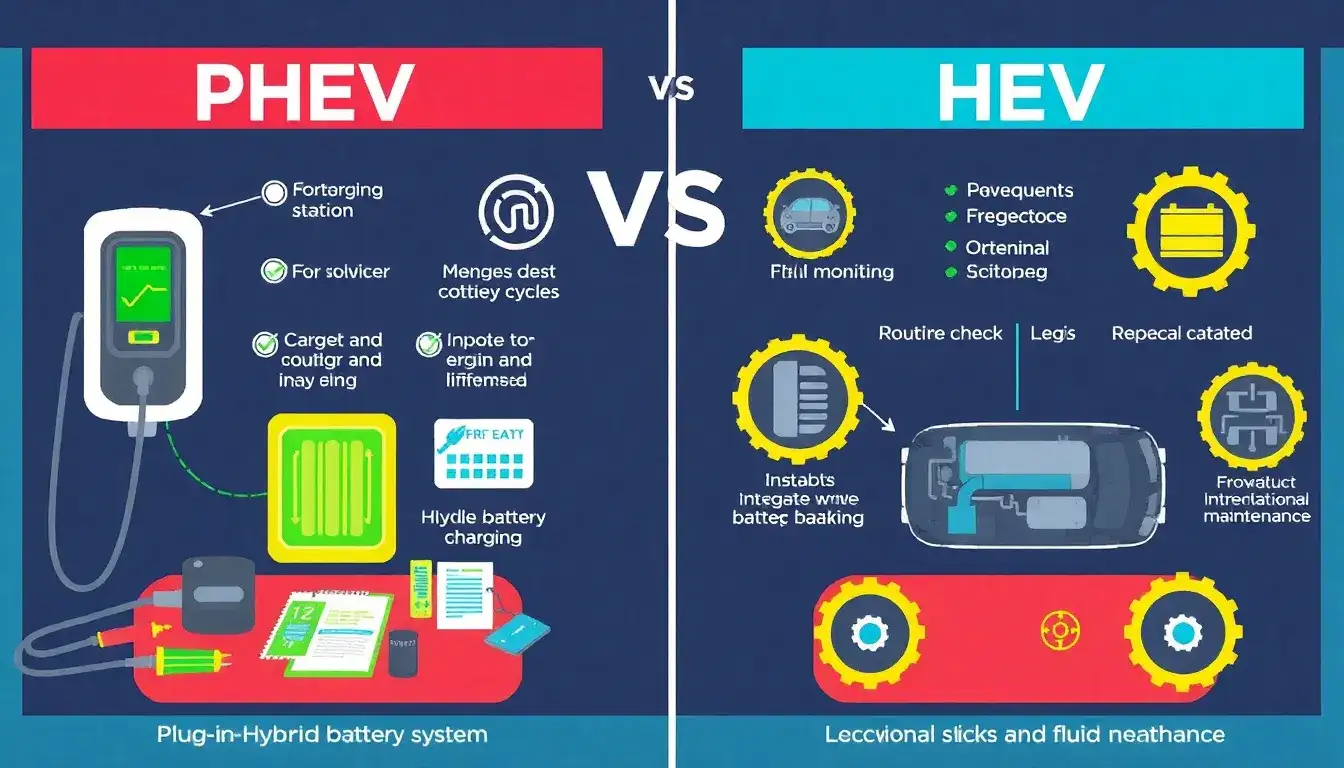
The main differences in battery maintenance between Plug-in Hybrid Electric Vehicles (PHEVs) and Hybrid Electric Vehicles (HEVs)
The main differences in battery maintenance between Plug-in Hybrid Electric Vehicles (PHEVs) and Hybrid Electric Vehicles (HEVs) stem primarily from their battery capacity, usage patterns, and charging.
Battery Capacity and Usage
- PHEV batteries are typically higher capacity than HEV batteries. They are designed to power the vehicle for longer all-electric driving ranges (usually 10 to 40 miles) before the gas engine kicks in, whereas HEV batteries are smaller and primarily assist the combustion engine rather than independently powering the vehicle for extended distances.
Charging Cycles and Battery Life
- PHEV batteries experience more frequent charging and discharging cycles than BEVs but fewer than HEVs. A PHEV battery might undergo approximately 4,000 to 8,000 cycles, while an HEV battery could endure 100,000 cycles or more due to its smaller capacity and frequent partial use through regenerative braking and engine assistance.
- HEVs limit their battery’s state-of-charge window to about 50% of capacity to prolong battery life, whereas PHEVs use a wider window (around 80%). This means PHEV batteries go through deeper charge/discharge cycles, requiring specific battery management to maintain longevity.
Maintenance Requirements
- Both PHEVs and HEVs require minimal scheduled maintenance for their electric battery systems, as these advanced batteries are designed for extended life but will eventually degrade. They also typically have liquid cooling systems to maintain safe operating temperatures, which may require periodic checks.
- PHEVs may require more attention to battery health monitoring due to higher battery capacity and deeper cycling compared to HEVs. Owners should follow manufacturer guidelines on charging habits and battery care to optimize battery lifespan.
- Both vehicles benefit from regenerative braking, which reduces brake wear compared to conventional vehicles, thus lowering brake maintenance demands.
Practical Maintenance Differences
- Since PHEVs have larger batteries that can be charged from external electrical sources, their maintenance involves not only monitoring battery health but also ensuring proper charging system function (e.g., charging port and onboard charger), which is less relevant for HEVs that charge batteries only via regenerative braking and the engine.
- HEVs have simpler battery charging maintenance since no external charging is involved, while PHEVs require care in managing charging cycles, possibly necessitating periodic software updates and checking coolant systems if liquid cooling is used.
Summary Table of Differences
| Aspect | PHEVs | HEVs |
|---|---|---|
| Battery capacity | Larger, supports 10-40 miles electric range | Smaller, assists combustion engine |
| Charge cycles | Fewer (~4,000–8,000 cycles) | Many more (~100,000 cycles) |
| Charging method | External charging + regenerative braking | Regenerative braking only |
| State-of-charge window | ~80% (deeper use) | ~50% (shallower use) |
| Battery cooling | Often liquid-cooled, requires checks | May also have cooling, requires checks |
| Maintenance focus | Battery health monitoring, charging system | Battery health and regenerative braking |
Overall, PHEV battery maintenance involves more attention to battery health due to deeper and external charging cycles, while HEV batteries have more frequent but shallower cycles relying solely on onboard charging and regenerative braking. Both require minimal battery maintenance compared to internal combustion engine components but have distinct needs related to their battery size and usage.
Original article by NenPower, If reposted, please credit the source: https://nenpower.com/blog/what-are-the-main-differences-in-battery-maintenance-between-phevs-and-hevs/

