

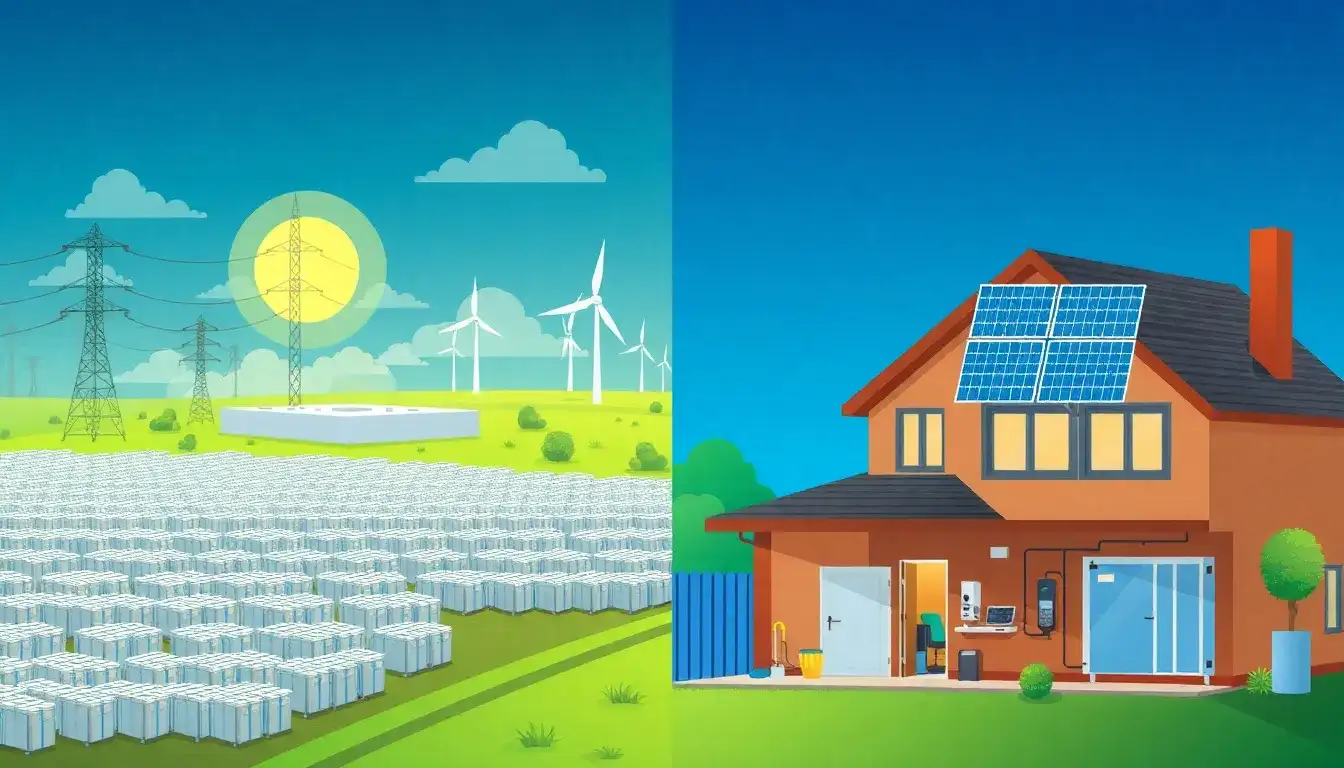
The main differences between utility-scale and residential battery storage lie in their size, capacity, purpose, and application within the power system:
Size and Capacity
- Utility-scale battery storage systems have very large capacities, typically ranging from several megawatt-hours (MWh) to hundreds of MWh. They are rated in megawatts of power output and hours of duration. For example, a utility-scale battery might have a capacity of 20 MW with 4 hours duration, equating to 80 MWh of stored energy.
- Residential battery storage systems are much smaller, typically rated in kilowatts of power and kilowatt-hours (kWh) of energy storage. Typical residential batteries provide around 5 kW of power and store between 10 to 15 kWh of usable energy, as seen in products like the Tesla Powerwall 2 and LG Chem RESU 10H.
Purpose and Functionality
- Utility-scale batteries serve the power grid directly, providing system-wide services such as frequency regulation, flexible ramping, black start capabilities, and deferring investments in new peaking plants or grid reinforcements. They increase power system flexibility and optimize renewable energy use by smoothing out supply fluctuations from large-scale solar and wind installations. They are often integrated with transmission and distribution networks or large-scale generation assets.
- Residential batteries primarily serve individual homeowners or businesses, storing solar power generated onsite for later use, providing backup power during outages, and reducing peak electricity demand from the grid. Their main function is to increase self-consumption of onsite solar generation and improve energy resilience at the local level.
Location and Integration
- Utility-scale systems are installed in centralized or distributed grid locations, such as substations or close to utility-generation capacity, and operate as grid assets supporting overall grid stability and renewable integration.
- Residential batteries are installed behind the meter at homes or small commercial properties, directly paired with onsite solar PV systems to manage local energy use.
Technology and Cost
- Both utility-scale and residential storage can use similar battery technologies, predominantly lithium-ion, but utility-scale may also use sodium sulfur or lead-acid in some cases. Utility-scale systems benefit from economies of scale, making them cost-effective for grid applications, while residential batteries have higher costs per unit capacity due to smaller scale and installation requirements.
| Feature | Utility-Scale Battery Storage | Residential Battery Storage |
|---|---|---|
| Capacity | Megawatt-hours (MWh) to hundreds of MWh | Kilowatt-hours (kWh), ~10-15 kWh |
| Power Rating | Megawatts (MW) | Kilowatts (kW), ~5 kW |
| Purpose | Grid services: frequency regulation, grid support, renewable integration | Onsite energy use, backup power, peak shaving |
| Installation Location | Grid-connected substations or alongside large generation assets | Behind the meter at homes or small businesses |
| Technology | Lithium-ion, sodium sulfur, lead acid | Mostly lithium-ion |
| Cost Efficiency | Economies of scale, cost-effective for utilities | Higher per kWh cost, smaller scale |
In summary, utility-scale battery storage is designed for large-scale grid support, measured in megawatts and megawatt-hours and integrated with the transmission/distribution network, while residential battery storage is smaller, measured in kilowatts and kilowatt-hours, and intended for individual energy management and backup purposes at the consumer level.
Original article by NenPower, If reposted, please credit the source: https://nenpower.com/blog/what-are-the-main-differences-between-utility-scale-and-residential-battery-storage/

