

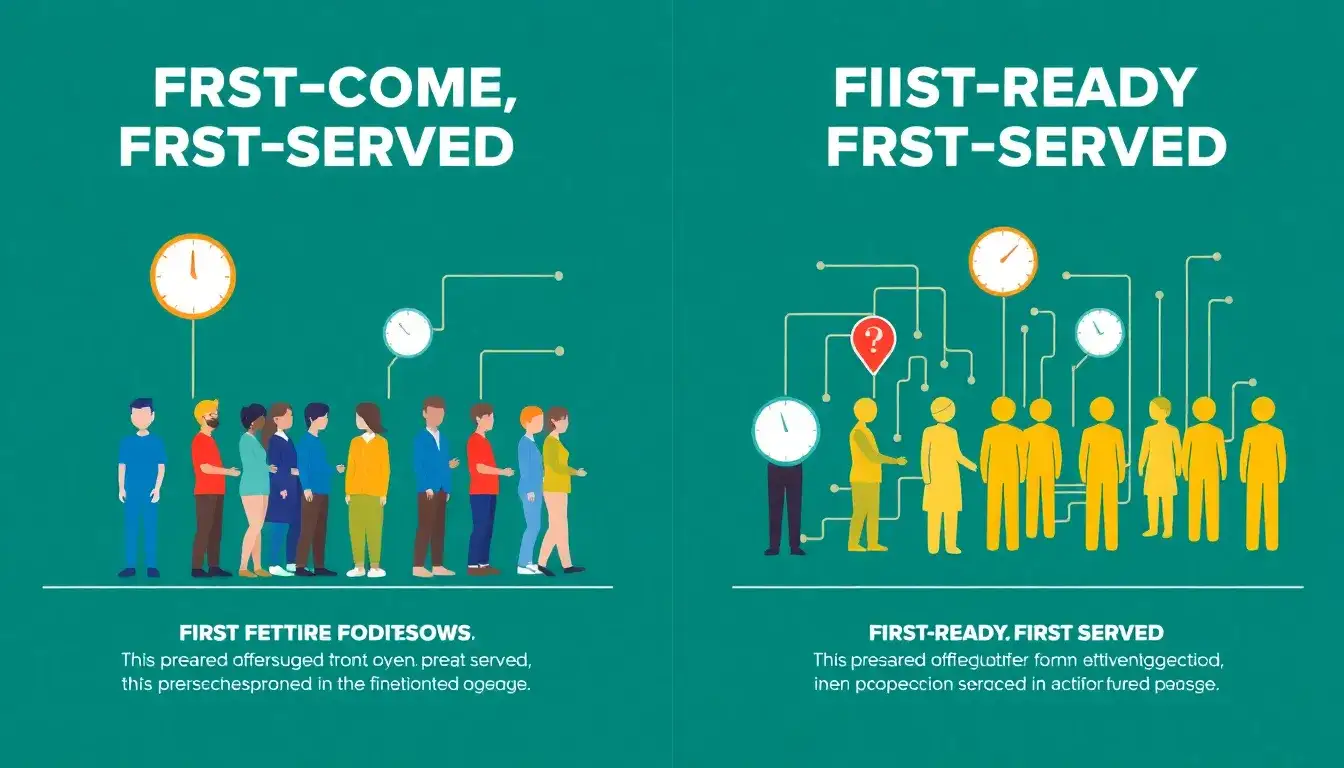
The main differences between the “first-come, first-served” (FCFS) and “first-ready, first-served” (FRFS) approaches in interconnection queues relate to how projects are prioritized, studied, and processed through the interconnection system:
First-Come, First-Served (FCFS)
- Prioritizes projects strictly by the order in which they enter the interconnection queue.
- Each project is studied separately and sequentially based on its queue position.
- This serial approach can cause significant delays, especially when early-queued projects are not viable or withdraw late, leading to restudy requirements and backlog congestion.
- May result in inefficient use of interconnection study resources and slower overall queue processing.
- Was commonly used by many transmission providers prior to recent reforms.
First-Ready, First-Served (FRFS)
- Prioritizes projects based on their readiness and financial commitments rather than simply queue arrival time.
- Uses a cluster study process grouping projects by location and time of queue entry to analyze them together instead of individually.
- Requires developers to demonstrate readiness with higher financial commitments like deposits and proof of site control to enter and proceed through the queue.
- Imposes penalties for withdrawing interconnection requests to discourage queue congestion by unprepared projects.
- Aims to speed up interconnection processing and reduce backlog by focusing on projects that are more prepared to move forward.
- Increases transparency by requiring transmission providers to publicly post interconnection information and use proportional cost allocation methods for upgrades and studies.
- Being implemented as part of FERC’s Order No. 2023 reforms to improve queue efficiency and help renewable development.
Summary Table
| Feature | First-Come, First-Served | First-Ready, First-Served |
|---|---|---|
| Priority basis | Order of entry into queue | Readiness and financial commitment |
| Study approach | Individual, serial project studies | Cluster studies grouping projects by location and queue entry time |
| Impact on queue processing | Can cause delays and restudy inefficiencies | Faster processing by focusing on ready projects |
| Developer requirements | Minimal readiness criteria | Higher deposits, site control, and penalties for withdrawal |
| Transparency and cost allocation | Varies, less standardized | Public info posting, proportional cost sharing |
In essence, the FRFS approach replaces a purely chronological queue with one that incentivizes and prioritizes project readiness and viability, allowing for more efficient interconnection processing and reducing delays caused by less-prepared project backlogs.
Original article by NenPower, If reposted, please credit the source: https://nenpower.com/blog/what-are-the-main-differences-between-the-first-come-first-served-and-first-ready-first-served-approaches-in-interconnection-queues/

