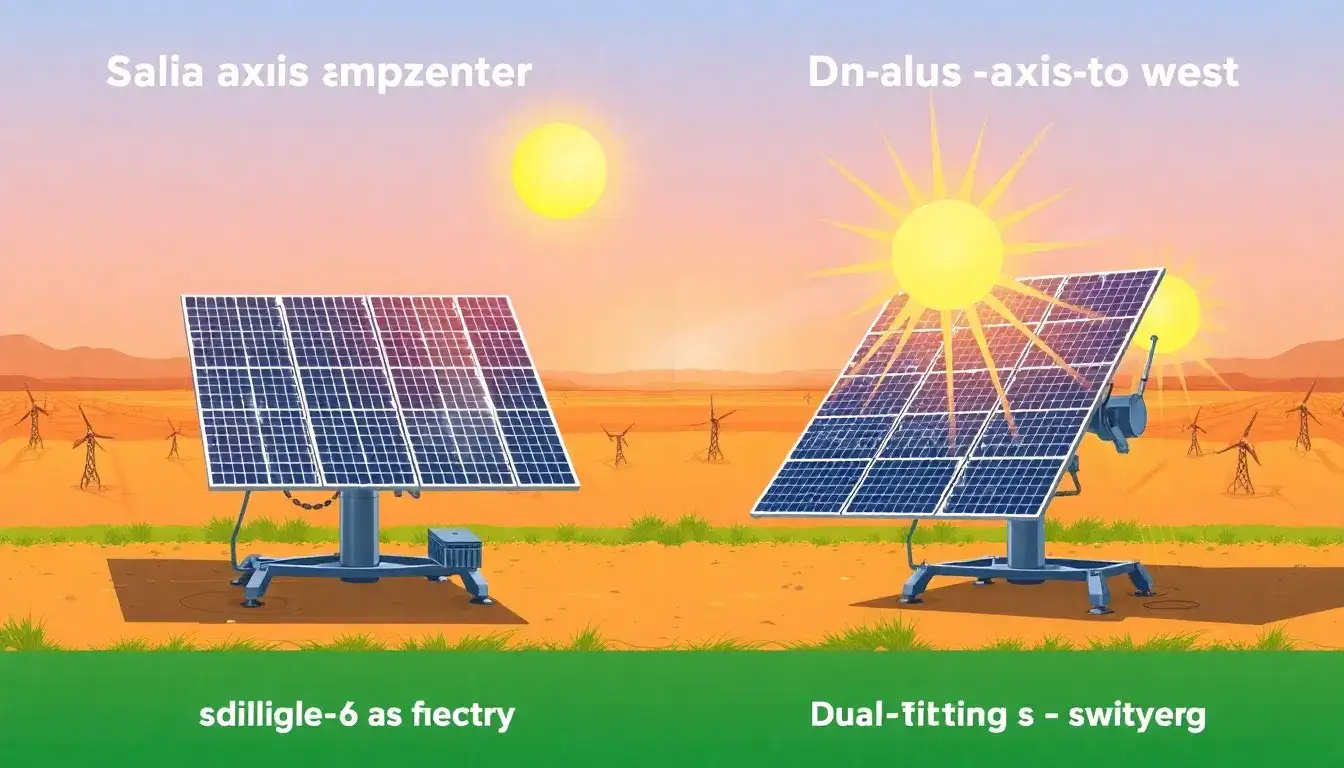
The main differences between single-axis and dual-axis solar trackers lie in their mechanisms, energy efficiency, complexity, cost, and suitability depending on location:
Tracking Mechanism
- Single-axis trackers rotate solar panels around one axis, usually horizontal, allowing them to follow the sun’s east-to-west movement across the sky during the day. Variants include horizontal single-axis, horizontal tilted, vertical single-axis, and vertical-tilted single-axis trackers that optimize for geographic latitude and seasonal changes to some extent.
- Dual-axis trackers have two degrees of freedom: they adjust both horizontally (east-west) and vertically (tilt). This enables them to follow the sun’s path across the sky throughout the day and adjust for seasonal changes in the sun’s altitude, keeping panels aligned more precisely to the sun’s rays.
Energy Efficiency and Production
- Single-axis trackers can boost solar energy generation by approximately 25% to 35% compared to fixed solar panels.
- Dual-axis trackers add an extra 5% to 10% energy gain on top of what single-axis trackers provide, resulting in the highest possible efficiency by maintaining near-optimal panel angles all day and year-round.
Complexity and Maintenance
- Single-axis systems are simpler mechanically, which generally leads to higher reliability, less maintenance, and fewer breakdowns over their typical 20+ year lifespan.
- Dual-axis trackers involve more complex motion controls and equipment, which results in increased system complexity, higher costs, and greater maintenance requirements. They also tend to have more downtime due to this complexity.
Cost Considerations
- Single-axis trackers are less expensive to purchase, install, and maintain, making them more cost-effective especially for large-scale projects where simplicity and reliability are valued.
- Dual-axis trackers are more costly upfront and operationally, justified mainly where maximum energy output is critical or in locations with highly variable sun angles.
Suitability by Geographic Location
- Single-axis trackers are well-suited for locations with relatively consistent sun paths and clear skies, such as near the equator or in desert regions with high sky clearness index.
- Dual-axis trackers are beneficial in areas where the sun’s angle varies significantly by season and time of day, allowing them to maximize solar capture even under varied conditions.
Summary Table of Differences
| Feature | Single-Axis Trackers | Dual-Axis Trackers |
|---|---|---|
| Axis of Rotation | One (usually horizontal) | Two (horizontal + vertical tilt) |
| Energy Gain vs. Fixed Panel | ~25% to 35% increase | ~30% to 45% increase (adds 5-10% over single-axis) |
| Complexity & Maintenance | Lower; simpler design | Higher; more complex and prone to downtime |
| Cost | Lower initial and maintenance cost | Higher initial and maintenance cost |
| Geographic Suitability | Best for consistent sun paths, clear skies | Best for locations with variable sun angles and seasonal changes |
| Reliability | Higher reliability, fewer mechanical issues | Lower reliability due to complexity |
In essence, single-axis trackers offer a cost-effective and reliable way to increase solar energy output with moderate complexity, while dual-axis trackers provide the highest efficiency and precision at the expense of higher costs and maintenance demands. The optimal choice depends on specific project goals, budget, and geographic conditions.
Original article by NenPower, If reposted, please credit the source: https://nenpower.com/blog/what-are-the-main-differences-between-single-axis-and-dual-axis-solar-trackers/