

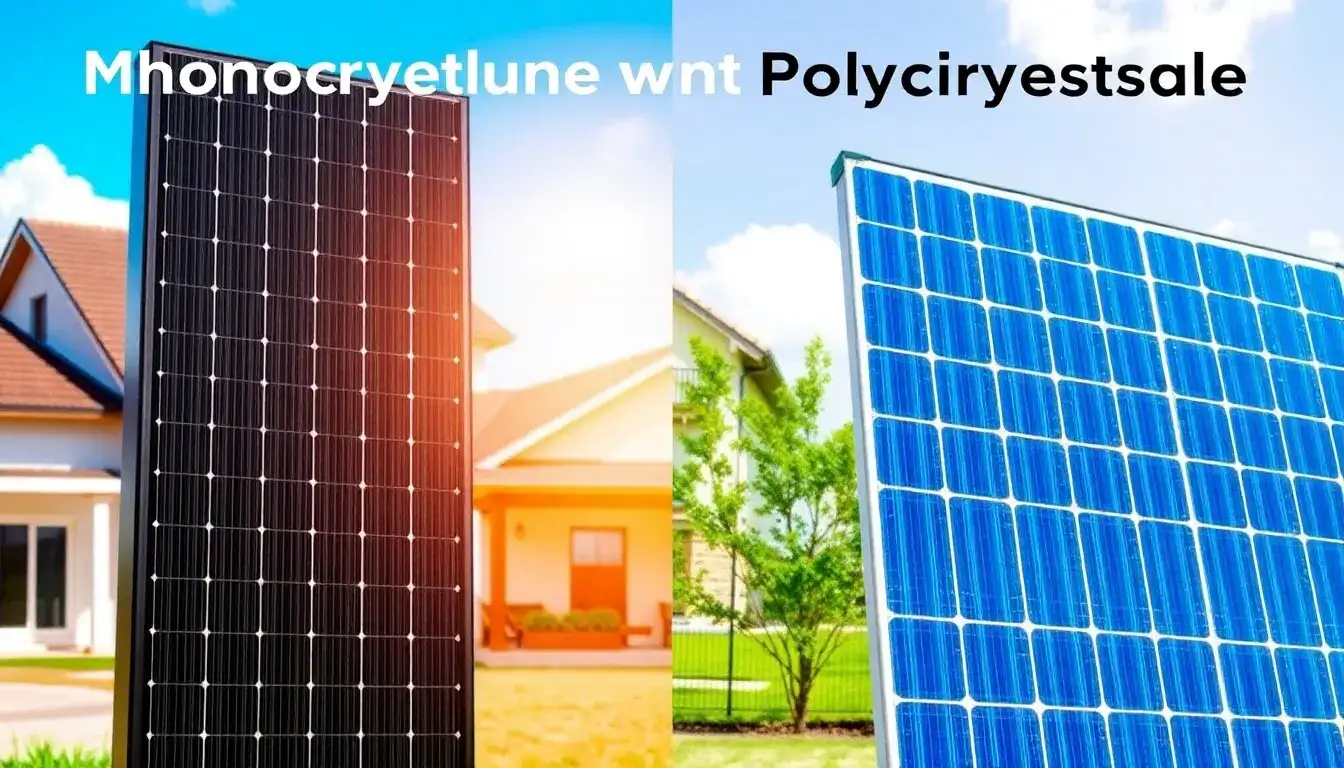
Differences Overview
Monocrystalline Solar Panels
- Efficiency and Effectiveness: Monocrystalline panels have the highest efficiency rates, typically ranging from 17% to 22%, because they are made from a single silicon crystal, allowing electrons to move freely and generate electricity more effectively.
- Appearance and Aesthetics: They have a uniform black color, making them more appealing and less noticeable on roofs.
- Cost: Generally more expensive due to the complex manufacturing process.
- Applications: Ideal for residential and commercial projects where space is limited, as fewer panels are needed to achieve the desired power output.
Polycrystalline Solar Panels
- Efficiency and Effectiveness: Less efficient, with an efficiency rate typically between 15% and 17%. They are made from multiple silicon crystals, which restricts electron flow and reduces their overall performance.
- Appearance and Aesthetics: Have a blue-ish, speckled appearance due to the multiple crystals used, which some find less visually appealing.
- Cost: More affordable compared to monocrystalline panels due to a simpler manufacturing process.
- Applications: Suitable for larger installations or where budget constraints are a concern, as they require more space to produce the same amount of electricity.
Key Comparison Table
| Feature | Monocrystalline Panels | Polycrystalline Panels |
|---|---|---|
| Efficiency | 17% to 22% | 15% to 17% |
| Cost | More expensive | Less expensive |
| Appearance | Uniform black color | Blue-ish, speckled appearance |
| Applications | Ideal for space-limited projects | Suitable for larger or budget-conscious installations |
| Lifespan | Up to 30 years | Up to 30 years |
Both types of panels have a long lifespan, typically up to 30 years, but monocrystalline panels are generally more effective and produce more power per unit area, while polycrystalline panels are more budget-friendly.
Original article by NenPower, If reposted, please credit the source: https://nenpower.com/blog/what-are-the-main-differences-between-monocrystalline-and-polycrystalline-solar-panels/

