

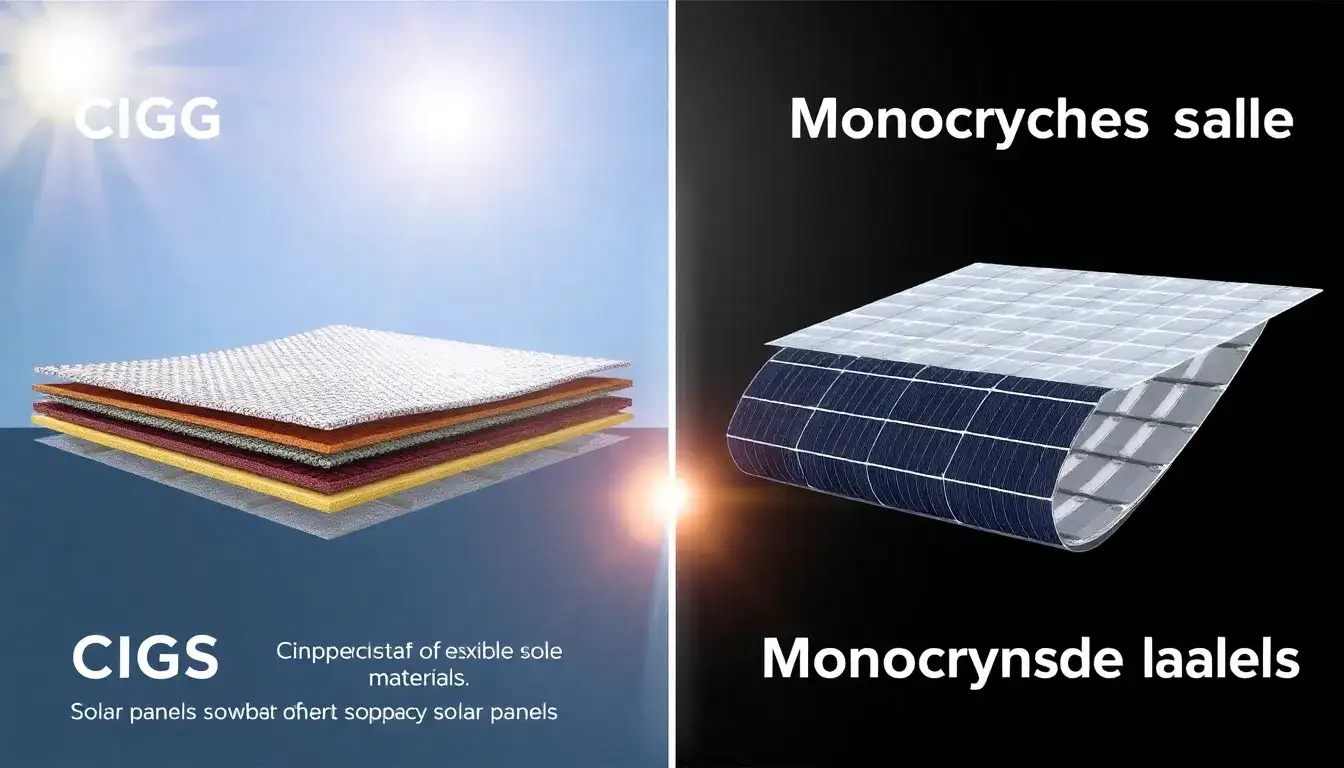
The main differences between CIGS and monocrystalline flexible solar panels revolve around efficiency, flexibility, durability, shading tolerance, temperature performance, weight, and cost-effectiveness.
Efficiency and Energy Yield
- Monocrystalline flexible panels generally offer higher efficiency, typically around 22.5% currently, with future improvements expected to reach about 24.5%. This high efficiency makes them more cost-effective for most users, maximizing power output in limited space.
- CIGS panels have a lower efficiency range, about 15-16%, but are still quite competitive among thin-film solar panels. Despite lower efficiency, they can generate about 10-15% more energy annually than monocrystalline panels of the same wattage due to better sunlight absorption across a broad spectrum.
Flexibility and Form Factor
- CIGS panels offer exceptional 360° flexibility and are extremely thin (only a few micrometers to nanometers thick), allowing for super slim, lightweight, and highly adaptable designs. This makes them ideal for curved or unconventional surfaces, offering maximum installation versatility.
- Flexible monocrystalline panels have significant flexibility too, generally around 248°, suitable for over 95% of installation scenarios. They are less flexible than CIGS but still highly adaptable and lightweight compared to rigid panels.
Durability and Environmental Resistance
- CIGS panels demonstrate outstanding durability: they resist microcracking, can withstand heavy impacts, pressure (e.g., a car driving over them), and harsh environments including hailstorms. They typically carry an IP68 waterproof rating, making them resilient in extreme outdoor conditions.
- Monocrystalline flexible panels are durable enough to endure heavy snow (5400 Pa) and wind loads (2400 Pa) but are more vulnerable to microcracks due to their delicate silicon wafers. They are reliable for most outdoor and off-grid uses but less robust than CIGS in extreme stress conditions.
Shading Tolerance and Performance in Low Light
- CIGS panels excel in shading tolerance because their interconnected cell design and integrated bypass diodes allow partial shading without significant power loss. They are also more effective in overcast or low-light conditions as they utilize a wider light spectrum.
- Monocrystalline panels lose more power under shading conditions (up to 60-80% energy loss from 10% shading). They perform best in direct sunlight.
Temperature Coefficient and Operating Temperature
- CIGS panels have better temperature performance, with only about 0.3% power decline per degree Celsius increase, helping them maintain output in hot conditions.
- Monocrystalline flexible panels experience a higher power loss of up to 0.6% per degree Celsius increase, which can reduce efficiency in hot environments.
Weight and Portability
- CIGS panels are lighter, about 4 pounds for typical 150W panels, due to thin film construction, enhancing portability.
- Monocrystalline flexible panels generally weigh around 6 pounds for a similar wattage, still light but heavier than CIGS.
Cost Considerations
- Monocrystalline panels are typically more cost-effective given their higher efficiency and widespread availability, fitting the needs of most users and projects.
- CIGS panels tend to be more expensive, partly due to their advanced materials and manufacturing complexity, and are preferred where flexibility, durability, and shading tolerance outweigh cost concerns.
Summary Comparison Table
| Feature | CIGS Solar Panels | Flexible Monocrystalline Solar Panels |
|---|---|---|
| Efficiency | ~15-16%, competitive energy yield due to spectrum absorption | ~22.5%, expected to reach ~24.5% efficiency |
| Flexibility | 360° super flexible, ultra-thin design | ~248° flexibility, strong but less than CIGS |
| Durability | Extremely durable, hail-resistant, IP68 rated | Durable, withstands heavy snow/wind, more prone to microcracks |
| Shading Tolerance | High, maintains output with partial shading | Lower, significant output loss with shading |
| Temperature Performance | ~0.3% power loss per °C rise | ~0.6% power loss per °C rise |
| Weight | Lighter (~4 lbs for 150W) | Slightly heavier (~6 lbs for 150W) |
| Cost | Higher price point | More cost-effective and widely used |
| Ideal Use Cases | Rugged, curved, shading-prone, harsh environments | General flexible installations, cost-sensitive projects |
In conclusion, choose flexible monocrystalline panels if you prioritize higher efficiency, cost-effectiveness, and standard flexible applications. Opt for CIGS panels if your project demands maximum flexibility, durability, excellent shading tolerance, and performance in harsh or irregular conditions despite a higher initial cost. Both technologies have valuable applications depending on specific installation and environmental needs.
Original article by NenPower, If reposted, please credit the source: https://nenpower.com/blog/what-are-the-main-differences-between-cigs-and-monocrystalline-flexible-solar-panels/

