

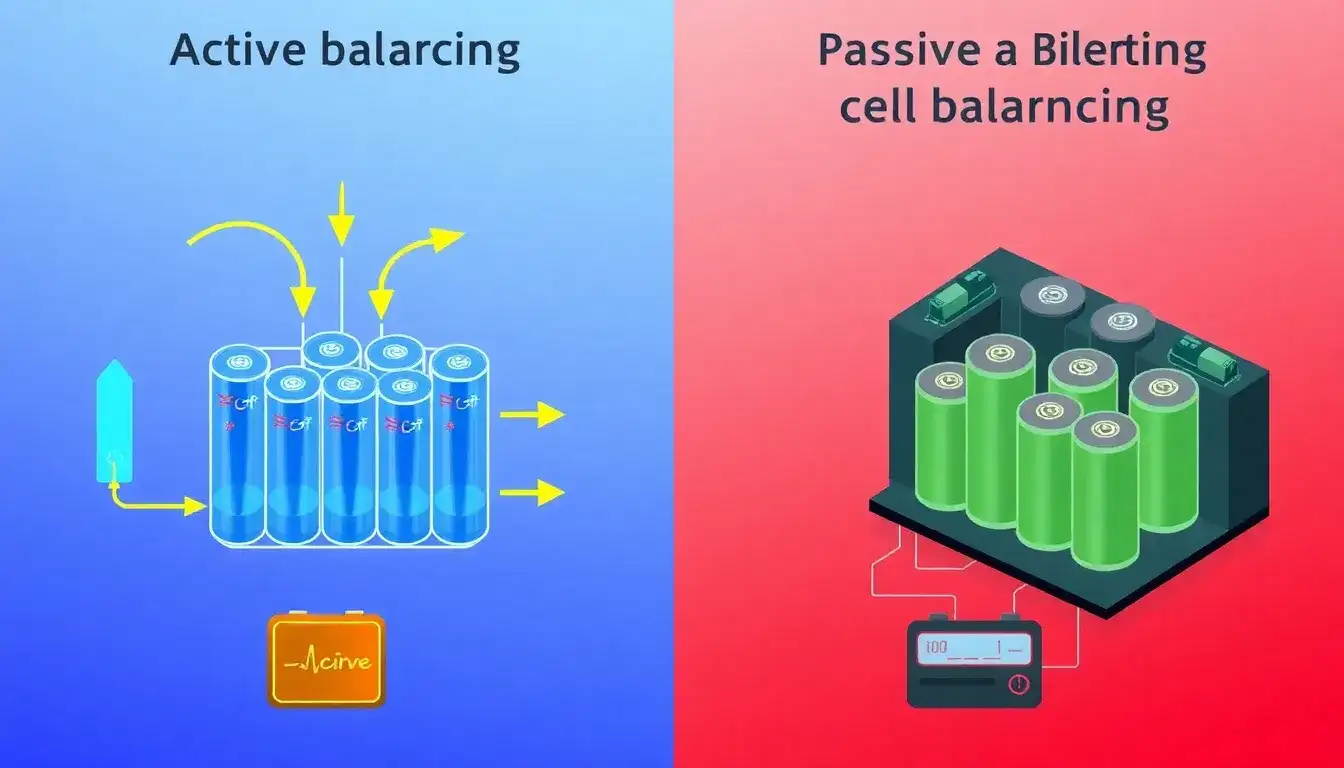
The main differences between active and passive cell balancing involve how charge is managed within a battery pack, including efficiency, speed, and functionality:
Key Differences
- Mechanism of Balancing
- Active Balancing: Actively redistributes charge between cells using techniques like inductive or capacitive charge shuttling to ensure all cells have the same state of charge (SoC). This method involves transferring energy from more charged cells to less charged ones, enhancing efficiency and runtime.
- Passive Balancing: Dissipates excess charge through a resistor, bringing cells to the same SoC by discharging the more charged cells until they match the least charged ones.
- Efficiency and Heat Generation
- Active Balancing: More efficient as it redistributes rather than dissipates energy, resulting in less heat generation.
- Passive Balancing: Less efficient as it releases energy as heat, which can lead to increased temperature and potential damage over time.
- Speed and Capacity
- Active Balancing: Generally faster and can handle higher currents (up to 6A), making it suitable for larger battery packs and fast-charging applications.
- Passive Balancing: Slower and typically limited to lower currents (around 0.25A), making it less suitable for high-capacity or rapid balancing needs.
- Operational Flexibility
- Active Balancing: Can balance cells both during charging and discharging, providing more flexibility and extending battery runtime.
- Passive Balancing: Typically only practical during charging cycles, as discharging could accelerate energy depletion.
Original article by NenPower, If reposted, please credit the source: https://nenpower.com/blog/what-are-the-main-differences-between-active-and-passive-cell-balancing/

