

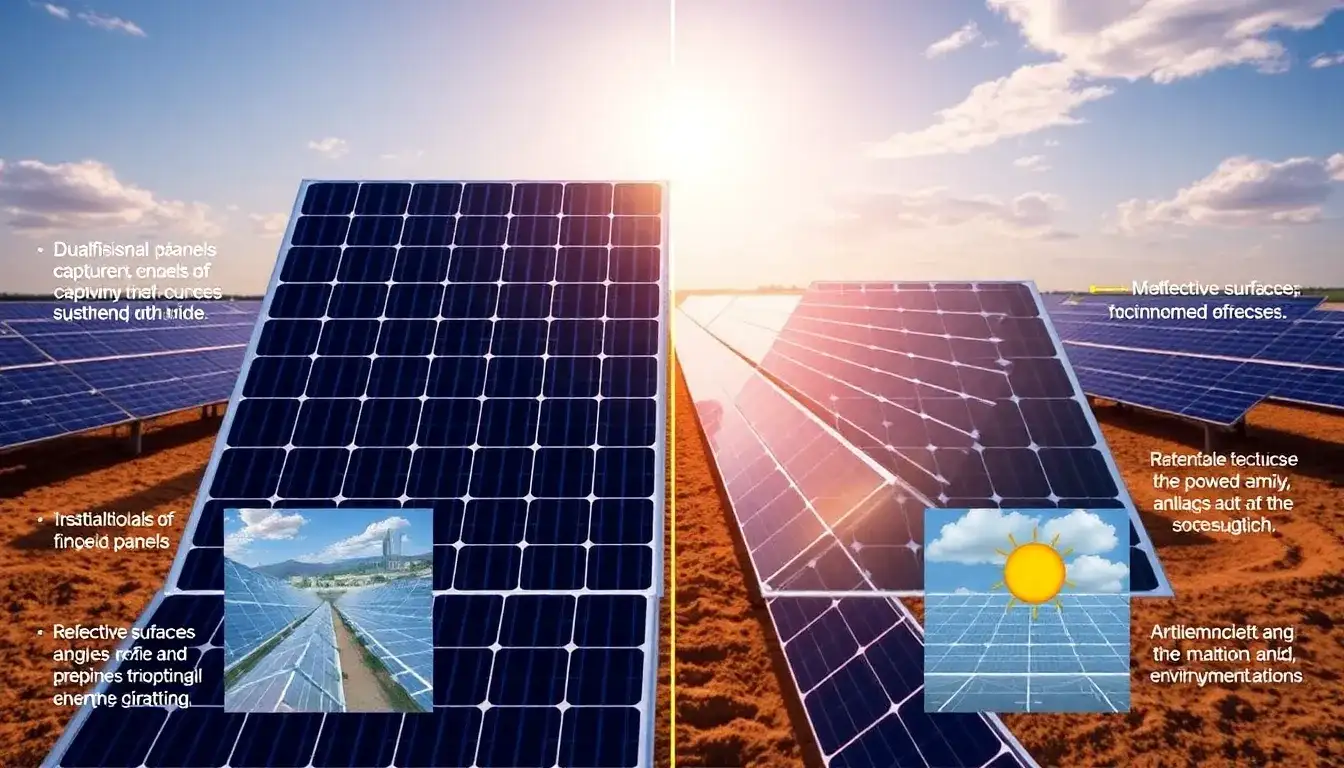
1. Accurate Energy Yield Predictions
Bifacial systems require complex modeling due to variable rear-side irradiation influenced by albedo (surface reflectivity), panel height, tilt, and site-specific conditions (e.g., latitude, diffuse light). Financial stakeholders demand precise simulations, but rear-side contributions remain difficult to forecast reliably, complicating LCOE optimization.
2. Installation and Site Optimization
- Height and spacing: Higher mounting (e.g., 1 meter) improves rear-side exposure but increases wind load risks and mounting costs.
- Albedo dependency: Performance relies on reflective surfaces (e.g., white concrete, snow). Dark or low-reflectivity surfaces (e.g., asphalt) reduce gains, sometimes rendering bifacial panels less effective than monofacial equivalents in suboptimal conditions.
- Site selection: Land cost and availability dictate layout. Expensive land may force flat layouts, reducing bifacial gains, while cheaper land allows optimal spacing.
3. Electrical and Thermal Management
- Inverter compatibility: Higher energy output risks overloading inverters designed for monofacial systems.
- Voltage imbalances: String inverters may struggle with uneven rear-side contributions, necessitating careful balancing.
- Thermal stress: Dual-sided exposure can increase operating temperatures, requiring enhanced cooling or spacing.
4. Reliability Concerns
- Potential-induced degradation (PID): High system voltages (up to 1500V) accelerate ion migration, degrading efficiency. Bifacial cells are particularly vulnerable due to double-glass construction and testing complexities.
- Durability: Glass/glass modules face mechanical stress from wind and thermal cycling, demanding robust mounting.
5. Maintenance and Monitoring
- Cleaning complexity: Both sides require maintenance, with automated systems often necessary for large arrays.
- Monitoring accuracy: Standard systems may fail to capture rear-side performance, necessitating specialized tools.
6. Financial and Regulatory Barriers
Higher upfront costs, coupled with uncertainty in long-term performance, deter investors. Lack of standardized testing and reliability data further complicates adoption.
7. Material and Design Trade-offs
The absence of a reflective backsheet in bifacial panels can reduce front-side efficiency in low-albedo environments, offsetting rear-side gains. Additionally, transparent backsheets or glass-glass designs introduce weight and fragility concerns.
These challenges necessitate tailored engineering solutions, from albedo-enhancing ground covers to PID-resistant materials, to unlock bifacial technology’s full potential.
Original article by NenPower, If reposted, please credit the source: https://nenpower.com/blog/what-are-the-main-design-challenges-specific-to-bifacial-solar-panels/

