

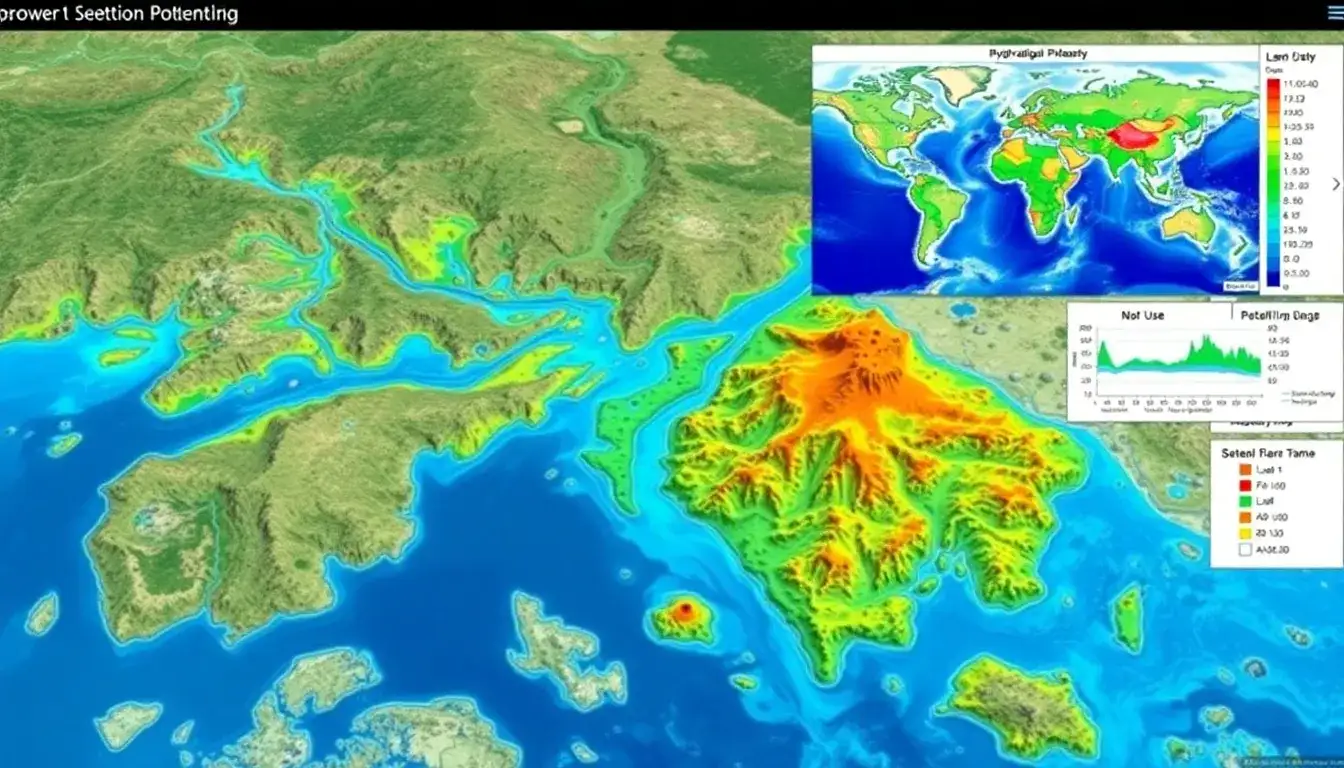
The main criteria used in GIS-based assessments for hydropower potential typically involve a combination of hydrological, topographical, environmental, and sometimes socio-economic factors. These criteria are applied through spatial analysis and multi-criteria evaluation within GIS environments to identify and prioritize suitable sites for hydropower development.
Key Criteria in GIS-Based Hydropower Potential Assessment
1. Hydrological Criteria
- Discharge (Flow Rate): A minimum long-term dependable discharge is required to ensure sufficient water availability. For example, sites with discharge ≥ 0.1 m³/s are often considered viable.
- In-stream Power: This reflects the power available from the stream flow, often with thresholds above 30 kW to identify feasible sites.
- Hydropower Production Potential: Based on the formula P = ρgQh, where ρ is water density, g is gravitational acceleration, Q is discharge, and h is the water head (height difference). This calculation integrates hydrological data with elevation data from digital elevation models (DEMs).
2. Topographical Criteria
- Head (Elevation Difference): The vertical drop along the stream section (head) must be sufficient, with common criteria being a minimum head of 5 meters or more for small to micro hydropower potential.
- Stream Gradient: Steeper gradients are more favorable for hydropower since they provide higher potential energy.
- Distance Between Sites: A minimum distance (e.g., 10 km) between consecutive hydropower sites is often maintained to avoid overlapping impacts and ensure spatial separation of developments.
3. Environmental and Spatial Suitability Criteria
- Environmental Restrictions: Areas with environmental sensitivities, such as critical habitats or protected zones, are often excluded or given lower priority.
- Land Use and Accessibility: Sites accessible for construction and operation are preferred. GIS layers for road networks, proximity to infrastructure, and land use patterns are incorporated.
- Stream Power and Flow Duration: Consideration of the temporal stability of flow, ensuring that hydropower sites can operate reliably throughout the year.
4. Multi-Criteria Decision Analysis (MCDA)
GIS-based assessments frequently employ MCDA techniques that integrate various spatial layers representing the above criteria. Fuzzy overlay and weighted overlays are common methods to combine and prioritize sites based on decision-makers’ preferences and constraints.
5. Socio-economic and Grid Integration Factors (in some studies)
For larger-scale assessments, factors like proximity to power grids, demand centers, community impacts, and economic viability can be included to rank potential hydropower sites further.
Summary Table of Main GIS-Based Hydropower Criteria
| Criterion | Typical Threshold / Consideration | Purpose |
|---|---|---|
| Discharge (Q) | ≥ 0.1 m³/s | Ensures sufficient water flow |
| Head (Height difference, h) | ≥ 5 m (micro to small-scale) | Provides necessary potential energy |
| In-stream Power | > 30 kW | Minimum power potential |
| Stream Gradient | Steepness favors potential | Enhances head and power generation |
| Distance Between Sites | ≥ 10 km | Spatial separation and operational feasibility |
| Environmental Restrictions | Exclude protected/sensitive areas | Minimize ecological impact |
| Accessibility & Infrastructure | Proximity to roads and grids | Cost and practical feasibility |
| Multi-criteria weighting | User-defined weights on criteria | Prioritization of sites |
In conclusion, GIS-based hydropower potential assessments rely mainly on hydrological parameters (discharge, head, stream power), topographical features (gradient, site spacing), environmental constraints, and multi-criteria decision analysis to identify and prioritize suitable hydropower sites efficiently and accurately.
Original article by NenPower, If reposted, please credit the source: https://nenpower.com/blog/what-are-the-main-criteria-used-in-gis-based-assessments-for-hydropower-potential/

