

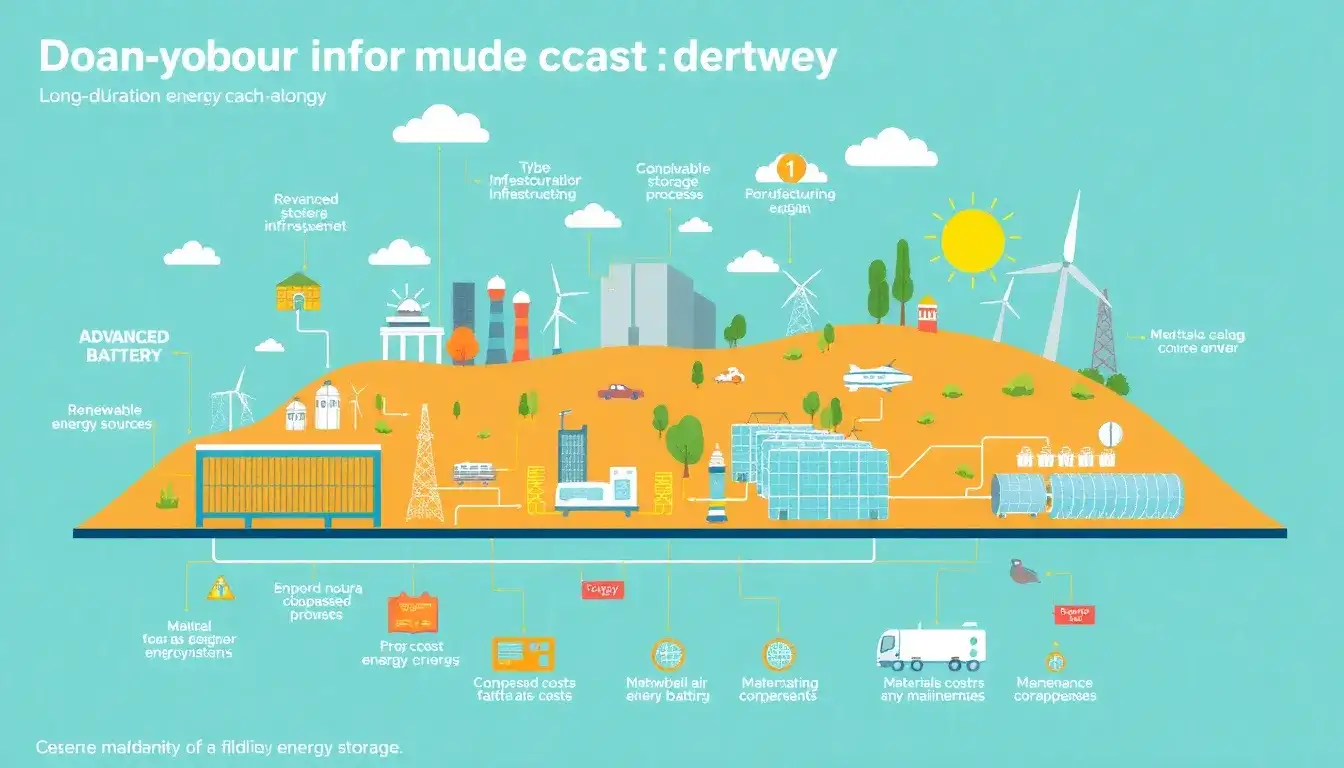
The main cost drivers for long-duration energy storage (LDES) technologies stem from capital expenses, manufacturing scale, technology maturity, and innovation needs specific to each storage type. Key factors influencing cost include:
Capital Costs
- Energy vs. Power Component Costs: LDES systems have distinct costs for energy storage capacity ($/kWh) and power capacity ($/kW). The longer the storage duration, the more energy capacity costs dominate the total cost since power costs are amortized over more hours.
- High Capital Intensity: Many LDES technologies require large upfront investments in infrastructure, such as pumped hydro reservoirs, compressed air chambers, or flow battery stacks, which raise initial capital costs.
Technology and Material Costs
- Battery Chemistry and Materials: Electrochemical storage costs depend heavily on battery materials—precious metals or rare elements (e.g., catalysts in metal-air batteries) hike costs due to scarcity and processing complexity.
- Manufacturing Scale and Automation: Larger-scale manufacturing and automation can reduce costs significantly, but many LDES technologies remain in early-stage deployment with limited economies of scale compared to lithium-ion batteries.
Innovation and Deployment Costs
- Research and Development (R&D): Achieving cost targets (such as the DOE’s $0.05/kWh goal for 10+ hour storage) requires continual innovation in battery chemistry, system design, and manufacturing processes.
- Demonstration and Project Costs: Scaling demonstration projects to commercial scale is costly, and investments here influence production costs and risk premiums.
Duration and Scalability Effects
- Cost Scaling with Duration: Unlike lithium-ion batteries—whose costs scale roughly linearly with added storage hours—many LDES technologies (e.g., compressed air, pumped hydro, thermal storage) see per-kWh costs drop as storage hours increase, improving cost-effectiveness for longer durations.
- System Complexity: Some LDES systems involve complex mechanical or chemical processes (e.g., hydrogen storage, flow batteries) that add cost due to system complexity and operational integration.
Market and Policy Factors
- Government Incentives and Policies: Subsidies, tax credits, and supportive policies can reduce effective costs and encourage deployment, impacting the financial viability of LDES projects.
- Energy Market Dynamics: The need for grid stability and renewable integration creates demand that influences investment and innovation priorities, indirectly affecting costs.
Summary Table of Key Cost Drivers by LDES Technology Category
| Cost Driver | Electrochemical (Flow, Lead-Acid, Sodium Batteries) | Mechanical (Pumped Hydro, Compressed Air) | Thermal Storage & Hydrogen |
|---|---|---|---|
| Capital Costs | High due to materials and manufacturing scale | High infrastructure costs (reservoirs, compressors) | High upfront plant and storage costs |
| Materials | Precious metals, rare materials for catalysts | Steel, concrete, etc. for mechanical parts | Specialized heat-resistant materials, storage vessels |
| Innovation Needs | Battery chemistry, cell packaging, electrolyte | System design, scaling, automation | Thermal materials, compression tech |
| Cost Impact of Duration | Linear cost increase with added hours | Cost per kWh decreases with longer duration | Cost per kWh decreases with storage time |
| Manufacturing Scale & Automation | Critical for cost reduction | Challenging due to site-specific builds | Scale and operational complexity |
| Policy & Market Incentives | Can significantly lower financial barriers | Enable financing of capital-intensive projects | Support R&D and project demonstration |
In essence, the main cost drivers for LDES technologies are capital-intensive infrastructure, materials and manufacturing processes, scale of production, and the need for ongoing innovation to achieve lower levelized costs of storage (LCOS). Mechanical and thermal storage technologies benefit from economies of scale with longer durations, while electrochemical solutions face challenges with material costs and scaling manufacturing efficiently. Government policy support and market demand for grid flexibility further shape cost trends and investment flows.
Original article by NenPower, If reposted, please credit the source: https://nenpower.com/blog/what-are-the-main-cost-drivers-for-long-duration-energy-storage-technologies/

