

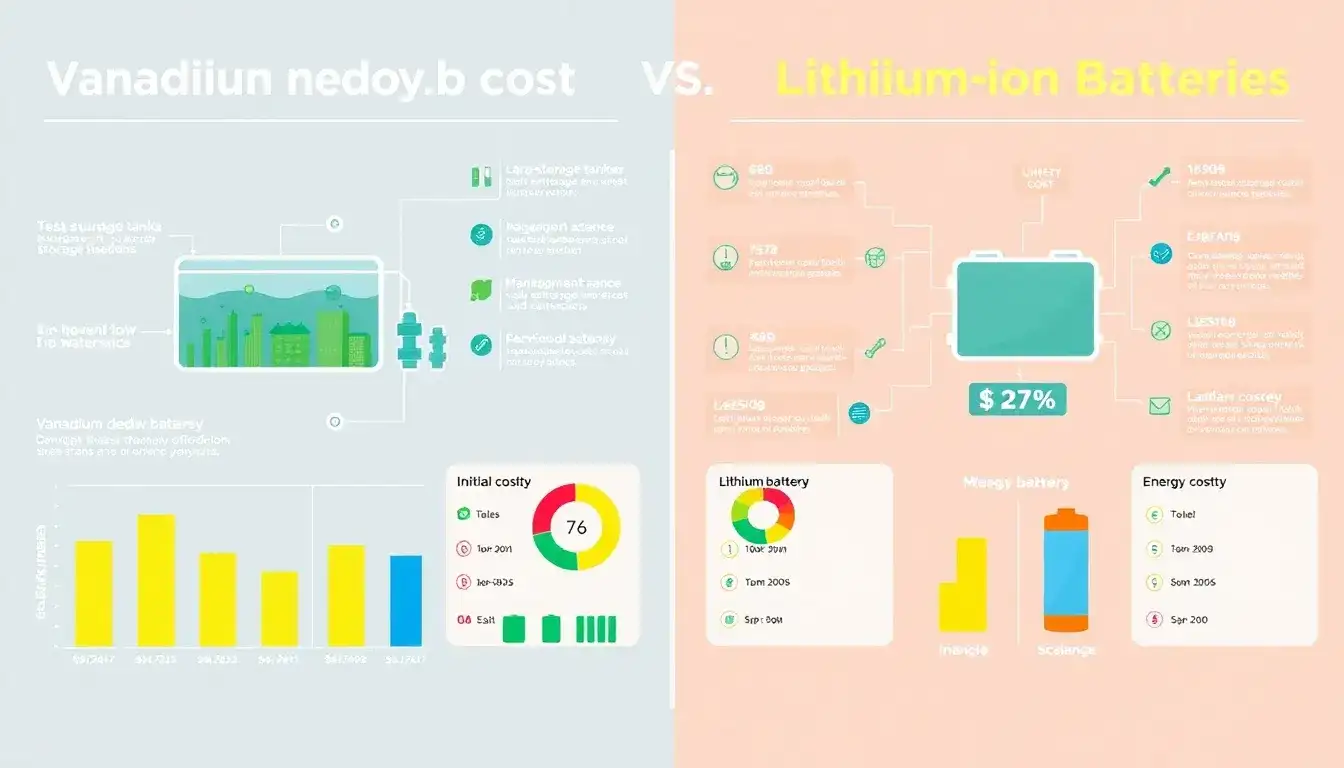
The main cost differences between vanadium redox flow batteries (VRFBs) and lithium-ion batteries (LIBs) can be summarized as follows:
Initial Investment Costs
- Vanadium Redox Flow Batteries (VRFBs): The initial investment cost for VRFBs is higher compared to LIBs. The cost of VRFB systems is approximately $500 per kilowatt-hour (kWh), although this is expected to decrease as production volumes increase.
- Lithium-Ion Batteries (LIBs): The upfront cost of LIBs is lower than VRFBs. The average cost of LIB cells is about $137 per kWh, but complete systems for grid-scale storage cost around $350 to $400 per kWh.
Lifetime and Cycle Costs
- VRFBs: Despite the higher initial cost, VRFBs offer advantages over their lifespan. They can be charged and discharged thousands of times with minimal capacity loss, significantly extending their operational life to over 10 years.
- LIBs: LIBs have a shorter cycle life compared to VRFBs, typically requiring replacement more frequently due to capacity degradation over time.
Long-Term Economic Performance
- VRFBs: In the long term, VRFBs may offer lower life cycle costs due to their long lifespan and ability to scale without significant additional expense. They are well-suited for large-scale applications and long-duration energy storage.
- LIBs: While LIBs are currently cheaper upfront, their high self-discharge rate and shorter lifespan result in higher costs over the long term for large-scale energy storage projects requiring frequent cycling.
Scalability and Flexibility
- VRFBs: These batteries can be easily scaled up by increasing the electrolyte volume, making them highly flexible for large-scale energy storage applications.
- LIBs: Scaling up LIBs involves adding more battery packs, which can increase costs and complexity for large projects.
Overall, VRFBs are more economical for long-duration, large-scale applications despite higher initial costs, due to their long lifespan and scalability advantages.
Original article by NenPower, If reposted, please credit the source: https://nenpower.com/blog/what-are-the-main-cost-differences-between-vanadium-redox-flow-batteries-and-lithium-ion-batteries/

