The main cost components of utility-scale battery storage systems
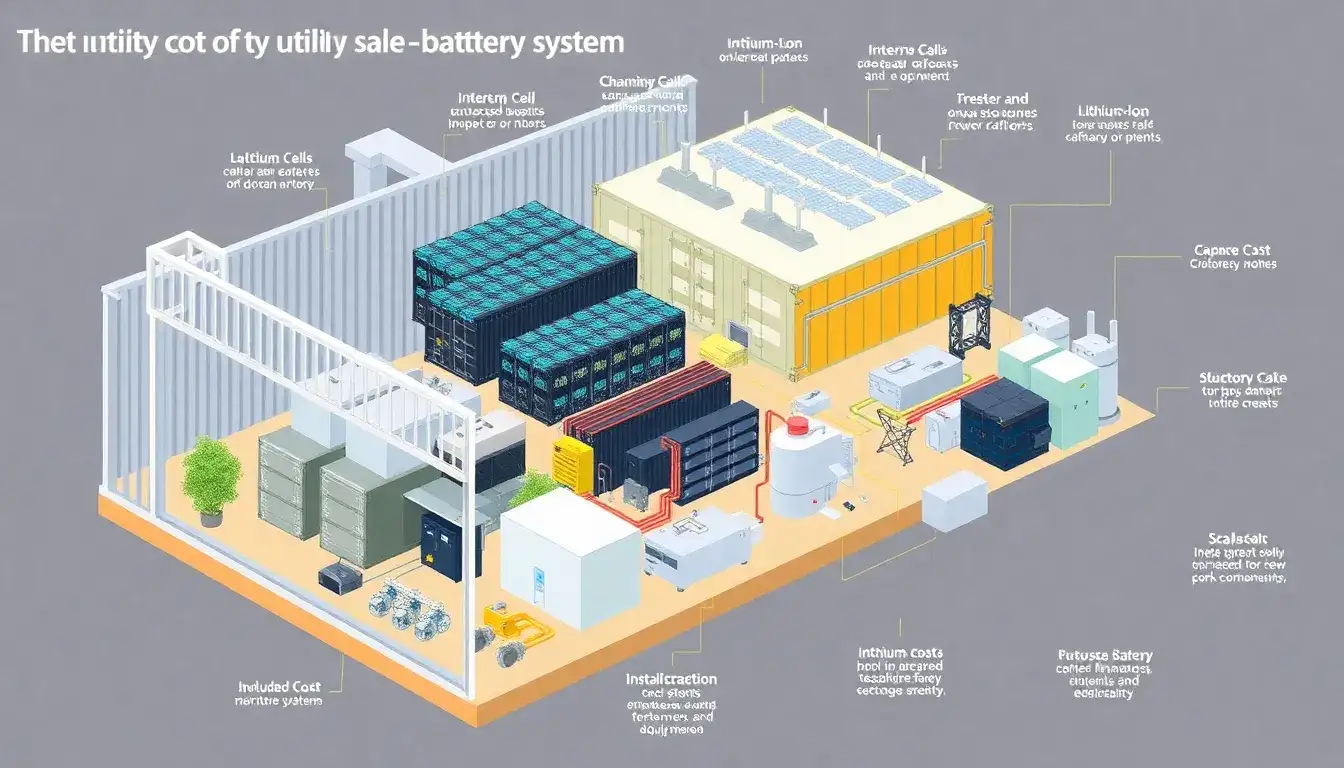
The main cost components of utility-scale battery storage systems can be categorized into capital expenditures (CAPEX), operational and maintenance costs (O&M), and financing costs. Here’s a detailed breakdown based on recent analyses and projections:
Capital Expenditures (CAPEX)
-
Battery Pack Costs
– The core battery cells represent the largest single cost component of utility-scale battery storage systems, typically accounting for about 30-40% of total system costs.
– For lithium-ion batteries, the cost ranges approximately from $100 to $300 per kWh depending on chemistry and market conditions.
– Battery pack costs are projected to decline significantly over time, driven by technological improvements and manufacturing scale. -
Power Conversion Systems (Inverters and Transformers)
– These components convert DC power from the batteries into AC power compatible with the grid and vice versa.
– Power conversion systems account for roughly 15-20% of total system costs, typically around $50 to $150 per kW in the US context, or €50-80 per kW in Europe. -
Balance of System (BOS) Components
– Includes battery management systems, cooling systems, electrical wiring, containment systems, racking, and other ancillary equipment.
– These components represent about 15-30% of the total capital cost. For instance, BOS may add 20-30% on top of battery and power conversion costs. -
Installation and Integration Expenses
– This covers site preparation, foundations, protective enclosures, grid connection equipment (e.g., transformers, switchgear), and system integration such as control systems and energy management software.
– Installation and integration typically account for 15-25% of total project costs.
– Labour, commissioning, safety systems, and fire suppression are included here as well. -
Supporting Infrastructure
– Includes grid connection equipment, monitoring systems, safety and climate control features. These may add 20-25% of the system cost in Europe.
Operational and Maintenance (O&M) Costs
-
Fixed O&M Costs
– Include battery augmentation to maintain rated capacity over battery lifetime, land rent (if applicable), property taxes, insurance, and regular maintenance.
– Estimated at about 2.5% of capital costs per year for fixed O&M in US studies, while annual fixed operational costs for a 50MW system can range from $50,000 to $150,000. -
Variable O&M Costs
– Mainly consist of energy losses during charging/discharging and electricity used for cooling and auxiliaries.
– Usually considered low or zero in many studies but can represent a few percent of costs in practice (energy losses typically 5-20%, with associated costs depending on electricity prices). -
Battery and Component Replacement Costs
– Batteries typically last 10-20 years; replacement costs can be substantial and range between $5 million to $15 million for a 50MW/50MWh system depending on future battery prices.
– Other components like power converters and cooling systems may also require replacement, adding 20-30% extra replacement costs.
Financing Costs
Financing costs can add 30-50% on top of initial capital investment depending on interest rates, loan terms, and repayment schedules.
Summary Table of Main Cost Components
| Cost Component | Approximate Share of Total (%) | Unit Cost Estimates | Notes |
|---|---|---|---|
| Battery Pack | 30-40% | $100–$300/kWh or €200–300/kWh | Largest component, decreasing over time |
| Power Conversion Systems | 15-20% | $50–$150/kW or €50–80/kW | Inverters, transformers |
| Balance of System (BOS) | 15-30% | Included above | Wiring, cooling, management systems |
| Installation & Integration | 15-25% | Varies | Site prep, grid connection, commissioning |
| Supporting Infrastructure | 20-25% (Europe) | €30-40/kW (climate control) | Safety, monitoring, climate control |
| Fixed O&M | ~2.5% of CAPEX annually | $50,000–$150,000/yr (50MW system) | Maintenance, land rent, insurance |
| Variable O&M | Low to moderate | Depends on electricity costs | Energy losses, auxiliary power |
| Battery Replacement | Significant at 10-20 year mark | Potentially $5–$15 million (50MW/50MWh) | Dependent on future battery prices |
| Financing Costs | 30-50% over project life | Dependent on loan terms | Interest, repayment schedules |
Overall, utility-scale battery storage costs are a composite of energy capacity-related costs (battery cells, BOS energy components) denoted mostly in $/kWh, power capacity-related costs (inverters, transformers) in $/kW, and fixed costs related to installation, infrastructure, and operations. This dual nature requires careful cost modeling for different storage durations and project specifications.
This breakdown aligns closely with recent detailed studies from the National Renewable Energy Laboratory (NREL) and market analyses from Europe and industry sources.
Original article by NenPower, If reposted, please credit the source: https://nenpower.com/blog/what-are-the-main-cost-components-of-utility-scale-battery-storage-systems/