

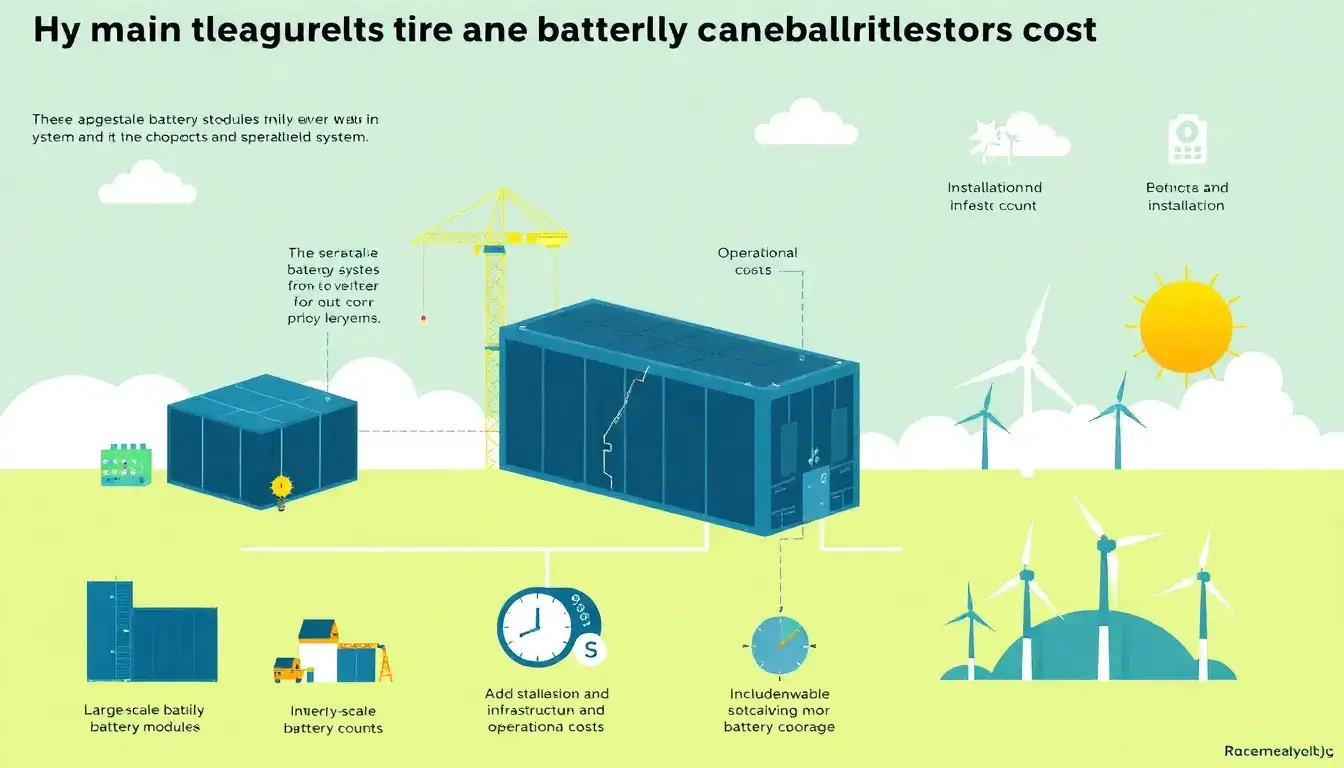
The main components that contribute to the overall cost of utility-scale battery storage systems include the following:
1. Battery Cells (Battery Pack)
- The battery cells themselves form the largest cost component, typically accounting for about 30-40% of the total system cost.
- These are lithium-ion batteries in most cases, with prices varying depending on technology and scale. For example, in Europe, lithium-ion battery costs currently range between €200 and €300 per kWh.
2. Power Conversion System (PCS)
- This includes inverters and transformers necessary to convert the direct current (DC) from the battery pack into alternating current (AC) for grid use and vice versa.
- The cost of power conversion systems generally represents about 15-20% of the overall system cost, and typical costs range from $50 to $150 per kilowatt (kW), translating to multimillion-dollar expenses for large systems (e.g., $2.5M to $7.5M for a 50 MW system).
3. Balance of System (BOS)
- BOS comprises all auxiliary components needed for installation and operation such as battery management systems, cooling and climate control systems, electrical wiring, racking, containment, and monitoring equipment.
- This category can add roughly 15-30% of total costs, often amounting to $1M–$3M for a 50 MW system, with climate control systems being particularly important in certain climates like Europe.
- BOS also includes supporting infrastructure like safety features and grid connection equipment, which can add another 20-25% of the total costs.
4. Installation Expenses
- Installation involves skilled labor, specialized equipment, and site-specific construction costs.
- These costs typically range from $50 to $100 per kW, which can translate to $2.5M to $5M for a 50 MW system.
Summary Table of Cost Components
| Cost Component | Share of Total Cost | Typical Cost Range (Example 50 MW system) | Notes |
|---|---|---|---|
| Battery Cells | 30-40% | €200-€300/kWh or roughly $XX million total | Largest cost driver |
| Power Conversion System | 15-20% | $2.5M – $7.5M | Includes inverters, transformers |
| Balance of System | 15-30% | $1M – $3M | Includes BMS, cooling, electrical wiring |
| Installation | Variable, ~10-15% | $2.5M – $5M | Skilled labor, equipment, site work |
| Supporting Infrastructure | 20-25% | Part of BOS, includes grid connection, safety | Vital for operation, monitoring |
Costs vary by project size, duration, location, and technology but the above components consistently form the core of the total capital expenditure for utility-scale battery storage systems.
In conclusion, utility-scale battery storage system costs are primarily driven by the battery cells, power conversion systems, balance of system components, and installation expenses, each representing significant portions of the overall investment necessary to deploy and operate these large-scale energy storage solutions.
Original article by NenPower, If reposted, please credit the source: https://nenpower.com/blog/what-are-the-main-components-that-contribute-to-the-overall-cost-of-utility-scale-battery-storage-systems/

