

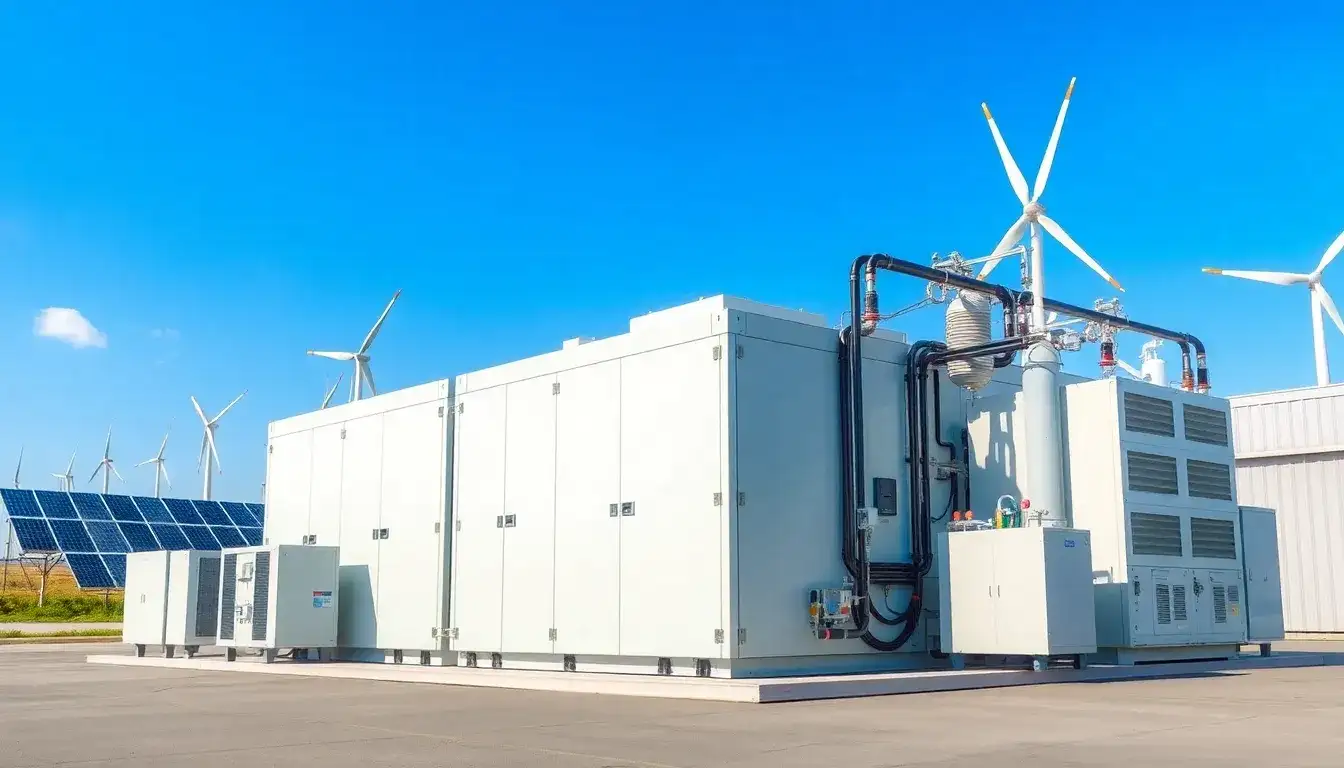
A utility-scale battery storage system typically comprises several key components that work together to store and dispatch energy efficiently and safely:
Main Components
- Battery Cells and Modules
The core of the system, battery cells store chemical energy and convert it to electrical energy when needed. Lithium cells are assembled into modules, which are stacked to form battery racks. These racks can be connected in series or parallel to achieve the required voltage and capacity for utility-scale applications. - Battery Management System (BMS)
The BMS acts as the “brain” of the battery system, continuously monitoring the health, safety, and functionality of the battery cells and modules. It manages charging and discharging cycles, ensures safe operation, and helps prevent issues like thermal runaway. This system is often multi-tiered, including monitoring units for individual cells and management modules for battery strings. - Power Conversion System (PCS) or Hybrid Inverter
The PCS converts the battery’s stored direct current (DC) energy into alternating current (AC) for use on the grid or by end-users. It also performs the reverse function during charging, converting AC from the grid to DC to store in the batteries. This bi-directional inverter is essential for integrating the battery system with the electrical grid. - Battery Enclosure and Thermal Management
Battery racks are housed in robust enclosures that are weatherproof, fire-resistant, and UL-rated. These contain climate control systems to maintain optimal temperature ranges and ensure safety by preventing overheating, which could lead to thermal runaway. Systems often include automatic shutdown features if unsafe temperatures are detected. - Energy Management System (EMS)
The EMS optimizes the battery system’s performance by managing energy flows, coordinating with the PCS to direct charging and discharging, and ensuring the system operates efficiently within grid requirements. - Supervisory Control and Data Acquisition (SCADA) System
SCADA provides real-time monitoring, control, and data acquisition for the battery storage system. It works alongside the EMS to enhance operational reliability and safety 24/7 by enabling remote oversight and automated control.
Summary Table
| Component | Function |
|---|---|
| Battery Cells & Modules | Store and release chemical energy as electrical energy |
| Battery Management System (BMS) | Monitor and manage battery health and safety |
| Power Conversion System (PCS) | Convert DC to AC and vice versa for grid compatibility |
| Battery Enclosure & Thermal Management | Protect batteries, control temperature, prevent hazards |
| Energy Management System (EMS) | Optimize energy flow and system performance |
| SCADA System | Real-time monitoring, control, and data acquisition |
These components collectively enable utility-scale battery storage systems to provide reliable, scalable energy storage solutions for grid support, renewable integration, and peak load management.
Original article by NenPower, If reposted, please credit the source: https://nenpower.com/blog/what-are-the-main-components-of-a-utility-scale-battery-storage-system/

